Overheard at EdgeTier
Most of what we hear on customer calls is useful. Some of it is just lovely. We've rounded up the
The week after Black Friday and Cyber Monday most contact centres would love let themselves breathe. The volume graph is coming down off its high, the war-room Slack channel has gone quieter, and there's a strong temptation (an earned one, let's be fair!) to call the peak done for another year. Anyone who's worked a…


The week after Black Friday and Cyber Monday most contact centres would love let themselves breathe. The volume graph is coming down off its high, the war-room Slack channel has gone quieter, and there’s a strong temptation (an earned one, let’s be fair!) to call the peak done for another year.
Anyone who’s worked a few peak seasons already knows it isn’t done. Returns are coming. Delivery questions are coming. The promo code that half-applied on Friday is going to show up as a confused email on Tuesday. The mad Christmas run-up. Volume begets issues, and during this high pressure time, contact centres can quickly become overwhelmed if they’re not prepared.
None of that is news to a retail CX team, of course. But what’s harder is that knowing this in theory and practice are two different things, and the gap between them is where peak season quietly does its damage.
It’s worth sitting with the scale for a second, because it’s easy to talk about “peak season” in the abstract and lose the size of what’s actually at stake.
US retail sales hit $994 billion in November and December of 2024 alone (NRF), a record high. For a huge share of online retailers, this window carries a vast portion of the year: WooCommerce data puts 30 to 50% of annual revenue inside the holiday period for around one in four e-commerce stores, and for one in twelve, it’s more than half.
Let’s do a little bit of math to see what kind of impact this can have:
Every hour a checkout bug runs undetected, or a payment gateway quietly fails for one card type, is an hour of that €4,500 could potentially be gone. Industry estimates put the cost of contact centre downtime as high as $100,000 an hour once you factor in the full picture, not just missed sales but the agent time, the escalations, the refunds issued to smooth things over.
And unlike a quiet Tuesday in March, none of this comes back. A retailer who loses six hours of Black Friday trading to a checkout failure doesn’t get to rerun that afternoon next week. The window is open, and then it’s closed.
The numbers are one thing, but what’s harder to put in a slide is what this period does to the people running it.
Team leads are fielding escalations from four directions at once. Agents are taking one difficult, emotionally loaded call after another with barely a breath between them, a stressed parent asking where a gift order has gone, a customer convinced they’ve been charged twice, someone who’s been on hold three times already and has stopped being patient about it. Somewhere, a CX lead is checking a dashboard at midnight because they’d rather know now than find out at 9am that something’s been wrong since 11pm the night before.
None of that shows up in a quarterly report, but it’s real, it accumulates, and peak season is exactly the period when burnout risk is highest and an organisation can least afford to lose an experienced agent partway through it.
Learn more: The Black Friday Survival Guide for Contact Centre Leaders
This is where the shape of the problem gets interesting, and it’s not quite what most people assume.
According to EdgeTier platform data from 2025, Black Friday week produces a genuine spike – over 3x a typical week’s anomaly count, on top of a 15% average lift in overall contact volume during event weeks. That part, everyone plans for. What’s less visible is what happens in the two weeks immediately after.
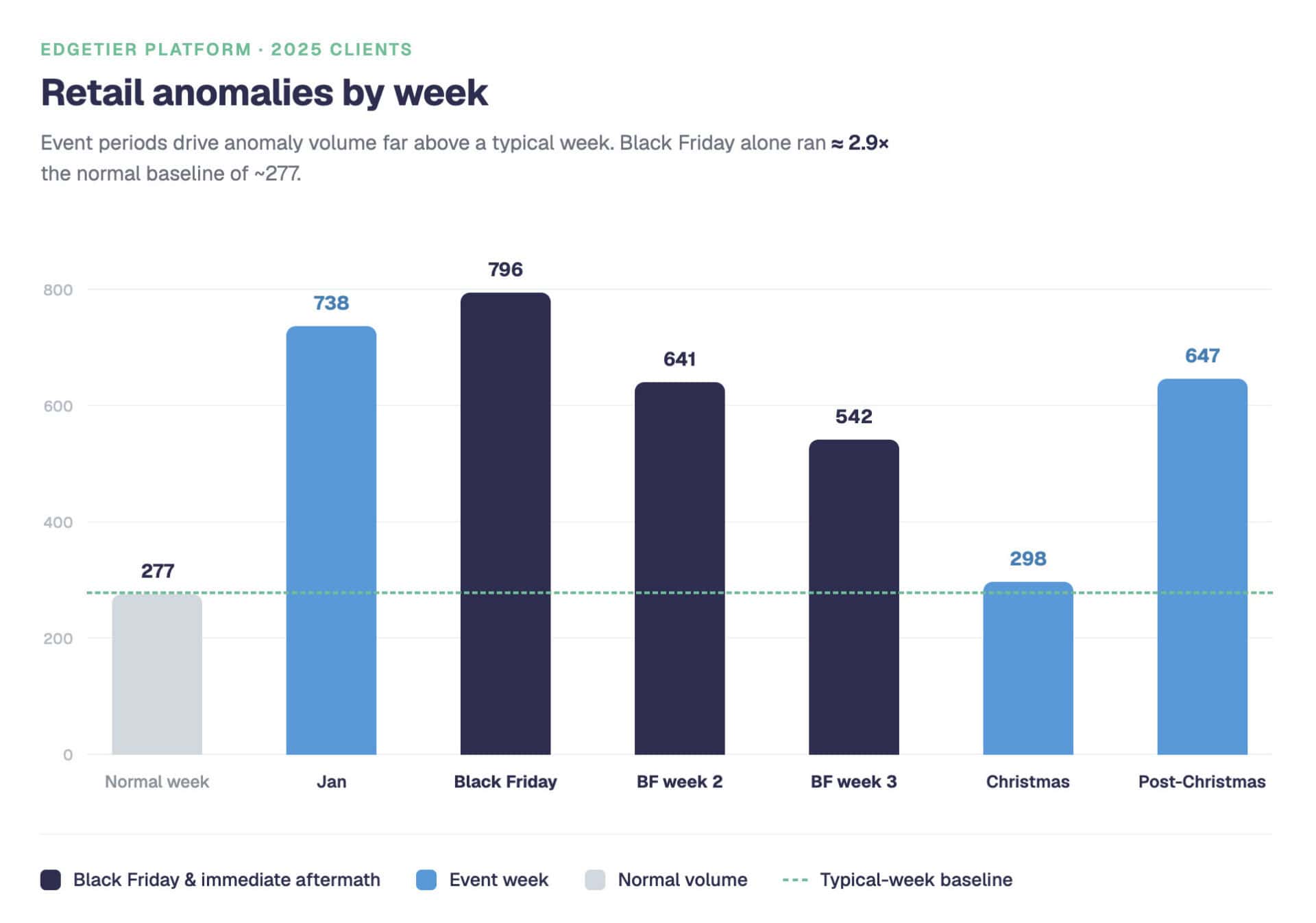
Look at the two bars sitting right after Black Friday in that chart: 641 and 542. A normal week for the same operation runs somewhere between 200 and 300. Christmas week itself is actually fairly contained, at 298, but the week immediately after jumps to 647 as returns and refund questions arrive in force. January opens with 738, the highest single month on the chart apart from Black Friday itself.
The volume graph tells you the worst is over by early December. The anomaly data tells you it’s really just changed shape, from one sharp spike into a longer, quieter grind that runs for weeks.
A large part of that grind is returns, and the 2025 numbers are genuinely striking. Black Friday return rates reached 19.3%, totalling $849 billion in returned goods, with resolution times running 28% slower than usual, and post-Christmas returns projected to climb a further 45% on top of that.
The mechanics are simple, which is exactly why the scale sneaks up on people. A return that doesn’t process cleanly turns into a contact. A contact that doesn’t get resolved first time turns into a second one. Multiply that by hundreds of thousands of orders placed over a single weekend, and you get a queue that keeps refilling itself for weeks, not because anything new has gone wrong, but because December’s problems are still working their way through the system in January.
The specific things that break during peak tend to be the same every year, and they’re hard to catch for the same reason every year: at a glance, they look identical to normal demand.
A gateway error or a checkout bug shows up as a rise in “payment” contacts, the same shape as any other spike, until someone traces it back to the actual cause. A promo code that’s stacking incorrectly or expiring mid-session generates a steady stream of frustrated customers that rarely fits a clean reason code, so it tends to get undercounted rather than flagged. Delivery problems are almost guaranteed at this kind of scale, UPS alone expects to handle over 32 million deliveries a day during Black Friday, and every customer who doesn’t hear about a delay proactively will contact you instead to ask. Stock issues, an item selling out mid-promotion or displaying incorrectly on a product page, produce a sharp burst of contacts that appears and vanishes with the underlying fault, easy to miss entirely if nobody happens to be looking at the right moment.
None of these are exotic. They’re the same handful of failure modes every retailer already knows about. The problem has never really been knowing what can go wrong, it’s about catching it early enough; and this in an environment where QA sampling typically runs at just 3 to 5% of contacts even in a normal month, let alone a peak one.
There is a solution, however.
None of this is really a staffing problem. It’s a visibility problem, and it’s the same one at every stage of the season: the failures that matter most are the ones that don’t show up until they’ve already cost something, because standard reporting only tells you the queue is growing, not why.
This is the specific gap Sonar, EdgeTier’s anomaly detection tool, was built to close. It doesn’t wait for someone to notice a pattern and escalate it. It watches every conversation, across chat, email, phone and social, learns what normal actually looks like for your operation, and flags a deviation the moment it starts forming, with the root cause, the scale, and who’s affected already attached. The traditional chain, an agent notices something, flags a team lead, someone pulls a report, a Slack message goes out, typically takes somewhere between 12 and 24 hours to produce a clear picture. Real-time detection cuts that to minutes, roughly 96 times faster by EdgeTier’s own measurement, and the difference isn’t just speed for its own sake. It’s the difference between finding out about a payment gateway issue after a few hundred customers have already hit it, and finding out after a handful have.
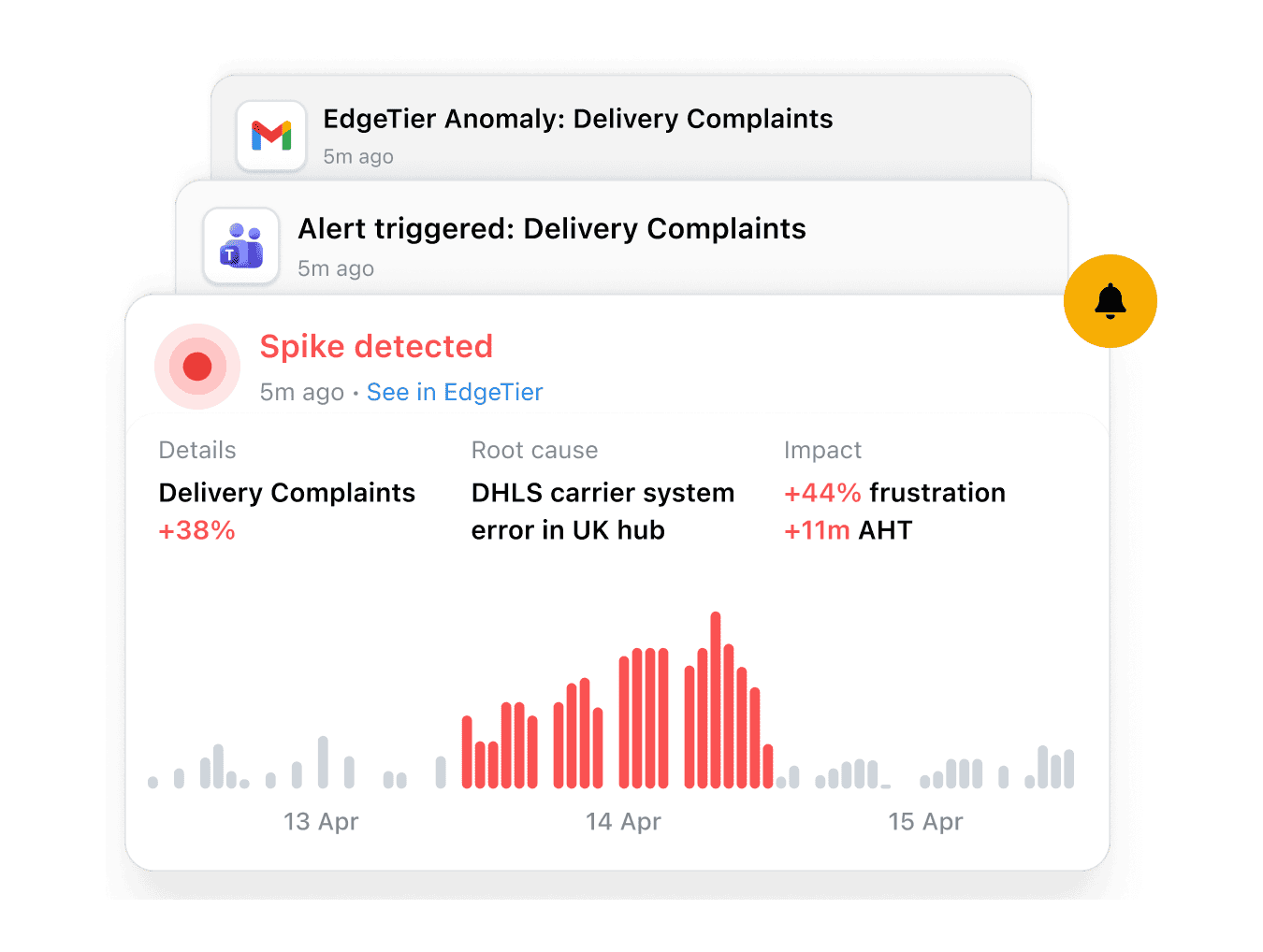
That’s also what it does for the people in the room at 11pm, not just the numbers on the dashboard. Knowing that something is actually watching overnight, that a genuine problem will surface on its own rather than depending on whoever happens to be on shift noticing it, changes what this season feels like to work through. Not calmer, exactly (peak season is still peak season!) but something closer to being run, rather than something that’s running you.
If there’s one practical takeaway in all of this, it’s timing. The two weeks after Black Friday and the whole of January aren’t recovery time, they’re the second and third acts of the same season, and the teams that come through peak in the best shape are the ones who set up their monitoring before the first spike hits, not partway through the second one.
If your team is heading into another peak season without real-time visibility into what’s actually breaking, it’s worth a conversation now rather than partway through the next spike. Get in touch and we’ll show you what Sonar would surface in your own contact data.
Most of what we hear on customer calls is useful. Some of it is just lovely. We've rounded up the
From self-serve Sonar anomaly models to a smarter, shareable Ask Spotlight and a fully transparent QA dispute process, here's everything
EdgeTier turns your customer conversations into a single connected system: it catches anomalies before they escalate, scores every agent interaction


Quentin Bottner
Head of Continuous Improvement
"We’re a big business, so getting the right people to agree and fix something hasn’t always been easy. Now we’ve got one version of the truth—it’s much easier to align and act"


Deborah Guivisdalsky
COO
"We now have highly detailed understanding of agent performance, not just on key agent metrics, but also on how customers react to our agents and the emotions of our customers feel when talking to our team."


Nick Brazitis
Global Customer Care Manager
"The anomaly feature is a game changer for us. It’s highly accurate and has helped us identify customer issues, agent errors, and even fraud that would have taken us longer to catch."



Let us help your company go from reactive to proactive customer support.
Unlock AI Insights