Overheard at EdgeTier
Most of what we hear on customer calls is useful. Some of it is just lovely. We've rounded up the
iGaming's biggest threat isn't the Super Bowl or Cheltenham, it's the fact that anomalies never really stop. This piece breaks down what the data shows about platform outages, player churn and real-time detection, and why operators need always-on monitoring, not just coverage during major events.


There’s a specific moment every iGaming ops lead knows. Kick-off. Race start. Puck drop. First serve. One second the platform is running a normal Tuesday, and by the time the ad break ends it’s carrying the busiest few hours of its year. There’s no ramp, nor warning shot, no morning-of Slack message to brace the team. While the retail sector gets Black Friday circled on a calendar months out, and travel gets a summer that builds for weeks. iGaming gets a whistle!
And whatever breaks in that window breaks in front of your most engaged, highest-spending players, at the exact moment they’re most likely to leave and never come back.
The money at stake isn’t abstract. The American Gaming Association put this year’s Super Bowl handle at $1.76 billion in legal US wagers alone, a record and a 27% jump on the year before. Cheltenham Festival regularly pulls in close to £1 billion in betting stakes across four days. And remember, that’s not revenue spread across a quarter, it’s compressed into a handful of fixed, immovable hours.
EdgeTier’s 2025 platform data across its iGaming client base shows exactly what that compression does to contact volume. A normal week for these operators runs at a median of around 300,000 interactions. Here’s what event weeks look like against that baseline:
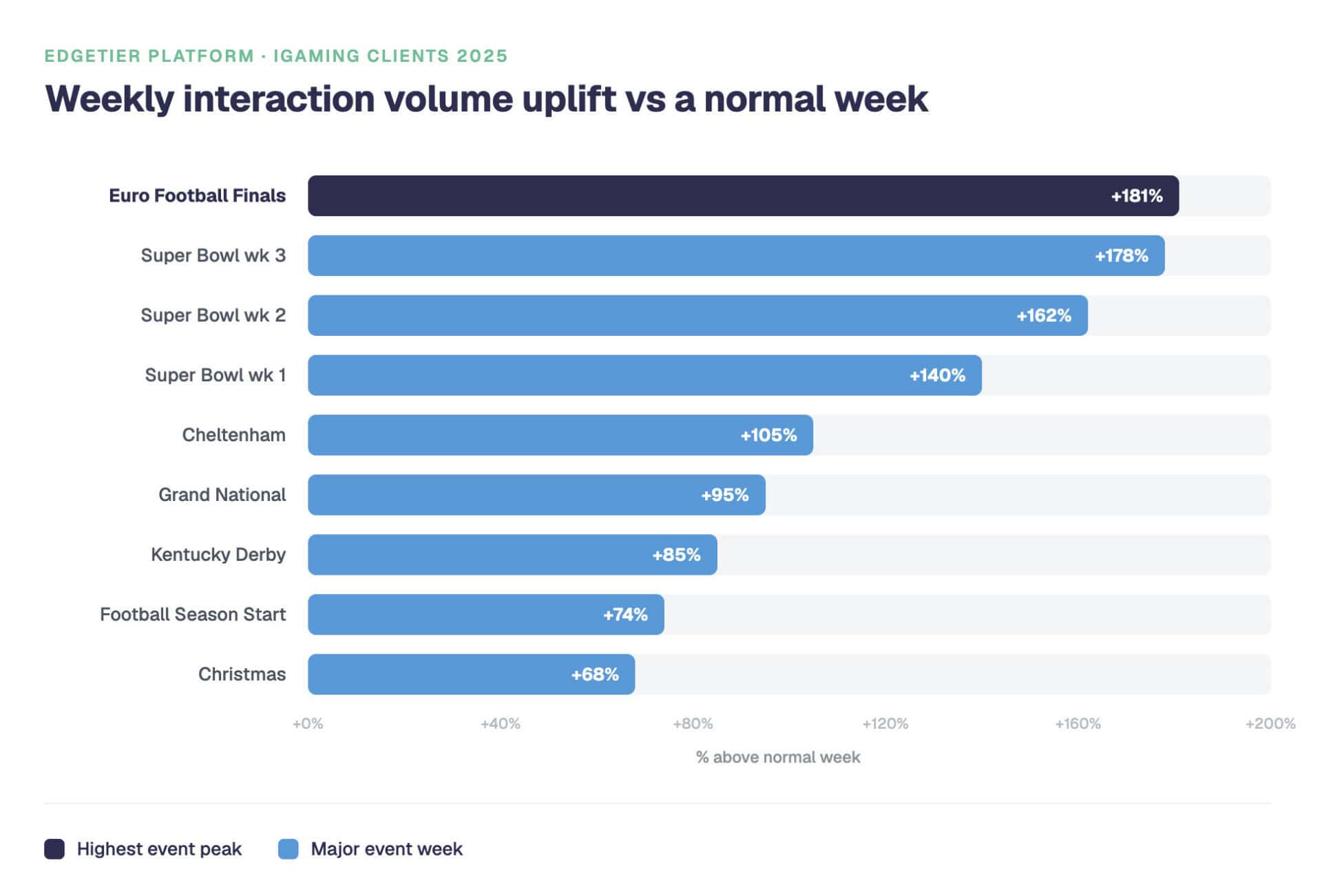
None of that arrives gradually. It’s a step change on a date that was fixed months ago, and a business shows up to it with whatever staffing and systems it already had in place. The math that follows is unforgiving: an issue generating 100 contacts on a quiet week generates 250 or more during an event peak. At 843,000 interactions, a fault affecting just 1% of players is over 8,000 people getting in touch. The same fault at normal volume is fewer than 3,000. Nothing about the failure changed. Only the number of people standing behind it did.
Here’s the finding that reframes the whole problem, and it’s the one worth sitting with longest.
Across the full year, EdgeTier’s iGaming clients average over 5,100 distinct anomalies a week. Even in the quietest stretches, that number rarely drops below 3,000. And the single busiest anomaly week in the entire dataset, with over 7,900 in one week, didn’t happen during Cheltenham or the Grand National. It happened during a normal trading period, with no major event attached to it at all.
That changes what “peak season” even means in this vertical:
Monitoring built around “known event windows” is, in practice, covering most of the calendar and still missing the weeks it wasn’t watching.
Three things are true in iGaming that aren’t equally true in retail or travel, and together they make slow detection a much more expensive problem:
The moment is irreversible. A retailer can technically win back a customer’s business next week. You can’t replay a match that’s already finished, or recreate the exact odds and emotional stakes of a live bet mid-game. Whatever revenue and goodwill is lost in that window is gone for good.
Platform failures happen live, in public, at the worst possible time. The industry’s track record here isn’t reassuring:
In every one of these cases, customers found out before the operators did.
Real money moves in real time, and regulators are watching how fast you notice. This is the piece that has no real equivalent in retail or travel. When something goes wrong in iGaming, it isn’t just a bad experience, it can be a customer losing money they can’t afford to lose, unnoticed. The UK Gambling Commission fined one operator £10 million after it failed to flag a customer who exceeded a £2,500 loss limit within sixteen minutes of registering, and who went on to lose over £16,000 within three months without any intervention. That pattern was sitting in the data the entire time. It simply wasn’t being watched closely enough, fast enough.
This is exactly the gap real-time anomaly detection is built to close: watching every conversation as it happens, learning what normal looks like for a specific operator, and flagging the moment something deviates, before it’s had time to compound.
PowerPlay, a Canadian sports betting and casino operator, had already lived through the alternative. During an earlier platform migration, issues took 12 to 24 hours to surface. Churn climbed. The team spent the rollout fielding Slack messages from agents with no real picture of how widely the damage had spread.
For their latest migration, they ran EdgeTier’s Sonar across every customer conversation from the moment the new platform went live. Within the first few hours, it surfaced three failures that would otherwise have gone unnoticed until the next day:
The system caught that final anomaly and alerted the casino manager on its own, with nobody awake to notice it first. It was fixed before the next morning’s login rush, before it had any real chance to become a story. Churn from this migration came in at a third of what it had been the time before.
“With the last migration, I was up all night. This time, we got it sorted and went to bed.” — Robert Davies, Consultant, PowerPlay
Learn more: How Powerplay used EdgeTier to catch critical issues during a platform migration
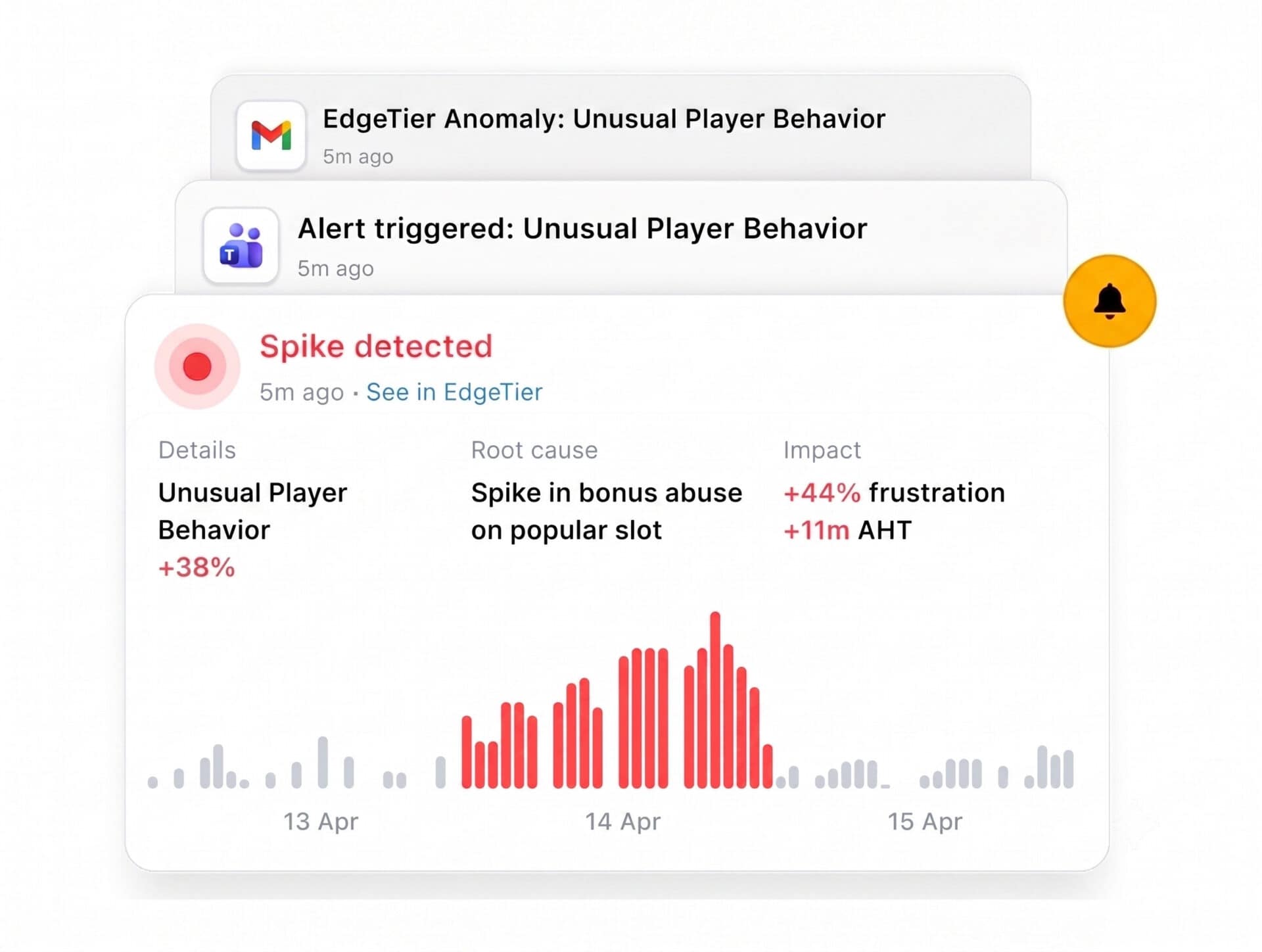
The volume spikes are predictable, but the failures inside them aren’t. Here’s what that means in practice for teams heading into their next major event or platform change:
None of this is really about having more people watching more dashboards. It’s about having something that never stops watching, in a vertical that never actually stops.
If your detection still depends on someone noticing a pattern in time, it’s worth a conversation before the next fixture, not during it. Get in touch and we’ll show you what Sonar would surface in your own contact data.
Most of what we hear on customer calls is useful. Some of it is just lovely. We've rounded up the
From self-serve Sonar anomaly models to a smarter, shareable Ask Spotlight and a fully transparent QA dispute process, here's everything
EdgeTier turns your customer conversations into a single connected system: it catches anomalies before they escalate, scores every agent interaction


Quentin Bottner
Head of Continuous Improvement
"We’re a big business, so getting the right people to agree and fix something hasn’t always been easy. Now we’ve got one version of the truth—it’s much easier to align and act"


Deborah Guivisdalsky
COO
"We now have highly detailed understanding of agent performance, not just on key agent metrics, but also on how customers react to our agents and the emotions of our customers feel when talking to our team."


Nick Brazitis
Global Customer Care Manager
"The anomaly feature is a game changer for us. It’s highly accurate and has helped us identify customer issues, agent errors, and even fraud that would have taken us longer to catch."



Let us help your company go from reactive to proactive customer support.
Unlock AI Insights