Overheard at EdgeTier
Most of what we hear on customer calls is useful. Some of it is just lovely. We've rounded up the
We sat in on hundreds of contact centre discovery calls this year, and the same ten questions kept coming up about manual reporting, thin QA coverage, and how long it really takes to spot a spike in complaints. This piece breaks down all ten questions, what the candid answers usually sound like, and what they…


We’ve sat in on hundreds, if not thousands of discovery calls with contact centre and CX leaders this year across gambling, travel, retail, financial services, and beyond. The same handful of questions came up again and again. What was interesting wasn’t the questions themselves, but the answers, and how often they came with a sigh, a pause, or an uncomfortable laugh before the honest version came out!
Here are the ten questions that came up most, what the honest answers usually sound like, and what they reveal about where CX analytics actually needs to go.
Short answer: Most teams are still doing it manually with spreadsheets, fixed dashboards, and ad-hoc sampling, even at large scale.
This was the single most revealing question we asked. Almost every leader described some version of the same setup: a patchwork of manual tagging, static reports, and dashboards that show what happened but not why. The tone was rarely angry, but more of a quiet, resigned acknowledgement that the process in place is inadequate and has been for a long time. One retail leader put it simply: the whole approach felt “artisanal“, built by hand, one report at a time.
If this sounds familiar, you’re not behind. You’re actually the industry norm.
How EdgeTier helps: This is exactly the gap Explore is built to close. Instead of manual tagging and static dashboards, Explore analyses 100% of conversations across chat, email, voice, and surveys in real time, automatically tagging contact reasons and sentiment as they happen. TUI, for example, used it to turn what had been weeks of manual analysis into minutes, surfacing a hidden payment confirmation issue responsible for 20% of all contact volume, and cutting related contacts by 40% once it was fixed.
Short answer: It’s normal. The gap between what CX leaders want (real-time, proactive insight) and what they actually have (manual, reactive reporting) is the industry default, not an exception.
When we lay out that gap directly, i.e. what “great” looks like versus what most teams are actually running on, the most common reaction is relief. Leaders consistently tell us it’s reassuring to learn they’re not uniquely behind. That relief is often the point where a conversation shifts from defensive to genuinely curious about what the reality of better could be.
How EdgeTier helps: Electric Ireland described their pre-EdgeTier setup as running on anecdotal evidence, even though the team believed they were putting customers first. After adopting EdgeTier for real-time QA visibility, they got what they called a true, unfiltered picture of what was actually happening across their contact centre and went on to lift CSAT by 21%, cut email volume by 37%, and improve first contact resolution by 19%.
Short answer: Typically 1–5%. Almost every team knows that number is too low, and almost none have found a scalable way to fix it.
This question tends to land harder than any other. Leaders can usually tell you the exact number of conversations they should be reviewing versus what they manage, and the gap between the two creates real discomfort. One CX lead in the travel sector described pulling 50–100 calls a week by hand against a volume of 3,000+, and openly wondering what was happening in the other 95%. That’s not a hypothetical question either, and it’s the one worth asking your own team this week.
How EdgeTier helps: Coach was built specifically to close this gap, reviewing 100% of conversations instead of the 1–5% most teams manage manually. Customers using Coach have seen QA coverage increase by over 90%, QA reviews run 2.5x faster, and up to 33 times more interactions analysed than manual sampling allowed, without adding headcount to the QA team.
Short answer: For most teams, the honest answer is “hours, sometimes days”, and that gap is where real damage happens.
This is the question that surfaces actual operational near-misses: issues that ran quietly for a weekend, a payment bug that went unnoticed for a day, a spike that was only caught because a customer escalated loudly enough. Leaders in high-volume, fast-moving sectors (betting, gaming, e-commerce) were especially candid that the cost of a delayed response scales fast; what’s a minor issue caught in ten minutes can be a five-figure problem by the next morning.
How EdgeTier helps: Sonar exists specifically to shrink that detection window. It monitors every conversation in real time, learns what “normal” looks like for a business, and flags deviations, e.g. a broken promo code, a payment gateway error, a delivery spike the moment they start trending. Customers using Sonar have cut detection time from roughly a day down to under 15 minutes. During a platform migration, PowerPlay used it to catch three critical issues within hours of going live, protecting up to 50% of daily revenue that would otherwise have been at risk. In one case, fixing an issue flagged by Sonar brought related contact volume down to zero within the hour.
Short answer: Usually, it doesn’t – not in any structured way. Insight tends to stay trapped in the team that heard it.
This question reliably produces a kind of resigned frustration, one I’m sure you’re acutely aware of. Leaders describe organisational silos where one department has half the picture, another has the other half, and nobody has the full one, often because everyone already knows how hard it would be to assemble. The pattern shows up across industries: insight generated in the contact centre rarely reaches product, marketing, or leadership in a form anyone can act on.
How EdgeTier helps: This is precisely the shift Novibet made, going from contact centre data that stayed within the team to using EdgeTier as a company-wide strategic asset. In practice, this works because different teams query the same underlying data for different reasons: product teams use it to catch recurring bugs, operations and compliance teams use it to track policy adherence and risk, and sales or marketing teams use it to spot buying signals and sentiment trends. Ask Spotlight, EdgeTier’s agentic, plain-English query layer, means any of those teams can ask a direct question and get an answer without waiting on an analyst or writing a query.

Short answer: More than most budgets reflect. Leaders consistently underestimate it until asked to quantify a single missed spike or a single regulatory near-miss.
For regulated industries especially, like gambling, financial services, insurance, etc., this isn’t an efficiency question, it’s a risk question. Leaders described specific compliance frameworks where fines scale with revenue, and where a missed vulnerable-customer signal isn’t a KPI miss, it’s a genuine institutional risk. In these conversations, analytics stops being a “nice to have” and becomes something closer to insurance.
How EdgeTier helps: In regulated sectors, this is where Sonar and Explore double as compliance tooling, not just CX tooling, automatically flagging risk signals (like a GDPR-related request or a responsible-gambling concern) the moment they appear, rather than relying on an agent to notice and escalate manually. Kaizen used EdgeTier’s real-time monitoring to get customer insight 80% faster and prevented 18% of flagged risk cases from escalating further, specifically in a responsible-gaming context. Underlying all of this: EdgeTier is ISO 27001 certified and processes data in full GDPR compliance, with EU or US data residency depending on where a customer operates.
Short answer: A lot of “AI-powered” tools on the market are still keyword search with a new label. The difference is whether the tool can actually answer a plain-English question, or just find where a word was mentioned.
This scepticism is healthy, and it’s everywhere. Many leaders have already spent money on a tool that promised insight and delivered a search bar. That history creates real caution and teams need to feel safe trying again before they’ll engage seriously. The honest answer here matters more than the enthusiastic one: being specific about what a tool can and can’t do disarms far more scepticism than a confident pitch does.
How EdgeTier helps: This is the specific distinction worth naming: many generic AI analytics tools are built on general-purpose language models with a reporting layer bolted on. They can answer broad questions but tend to struggle with contact-centre-specific nuance, like the difference between frustration in a billing query versus a flight disruption, or what a normal contact pattern looks like during a high-variability peak period.
EdgeTier’s models are trained specifically on hundreds of millions of real contact centre conversations, giving us the contact-reason taxonomy and business context that generic tools lack. It also integrates directly with the systems already in place (Zendesk, Salesforce, Intercom, Gorgias, Five9, Freshdesk, LivePerson, and others) so adopting it doesn’t mean ripping out an existing stack, which is often the real underlying fear behind this question.
Short answer: Because most QA processes are built around compliance sampling, not agent development (and spoiler alert: agents can tell the difference!)
This was one of the more emotionally rich questions in our conversations. Leaders described QA scores that don’t differentiate performance, coaching based on a handful of random calls, and a nagging sense that the process demotivates the people it’s meant to develop. The more interesting version of this question isn’t “what’s our QA coverage“, it’s “what do our agents deserve,” including recognition for the calls where they went above and beyond, not just correction for the ones where they didn’t.
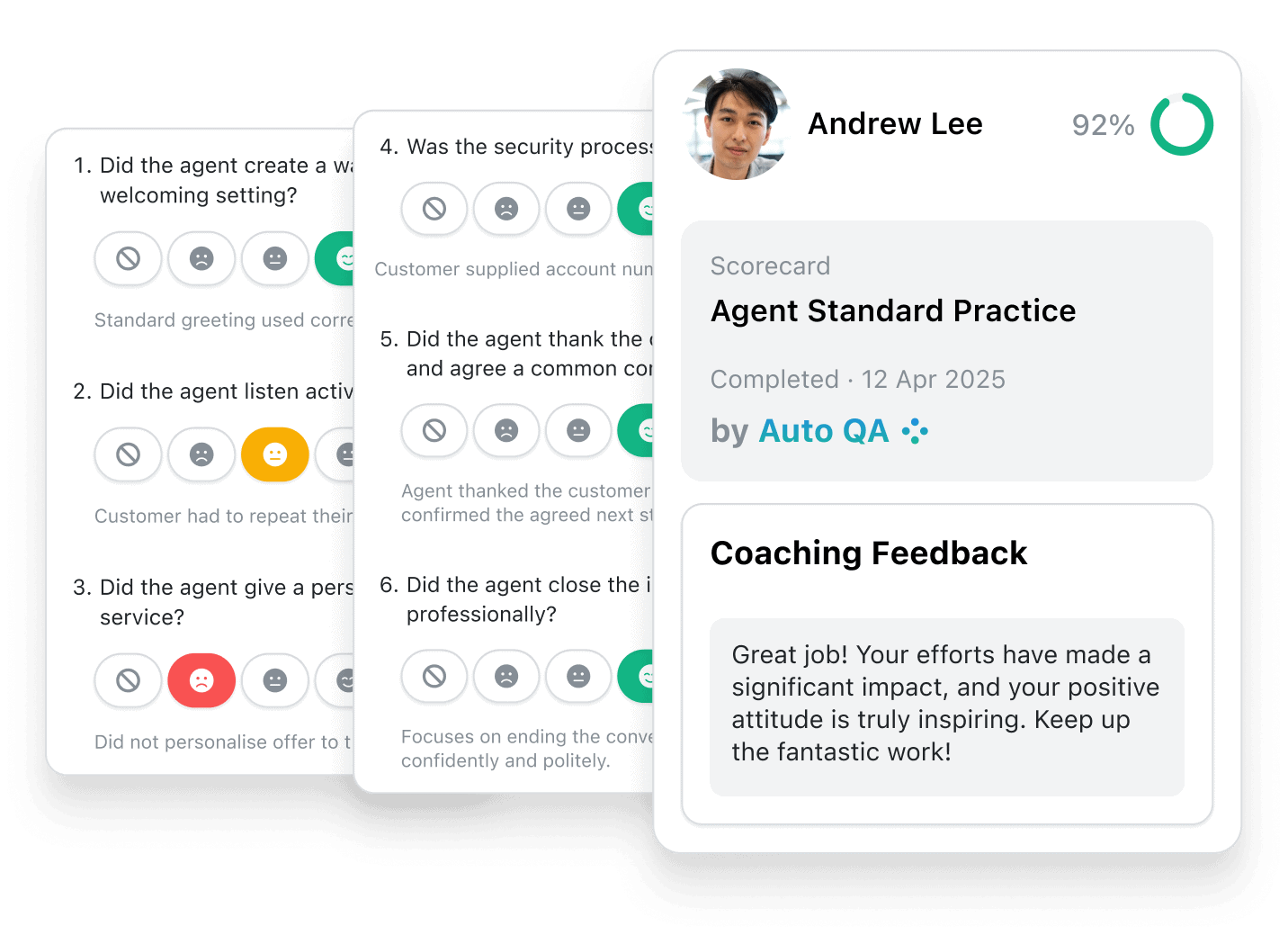
How EdgeTier helps: Because Coach scores 100% of conversations rather than a random sample, every agent is evaluated on a consistent, complete picture rather than the luck of which five calls got pulled that week, and agents can see their own scorecards and feedback directly in the platform, rather than QA feeling like something done to them.
Short answer: Usually far more than the cost of getting there, but almost nobody has done that maths until asked directly!
This is the question that reframes the whole conversation, because it moves from “what’s broken” to “what’s possible.” Leaders who work through it out loud, looking at fewer escalations, better coaching, faster compliance response, more consistent customer experience, etc., tend to arrive at a number that makes any reasonable investment look small by comparison.
How EdgeTier helps: Across EdgeTier’s customer base, the pattern holds up in aggregate: an average 21% improvement in CSAT, a 25% reduction in chat handling time, and a 12% reduction in overall contact volume, alongside 2.5x faster QA reviews. For teams that want to work through their own version of this maths before a conversation with sales, EdgeTier published an ROI calculator that estimates savings from reduced contacts, fewer repeat interactions, and improved agent efficiency based on your own volumes.
Short answer: Usually clarity on the specific obstacle, whether that’s budget, a technical requirement, or another stakeholder who needs to be convinced.
The most common failure point in any evaluation isn’t a lack of interest, it’s momentum quietly dying between “this looks great” and an actual decision. Asking this question directly, rather than assuming enthusiasm will carry a deal forward, is what actually surfaces the real blocker while there’s still time to address it.
How EdgeTier helps: This is usually a question about risk, not enthusiasm, so the answer is to lower the risk of finding out. Most EdgeTier customers connect their existing helpdesk and start seeing real insights within weeks, guided by a dedicated Onboarding Manager and ongoing support from a Customer Success Manager, not a lengthy implementation project. Teams can also see the platform against a live sandbox before committing. And for what it’s worth, EdgeTier currently holds a 4.9 rating on Capterra and 4.5 on G2, for a lot of the leaders we spoke to, that kind of independent, low-stakes proof mattered more than any single feature on a slide.
Almost all of these questions are really about a gap between what CX and contact centre leaders want (to be proactive, fair to their agents, protected from regulatory risk, and confident in what customers are actually telling them) and what most current tools and processes actually deliver.
If your honest answers to a few of these questions made you wince a little, that’s a very normal reaction. It’s also usually the first sign that it’s worth a closer look at what’s actually possible today.
EdgeTier was built around exactly this gap, turning 100% of customer conversations into real-time visibility, proactive alerts, and fair, consistent agent coaching, instead of the manual, partial picture most teams are still working from.
Curious what your own answers would reveal? See EdgeTier live and find out what real-time visibility into 100% of your conversations could look like.
Most of what we hear on customer calls is useful. Some of it is just lovely. We've rounded up the
From self-serve Sonar anomaly models to a smarter, shareable Ask Spotlight and a fully transparent QA dispute process, here's everything
EdgeTier turns your customer conversations into a single connected system: it catches anomalies before they escalate, scores every agent interaction


Deborah Guivisdalsky
COO
"We now have highly detailed understanding of agent performance, not just on key agent metrics, but also on how customers react to our agents and the emotions of our customers feel when talking to our team."


Debbie Duggan
Contract Manager for Customer Solutions
"We thought at the time that we were putting the customer at the fore. We thought we were doing things right. But in hindsight, we really weren’t because we had no real-time insights whatsoever into customer issues."


Giovane Nicolau Junior
Head of Operations Performance
"EdgeTier is really shining when it comes to responsible gambling. We can proactively track critical issues and take actions, reducing human error."



Let us help your company go from reactive to proactive customer support.
Unlock AI Insights