Overheard at EdgeTier
Most of what we hear on customer calls is useful. Some of it is just lovely. We've rounded up the
A behind-the-scenes look at building 'Ask Spotlight', our AI-powered feature that lets users query their data in natural language, covering our journey from an early AWS Bedrock proof-of-concept to a production system on AWS Bedrock AgentCore, along with the tradeoffs, architecture decisions, and costs involved.

An engineering deep-dive into the architecture behind Ask Spotlight
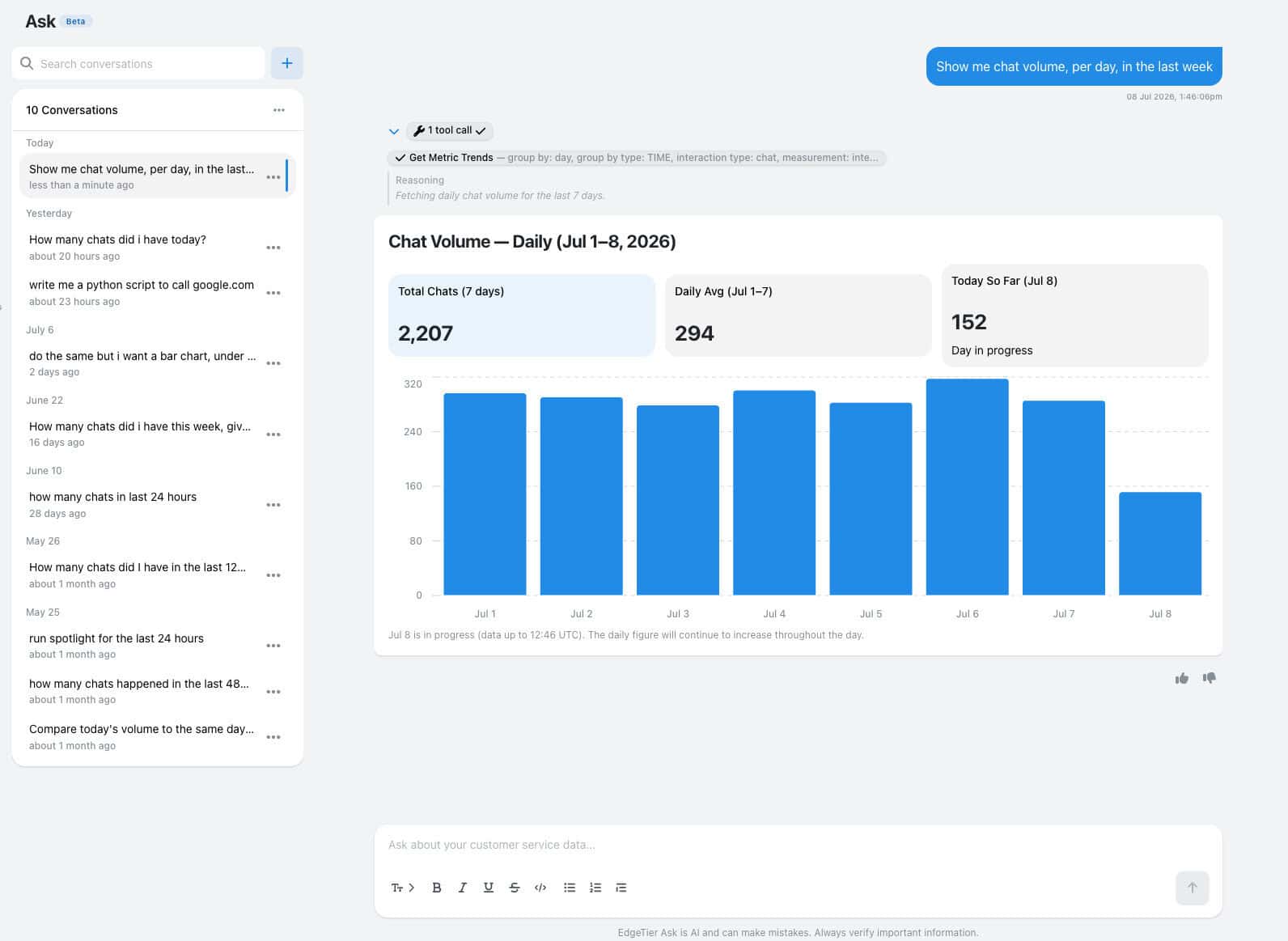
Recently we launched Ask Spotlight. The idea of Ask Spotlight is to allow users to ask anything they want to know about their data. For example, in our system, they might ask “How many chats have I had every day since Monday?” or “What contact reasons have changed most significantly in the last week?”. Here’s how we built it.
The first thing you might need to build is an MCP to your API(s) or various data sources. We already had one we built for internal use only initially. Since we use Python for almost everything backend-related, we went with FastMCP, but there are many alternative frameworks to choose from.
Can you skip the MCP? Probably yes, but you will end up creating something like an MCP for your agent to use. Ultimately it needs some way of retrieving the data it needs. As you will discover as you read further, MCP is a good standard if you choose an out-of-the-box solution such as AWS AgentCore.
As big users of AWS, we naturally looked for an AWS-based solution to the problem. We also wanted to keep all client data inside the AWS ecosystem.
Our first objective was to create a POC relatively quickly. The first prototype was quite simple and didn’t really introduce much new infrastructure. As current users of AWS Bedrock, we built an endpoint into our API that sent requests to Bedrock Converse directly. Our MCP was already deployed on an EC2 at this stage.
Here is a diagram of the POC, which probably looks more complicated than it was in reality (you may need to open in a new tab to see the full thing):
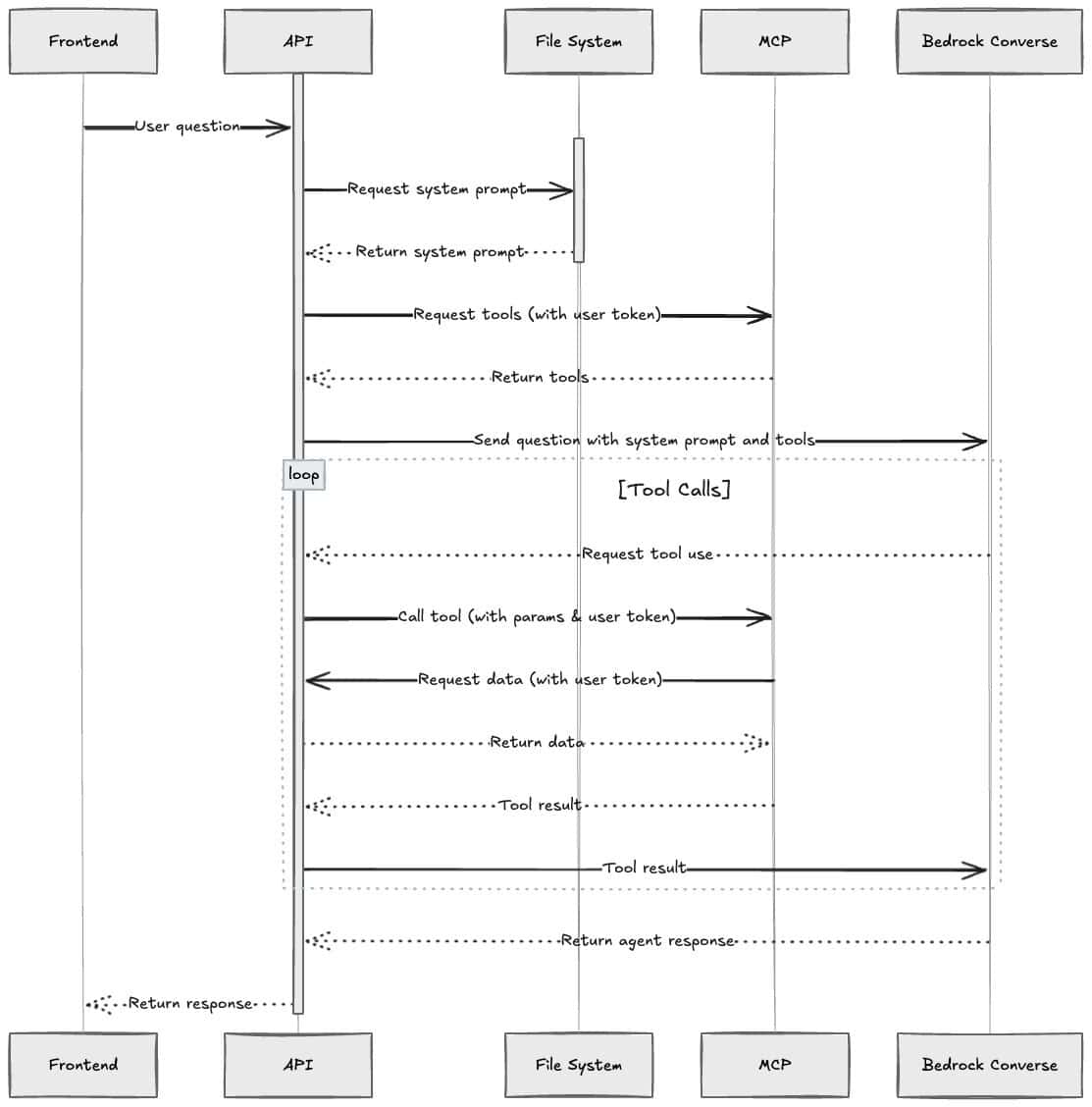
This solution worked fairly well for evaluating the concept and to support the build and test of our frontend. And ultimately it proved that we wanted to continue with the project. However, we never expected that this solution would ever get close to production, as it has many limitations:
Can you address these limitations? Almost certainly, but it would require a decent amount of engineering effort and ongoing maintenance. There are enough solutions out there these days that you probably don’t need to build your own unless you have extremely specific requirements or are really optimising for running costs.
We decided AWS Bedrock AgentCore was the most obvious alternative for a production-ready solution. It basically addresses all the limitations mentioned above:
Apart from this there are other advantages:
The disadvantages of using AgentCore:
We also decided to use the Strands SDK and, rather than storing prompts in markdown files, we chose to use Langfuse. Langfuse was something we are already using for other use cases so it was an easy transition in this case.
Here is the final (somewhat simplified) diagram of our production solution (again, you may need to open in a new tab to view it fully):
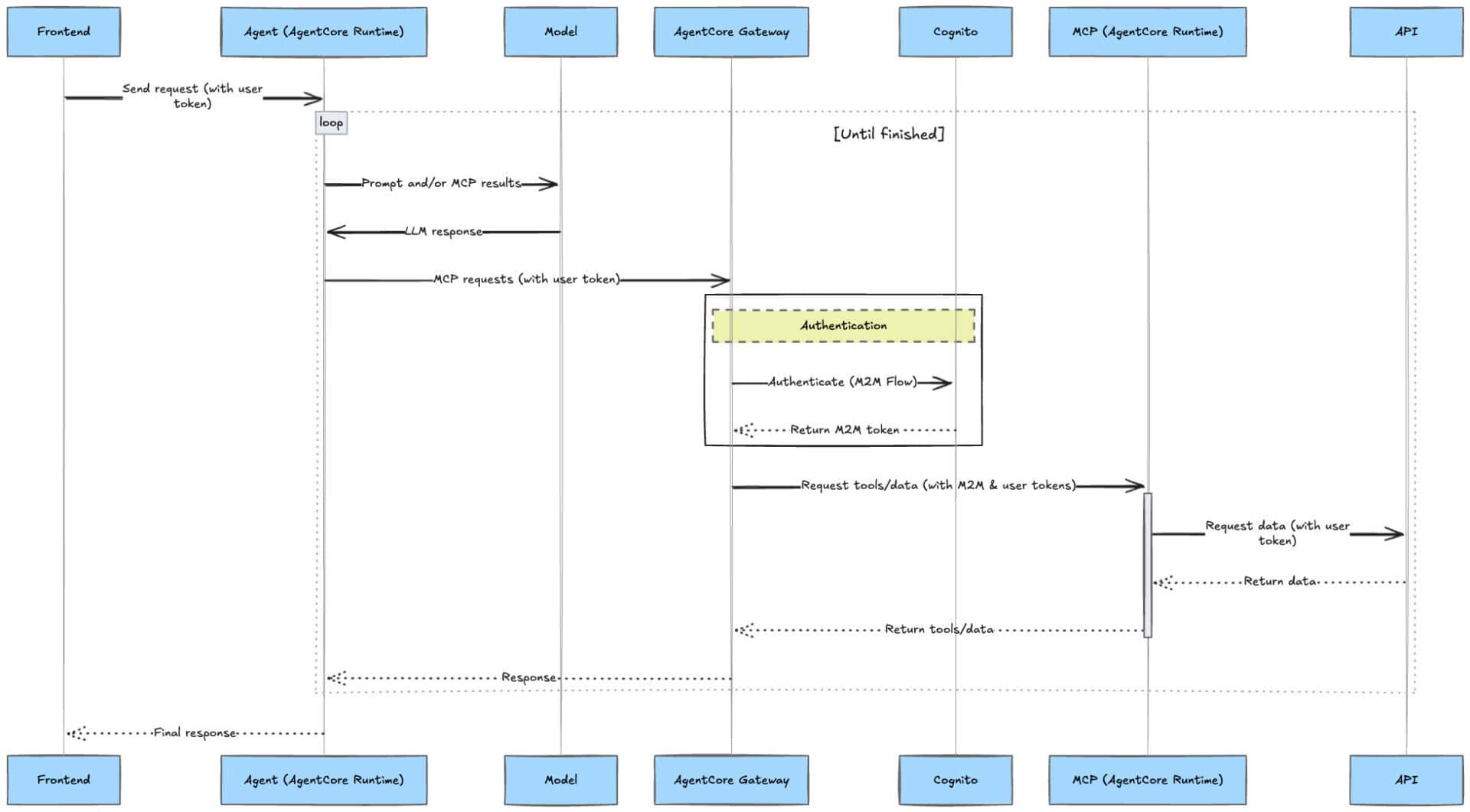
Omitted from the diagram for size:
This was the solution we eventually ran in our alpha test with real users before going fully to production. So far, we have been really happy with the result.
Just the infrastructure cost (not the total cost) per user question for us is on average about 7 cents USD in the eu-west-1 AWS region. You can add at least another 30% onto that cost for supporting infrastructure like Cognito, CloudWatch etc. depending on what you have enabled. Ultimately, this is nothing compared to what we pay for tokens, so it only makes up a small fraction of the total cost per question. That can vary a lot depending on what model you choose.
Overall we and our users are happy with how we built this feature. In some ways, we could have gone straight to the AgentCore solution without the POC version, but building a POC like that these days with AI is no longer a big task, so in our opinion it was worth getting to a prototype as fast as possible to test the frontend quickly.
Most of what we hear on customer calls is useful. Some of it is just lovely. We've rounded up the
From self-serve Sonar anomaly models to a smarter, shareable Ask Spotlight and a fully transparent QA dispute process, here's everything
EdgeTier turns your customer conversations into a single connected system: it catches anomalies before they escalate, scores every agent interaction


Afroditi Pina
Director of Customer Service
"It has reduced the time for the quality assurance process as it provides clear data and a very robust direction on where to look and what matters the most."


Nick Brazitis
Global Customer Care Manager
"The anomaly feature is a game changer for us. It’s highly accurate and has helped us identify customer issues, agent errors, and even fraud that would have taken us longer to catch."


Vladimir Greavu
BBG Director of Customer Service
"I specifically liked the flexibility. I liked the can-do attitude. I always felt supported. There hasn’t been any single point in our journey where EdgeTier has said no."



Let us help your company go from reactive to proactive customer support.
Unlock AI Insights