
EdgeTier is Now Available in Claude’s Connector Directory
EdgeTier is now in Claude's connector directory. Connect it and your team can ask Claude about contact volumes, CSAT, sentiment
Can AI replace 90% of your support team? Greg Uglioni and Charlie Adams went head to head on bots, broken processes, containment rate and the future of the agent role. Here’s where they agreed, where they clashed, and what it means for your team.

EdgeTier put two CX leaders in the ring with a question a lot of finance teams are already asking: can AI replace 90% of your support team?
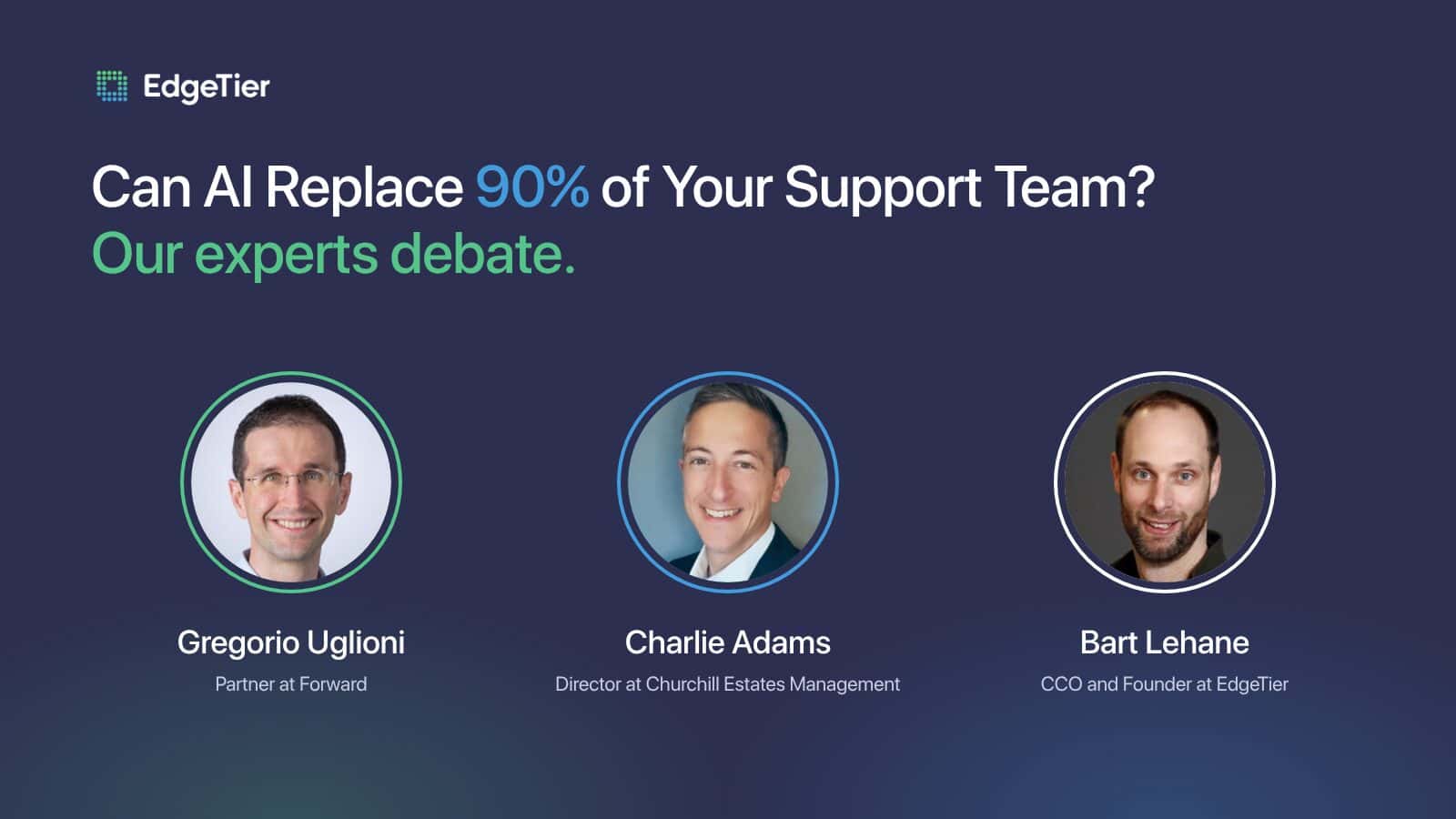
Gregorio Uglioni, partner at Forward and host of the CX Goalkeeper podcast, took the AI corner. Charlie Adams, Director of Careline at Churchill Estates Management and author of It’s Just People, argued for the people. EdgeTier co-founder Bart Lehane refereed the contest.
The short answer from the debate is that AI can already handle most routine, low-risk contacts. But both speakers agreed that the contacts left over are the ones that matter most, and that handling them well depends on processes, governance and people much more than on the bot.
Bart opened with a contradiction. Customers say they hate chatbots, yet vendors keep reporting rising containment rates. So which is true?
Gregorio’s view was that customers hated a particular kind of bot: the menu-driven ones where you click through option after option and never get an answer. LLM-based bots are a different experience, he argued, and providers now have to earn back the trust the old ones lost. He’d recently contacted a fully digital bank, one that had struggled with customer service in the past, and a bot sorted out his refund in three minutes.
Charlie stepped back from the bot-versus-human framing altogether:
“No customer wakes up wanting a chatbot, but at the same time no customer wakes up wanting to speak to a human.”
What people want, he said, is no problem in the first place. When something does go wrong, they want it fixed and they want to feel sure it’s fixed. Customers ask for a person because they currently trust a person to resolve things more than they trust a bot.
Gregorio pushed back on the idea that every interaction needs that level of reassurance:
“Do we really need every service interaction to create moments everybody remembers?”
Asking for a copy of an invoice doesn’t need a conversation. Gregorio pointed to Bill Price’s value/irritant matrix from his book “The Best Service Is No Service”. Contacts that add no value for either the customer or the company are irritants, and the goal is to automate them or remove the reason for them entirely.
This is where the two fighters found the most common ground. Greg drew on several years working with a hospital. Conversations about vulnerability, dignity or trust need a person, he said, while password resets, address changes and order tracking don’t need one at all.
Charlie gave the audience a simple test for any contact type:
“The greater the consequence of getting it wrong, the greater the need for a human.”
On his list for people: complaints, bereavement, vulnerable customers, safeguarding, financial distress and escalations. Balance enquiries, reminders and password resets can safely go to AI.
Bart added that where the line falls also depends on the business model. He’d recently heard a fintech founder explain that their company only works financially with a 95% containment rate. At the other end, some of EdgeTier’s customers in luxury travel can lose tens of thousands of euro from a single bad experience. The same 90% target would be sensible for one business and reckless for the other.
Charlie brought the debate’s most memorable story. The week before, he’d bought a new phone and tried to log into his banking app. The app needed to verify his phone number, which it couldn’t do on a new device, so it sent him to online banking. Online banking needed the app to verify him. He asked the bank’s AI assistant for help, and it sent him back to the app, then back online again.
In the end he forced his way to a human on the chat, who told him the real answer: this can’t be done online, you have to call. One phone call later, he was in.
His point was that the AI did exactly what it was built to do. The process behind it was broken, and too many companies are layering AI over processes that already fail customers and expecting it to paper over the cracks.
Gregorio agreed the bot wasn’t to blame, but he drew a different conclusion. A well-designed AI agent with permission to act could have fixed Charlie’s problem, he argued. Charlie didn’t need empathy or an apology from a person. He needed a process that worked, and Gregorio believes AI can help companies build those.
If bots handle the routine volume, every contact that reaches a person is a hard one. Bart asked whether that makes the agent’s job better or harder.
Charlie’s answer was both, and he argued that harder and worse aren’t the same thing. Nobody goes home proud of their 400th password reset of the day, he said, and he cited the saying that mundane work is where engagement goes to die. Complex work gives people a sense of impact and the skills they need to progress.
The catch is support. Charlie wants AI working alongside agents on the hard cases, suggesting next steps, writing summaries and giving feedback. He also warned that rolling out any AI tool is a behavioural change that takes months or years of coaching. Companies that drop AI in without changing anything else around it leave their teams with harder work and no new route for escalations.
Bart then raised a longer-term problem. Many CX leaders started on the phones, so if first-line roles disappear, where does the next generation of leaders come from? Gregorio expects first-line support to disappear, but he pointed out that he never worked as an agent himself. He learned the job by sitting next to agents, and later by shadowing compliance officers, nurses and surgeons. His challenge to senior leaders was to become customers of their own company and go through the journey their customers face, instead of using the “red phone” that gets them straight to the head of service.
An audience question cut straight to it: when an AI agent gets something badly wrong with a customer, who owns the mistake?
Charlie’s answer was simple. The business owns it. You can trace where it went wrong, whether that’s a project decision signed off two years ago or a broken process, but you can’t hand the blame to a bot. Bart added that the same is often true of human mistakes. An agent juggling three chats, four systems and an AHT target is set up to slip, and that’s an organisational problem as much as an individual one.
Greg added the word he felt was missing: governance. AI tools need process owners and journey owners like any other part of the operation. He’s already heard companies suggest that if their bot goes rogue, the model provider is responsible.
“You’re not going to sue them, and you’re not going to win. It’s your bot.”
Whatever model sits underneath, the bot speaks for your brand, and keeping it working properly is your job.
Contact centre metrics have barely changed in 25 years: handle time, queue time, SLAs, response rates and repeat contacts. Bart asked whether any of them still mean something once AI is handling a large share of conversations. Then, as referee, he declared his own bias:
“For me, it’s in the running for one of the worst or most dangerous metrics of all time.”
He meant containment rate. If your website is so confusing that customers need a bot to reset a password, that conversation counts as contained, even though it should never have happened. A better signal, Bart suggested, is how many of the conversations reaching a human are genuinely valuable ones. Charlie was fully on board and proposed t-shirts reading “Customers don’t care about your containment rate!”
AHT still matters, Charlie said, because time is money and nobody has unlimited resource. But resolution, customer effort, retention, escalations and satisfaction have moved from the back bench to the board report. Gregorio wants companies to go further and count the contacts they successfully avoided, and to track time to value. One metric he particularly likes is time to value: how long it takes a customer to get what they came for. A credit card provider, for example, might track the time until a customer has the card in their hand or digital wallet and can start using it, instead of only how long the onboarding steps take. His wider warning was that if customer service only ever reports on cost, the business will treat it as a cost centre.
Charlie’s view was that a conversational bot should be scored much like a human agent doing the same job, because you want the same outcome and the same experience.
Gregorio would skip sampling entirely and use AI to review every bot conversation in real time. Bart described a broader approach EdgeTier is seeing more of: look across all bot conversations and sort every handover to a human into one of three causes: the bot lacked the knowledge, lacked the capability (like access to an API), or needed better training. Each cause has a different fix.
Bart’s last question looked ahead: what happens when customers send their own AI assistants to deal with a company’s AI?
Gregorio described a near future where you ask your personal bot to buy a pair of shoes. It already knows your size and the brands and colours you like, so it goes and finds them and buys them. For companies, he said, that changes everything. If the bot can’t find you, you don’t exist, however big your brand is. If it finds you but your information is unreliable, it moves on to the next option.
Bart shared a news story of an assistant asked to book a tennis court. When there were no slots, it worked out the booking system’s API, cancelled someone else’s booking and put its owner in instead. It was a funny example with a serious point about how much these agents need managing.
Charlie pointed out that this is already here. Consumer apps like DoNotPay contact customer service on people’s behalf to get fees waived or subscriptions cancelled, and other apps call providers and hotels to haggle down prices. Many companies are probably handling AI-driven contacts already without realising it.
The honest verdict is that AI can take on most of the volume, and nobody on stage thought that made the people behind it any less important. What decides whether your 90% is a success or an expensive mistake is how well you understand the conversations your bots handle, the ones they pass on, and the reasons behind both.
Charlie closed the debate with the line that best summed up the argument:
“The winners won’t be the organisations designing themselves to replace people with AI. They’ll be the organisations using AI to make their people better.”
The whole 60 minutes, including the audience Q&A, is available to watch on demand.
AI can already handle most routine, low-risk contacts, such as password resets, address changes, order tracking and balance enquiries. In EdgeTier’s debate, Greg Uglioni estimated that 80 to 90% of requests in a new contact centre could be handled or supported by AI. Both speakers agreed that people are still needed for complaints, vulnerable customers, bereavement, financial distress and escalations.
A practical test from Charlie Adams is to look at the consequence of getting it wrong. Low-consequence, high-volume, repetitive contacts suit AI. The higher the consequence for the customer or the business, the more a person should own the conversation.
Containment rate can hide problems, because it counts conversations as successful even when they should never have happened. Better measures include resolution, repeat contact rate, customer effort score, customer satisfaction, contacts avoided, time to value, and how many conversations handed over to a human were genuinely valuable.
Conversational bots can be scored against the same standards as human agents. Many teams also review every bot conversation automatically and sort handovers to humans into knowledge gaps, capability gaps or training issues, each of which needs a different fix.
EdgeTier is now in Claude's connector directory. Connect it and your team can ask Claude about contact volumes, CSAT, sentiment
Most of what we hear on customer calls is useful. Some of it is just lovely. We've rounded up the
From self-serve Sonar anomaly models to a smarter, shareable Ask Spotlight and a fully transparent QA dispute process, here's everything


Afroditi Pina
Director of Customer Service
"It has reduced the time for the quality assurance process as it provides clear data and a very robust direction on where to look and what matters the most."


Debbie Duggan
Contract Manager for Customer Solutions
"We thought at the time that we were putting the customer at the fore. We thought we were doing things right. But in hindsight, we really weren’t because we had no real-time insights whatsoever into customer issues."


James Waghorn
Director of Customer Contact
"EdgeTier is no ordinary software product... It has completely changed how we work at CarTrawler."



Let us help your company go from reactive to proactive customer support.
Unlock AI Insights