Overheard at EdgeTier
Most of what we hear on customer calls is useful. Some of it is just lovely. We've rounded up the
Most contact centres find out about a problem the same way their customers do: after it's already spread. This piece breaks down what real-time issue detection actually requires: full conversation coverage, a live baseline of "normal," and sensitivity to what customers are saying, not just how many are calling. It also compares metric-based monitoring with…


The fastest way to detect an emerging issue in a contact centre is to monitor 100% of customer conversations against a live baseline of “normal” – not just volume, but the actual topics and language customers are using, so a new pattern gets flagged the moment it starts forming, rather than after it shows up in a weekly report or an agent’s Slack message. That means moving beyond dashboards and manual thresholds, and toward systems that read conversation content itself.
Here’s what that looks like in practice, and how to build (or buy) it.
Ask any contact centre leader these questions and watch the pause:
These should be easy questions. In most contact centres, they’re not. Data is scattered across chat, email, and voice. Labels get applied inconsistently, if at all. And by the time an issue is visible (in an end-of-week report, a spike on a dashboard, or a pattern an agent finally flags to their supervisor) it’s often already affected hundreds or thousands of customers.
The cost of that lag is real, and it’s growing. Customer patience is shrinking: 88% of consumers now expect faster response times than they did just a year ago, according to Zendesk’s 2026 CX Trends report. And the margin for error once a problem does reach them is thin; PwC research has found that 32% of customers will stop doing business with a brand they love after just one bad experience. A single missed or mishandled contact rarely stays a single contact, it tends to be the first sign of a wider problem building underneath it. The gap between “an issue exists” and “we found out” is where most of the damage happens.
A handful of things separate contact centres that catch problems early from those that hear about them from a customer:

Worth being clear-eyed here, because a lot of “real-time analytics” marketing blurs these together. There are really two distinct approaches:
This tracks numeric time series – call volume, average handle time, abandonment rate, queue length – and flags when they deviate from a statistical baseline (using techniques like z-scores, control charts, or regression-based forecasting). It’s genuinely useful for operational health: knowing your queue is about to break is valuable. But it only tells you that something changed. It won’t tell you a new group of customers are all describing the same broken checkout flow, until the volume gets big enough to move the needle on a chart.
This works directly on the language of the conversation, clustering similar chats, emails, and calls together based on what customers and agents are actually saying, and watching for new or growing clusters that don’t match the normal topic mix. This is what lets a system name the issue (e.g. “promo code failing at checkout”, rather than just report a number trending up.) It’s harder to build well as it needs to work across languages and channels, and separate genuine signal from noise, which is probably why most real-time monitoring tools stop at the first kind.
The most useful setup uses both: operational metrics for capacity and SLA risk, and content-based detection for the issues that are only visible in what people are actually saying.
Sonar is built specifically for the second, harder problem: catching emerging issues in the actual substance of customer conversations, in real time, across every channel and language.
It works by continuously learning what a normal spread of conversation topics looks like for your business, like how many customers typically ask about refunds, cancellations, or password resets on any given day.
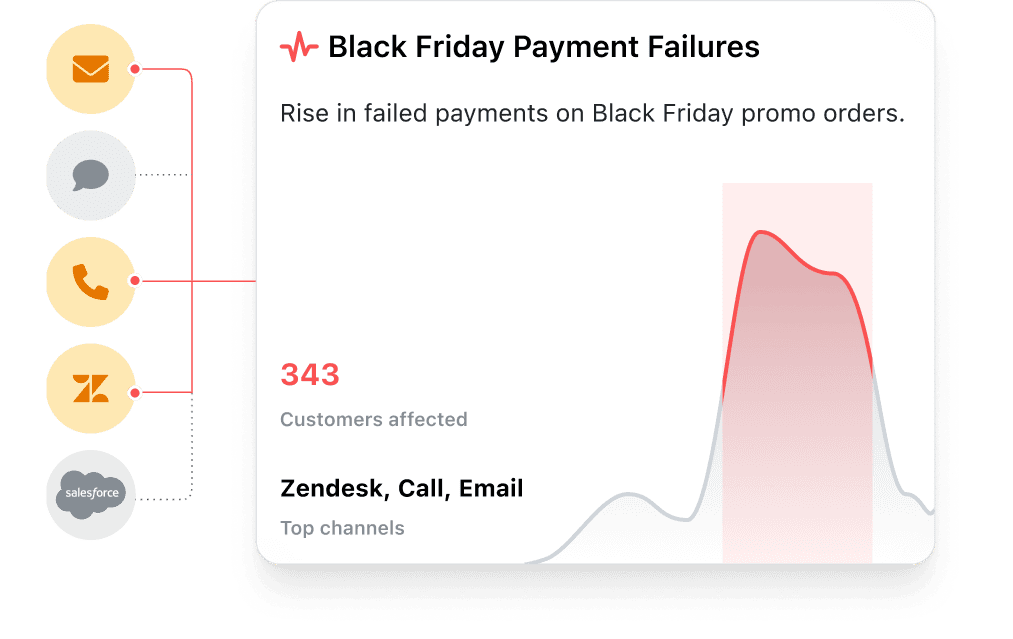
Every new batch of conversations is compared against that baseline. When a cluster of similar conversations starts to diverge from it, a pattern of chats all describing the same checkout error, say, Sonar treats that as an emerging anomaly.
From there, it does the work a human team would otherwise have to do manually:
It can also run multiple detection models in parallel; for example, one watching all English-language conversations, another scoped to a specific brand or team, so alerts reach only the people who need to see them.
This is the same approach that let one EdgeTier customer, PowerPlay, catch three critical issues within hours of a full platform migration, cutting detection time from 12–24 hours down to around 15 minutes and protecting up to half of daily revenue at risk during the launch. As one of their team put it afterwards: “we fixed problems fast enough that they barely became problems.”
Sonar doesn’t work in isolation, either. EdgeTier Explore provides the always-on tagging and sentiment layer that keeps the topic baseline accurate across every conversation, and Ask Spotlight lets teams ask follow-up questions in plain language: “why did this spike?“, “which region is most affected?” etc., without waiting on an analyst.
If you’re evaluating how to add this capability to your contact centre, a few questions cut through most of the noise:
Waiting for a weekly report, or for a customer to tell you what’s wrong, isn’t a strategy, it’s a delay. The contact centres getting ahead of issues are the ones treating every conversation as a signal worth listening to, in real time.
Any pattern of customer contact that’s new or growing faster than normal: a payment error, a delivery problem tied to one courier, a bug introduced by a recent release, or a spike in complaints about a specific policy. The common thread is that it starts small, in a handful of conversations, before it’s obvious on a dashboard.
A dashboard shows you metrics you already know to watch, like queue length, AHT, volume by channel. Emerging-issue detection is designed to catch things you didn’t know to look for, by analysing the content of conversations for new patterns rather than tracking pre-defined numbers.
With full-coverage, content-based detection, minutes rather than hours is achievable; EdgeTier customers have seen detection times drop from 12–24 hours down to around 15 minutes. Detection speed depends on how quickly a genuine pattern forms across conversations, so very early single instances may take a little longer to confirm as real anomalies rather than noise.
Rule-based thresholds (e.g. “alert if volume exceeds X”) work for known, well-defined problems. They can’t catch something you haven’t thought to set a rule for, which is exactly what most emerging issues are. That’s where language-based, learned-baseline detection earns its place.
It should. A genuine emerging issue doesn’t respect channel or language boundaries, the same broken feature might show up as complaints in five languages across chat, email, and voice simultaneously. Detection that only covers one channel or language will always be working with a partial picture.
Most of what we hear on customer calls is useful. Some of it is just lovely. We've rounded up the
From self-serve Sonar anomaly models to a smarter, shareable Ask Spotlight and a fully transparent QA dispute process, here's everything
EdgeTier turns your customer conversations into a single connected system: it catches anomalies before they escalate, scores every agent interaction


Quentin Bottner
Head of Continuous Improvement
"We’re a big business, so getting the right people to agree and fix something hasn’t always been easy. Now we’ve got one version of the truth—it’s much easier to align and act"


Deborah Guivisdalsky
COO
"We now have highly detailed understanding of agent performance, not just on key agent metrics, but also on how customers react to our agents and the emotions of our customers feel when talking to our team."


Nick Brazitis
Global Customer Care Manager
"The anomaly feature is a game changer for us. It’s highly accurate and has helped us identify customer issues, agent errors, and even fraud that would have taken us longer to catch."



Let us help your company go from reactive to proactive customer support.
Unlock AI Insights