Overheard at EdgeTier
Most of what we hear on customer calls is useful. Some of it is just lovely. We've rounded up the
Most Ask Spotlight conversations run to about two messages. The longest one we found ran to forty-eight. Both can be right, but if you've never pushed past the first answer, there's a gear you haven't used yet. Leanne Sullivan, EdgeTier's Head of Product, went through a month of real usage to find out what separates…


I went digging through a month of Ask Spotlight usage to find out what people actually ask it and two things surprised me:
Now, two messages are often exactly right. You had a good question, you got your answer, you got on with your day feeling empowered and informed. Most of what people need from Ask Spotlight can genuinely be one or two well-aimed questions away.
But the long conversations are doing something different; somewhere around turn four or five you stop asking what happened and start asking why, and what to do about it, and can I have the receipts. You come out the far end with a root cause, a coaching plan, and real data you can forward to Product with the subject line “please fix this.”
So let’s do a masterclass; whether you’re using Ask Spotlight or another agentic AI tool to question your contact centre data, these tips are for you.
Think about prompting like this: you’re briefing a colleague.
Don’t agonise over it though. Your first question isn’t a spell and if you get it slightly wrong, you just ask again. Which brings us to the good bit.
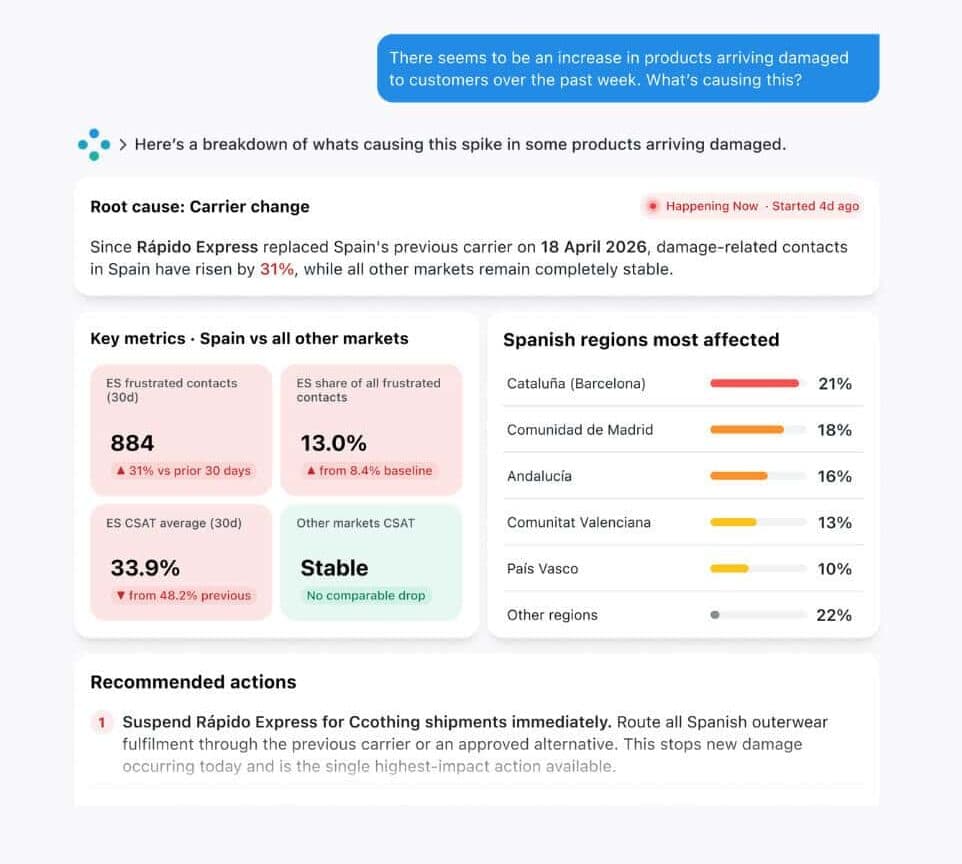
Most of us learned our search habits from Google and our data habits from dashboards. Both taught us a variation of the same thing: you ask, you get, you’re done. If the answer’s wrong you go back and phrase it better from scratch.
Bin that, because it’s costing you the good stuff.
Every follow-up does something different with the same investigation. And you never re-type the filters, the dates, or the context. It’s all still sitting there. Here’s a real one, from an iGaming operator wondering why ‘welcome-offer contacts’ were creeping up.
Turn one: how big is this?
Q: “Welcome-offer contacts have been climbing this month, what are players actually getting in touch about?“
A: 312 contacts, up 38% on last month. Three sub-reasons do most of the damage: bonus not credited after first deposit (44%), wagering-requirement confusion (31%), offer expired before it was used (18%).
Turn two: why is it happening?
Q: “Why the confusion? Is the offer itself unclear, or is something breaking?“
A: Clarity, not a bug. The “not credited” players had deposited but hadn’t met the 40x wagering requirement, and assumed the bonus had failed. They say over and over that the wagering requirement and the 7-day expiry aren’t visible at sign-up, they find out when they contact support. Actual crediting errors are rare.
Turn three: so what do we do?
Q: “What could we change to bring these contacts down?“
A: The biggest preventable chunk is wagering and expiry confusion, about 49% combined. Show the wagering requirement and expiry on the offer page and the deposit-confirmation email. Add a bonus-progress indicator to the player account. Send a nudge on day five of seven. Roughly 6 in 10 of these contacts look self-serviceable if the terms had been visible earlier.
Turn four: prove it
Q: “Give me three example conversations I can send to the product team.”
A: Three representative interactions, links straight through to the transcripts.
Four questions. About two minutes in total to ask. Out the other end: a diagnosed problem, a sized opportunity, a specific product recommendation, and the receipts.
Same tool, completely different question. An ops lead’s Monday morning looks nothing like a QA manager planning their review week, which looks nothing like a CX director prepping a board update.
EdgeTier’s biggest group, and the most habitual. Volume, themes, and contact reasons make up roughly one question in three across the whole platform.
Volume says something happened, but deviation says something changed. Chase the deviation.
Second biggest group, about 17% of questions. They have three major jobs: what are our evaluations already telling us, where do my remaining review hours go, and what do I actually say in the 1:1.
“Across last month’s evaluations, where are we losing the most points, and which sections of the scorecard are weakest?“
Then push on it: “Which agents are struggling most on that section, and what’s the pattern in how they’re handling those calls?” You’ve gone from a scorecard average to a specific, coachable behaviour without opening a single evaluation form.
Then work out where to look next. The evaluations only cover what’s been sampled. For everything else: “Show me the agents with the highest customer frustration rate on calls last week.” “What’s driving it for the top three?“
That’s a prioritised review queue built from the whole population rather than the sample, and Ask Spotlight will link you straight to the interactions worth opening.
One more worth stealing: repeat contact by agent. If the customer came back, the first answer didn’t land. That’s a coaching insight you will never find in a CSAT score, or on a scorecard.
Fewer questions but higher stakes. Senior leaders don’t live in dashboards, but you still need the picture, ideally in the language of your own targets.
Underneath the job titles there are three ways of working that show up across all of them.
About one question in ten isn’t analysis at all. It’s finding one thing, quickly.
Fun fact, a decent few I found are just a number pasted in with no sentence around it at all, which delighted me as it shows that people are in the habit of using Ask Spotlight and find it a reliable source!
Other end of the scale. Around 18% of prompts run past 500 characters, and they mostly come from people who could have written the SQL themselves.
These read like specs, not questions. Objective, date range, explicit exclusions, the specific angles to dig into, and the exact output structure required, right down to “give me an executive summary, main findings, recommendations, and thirty representative conversations.”
You don’t have to work this way, but if you run the same complex analysis every month, writing it out properly once beats asking it vaguely five times. Brief it like a sharp junior analyst. The tighter the scope, the less you’ll correct.
Let me tell you about a question pattern I nearly labelled a mistake. It shows up constantly and looks like this:
Can you do the same search for 2 Mar – 4 Mar? Can you do the same search for 2 Mar – 15 Mar? Can you do the same search for 16 Mar – 31 Mar?
My read: these poor people don’t get it. They’re re-asking instead of digging. They’re using a conversation like a search box!
Then I looked properly, and no, they get it just fine. They’ve got an answer they like and they want the identical analysis with one thing swapped. The dates. The market. The agent. The queue.
“Why” is still the main topic here, users just want to steer the platform towards their way of working rather than having one catch-all report that’s less nuanced. Nothing wrong about that!
Here’s a workaround I keep spotting: people maintaining a prompt library in a Google Doc somewhere, pasting the same thing every week with the filters swapped. That’s a hack, and hacks are the best product feedback there is.
So next: saving prompts. Repeatable report templates with your own guidelines and branding. Filtering the same report per market, team or region. Delivered on a schedule to the people who need it. Same analysis but none of the copy-paste.
After that, it gets more interesting. Ask Spotlight is EdgeTier’s first agentic feature, but it still stops where you start; it gets the information and builds the report, then hands it over. We’re looking at what happens when EdgeTier can act on its own analysis. Something closer to a colleague with a target to lower contact rates, who comes up with ideas from the data, does something about them, and tracks whether it worked.
And if you’re technical: the free EdgeTier MCP server already lets you pull EdgeTier data into your own LLM tools (Claude, Copilot, ChatGPT, whatever you’ve built) and mix it with your other sources. If you’re the sort of person writing 500-character prompts, go and have a look at that.
Already using EdgeTier? Ask Spotlight is in your platform now. Go and ask it something specific!
Not yet? Have a look at what Ask Spotlight does, and book a demo if you want to see it against your own data. See Ask Spotlight →
Most of what we hear on customer calls is useful. Some of it is just lovely. We've rounded up the
From self-serve Sonar anomaly models to a smarter, shareable Ask Spotlight and a fully transparent QA dispute process, here's everything
EdgeTier turns your customer conversations into a single connected system: it catches anomalies before they escalate, scores every agent interaction


Vladimir Greavu
BBG Director of Customer Service
"I specifically liked the flexibility. I liked the can-do attitude. I always felt supported. There hasn’t been any single point in our journey where EdgeTier has said no."


Quentin Bottner
Head of Continuous Improvement
"We’re a big business, so getting the right people to agree and fix something hasn’t always been easy. Now we’ve got one version of the truth—it’s much easier to align and act"


Robert Davies
Consultant
"You’ve got an issue, but you don’t know how many people are affected. You don’t know the scale. You don’t even know if it’s real."



Let us help your company go from reactive to proactive customer support.
Unlock AI Insights