
5 Ways Conversational AI is Improving the Life of Contact Center Managers
Contact center management has always been a job of contradictions. You’re expected to keep service levels stable while volumes shift
Based on a recent talk at Contact Centre Expo Customer experience is supposed to be a priority. We all say it. We put it in strategy decks. We stick it on posters in the office kitchen. And to be fair, most exec teams genuinely believe it – 85% of executives say improving CX is a…
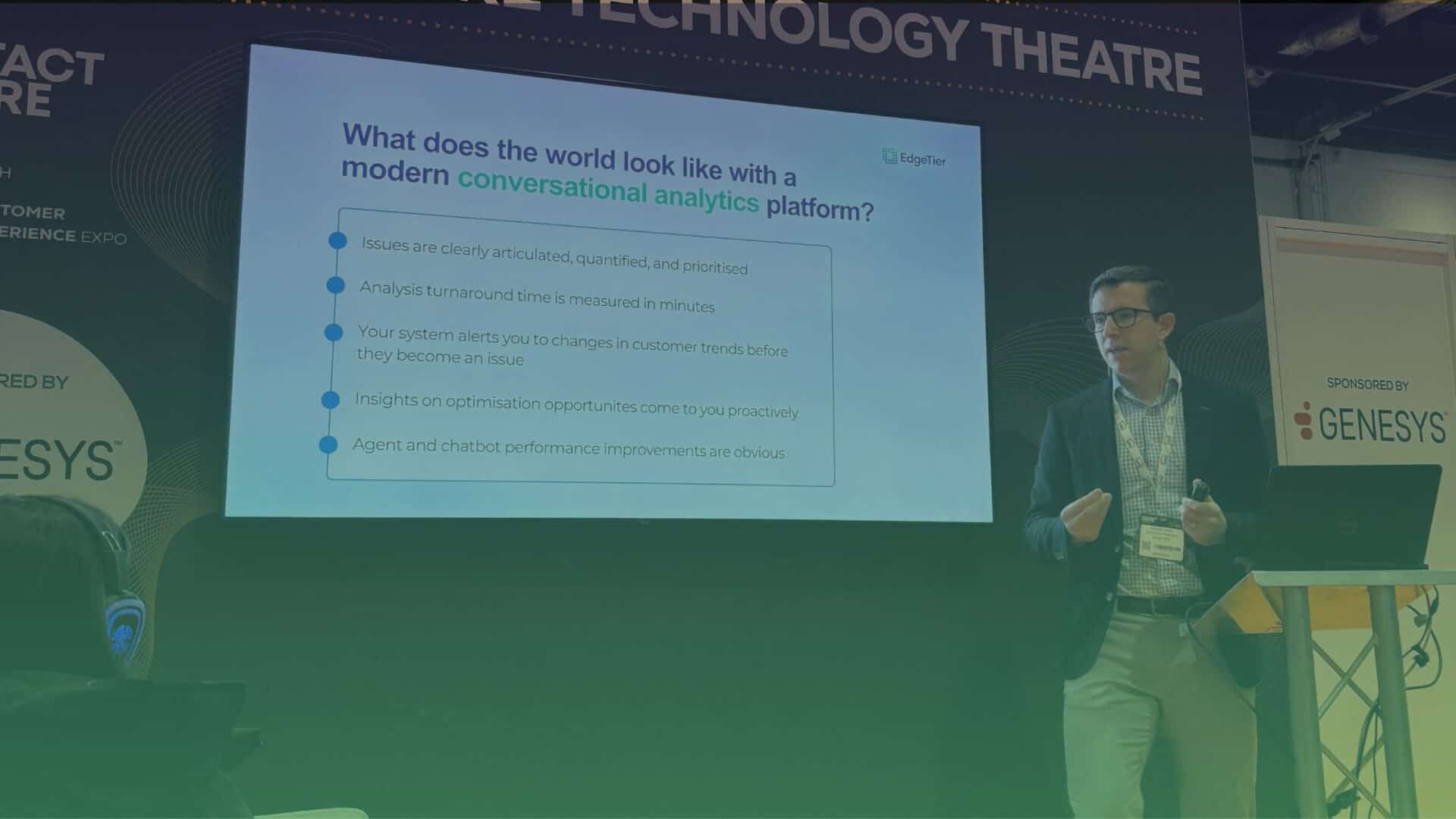

Based on a recent talk at Contact Centre Expo
Customer experience is supposed to be a priority. We all say it. We put it in strategy decks. We stick it on posters in the office kitchen. And to be fair, most exec teams genuinely believe it – 85% of executives say improving CX is a top or significant business priority (Adobe). Forrester research also backs this up, stating that: “more than 80% of business leaders indicate that improving CX is a high priority.”
But clearly it’s not enough. Because if CX really has that status, there’s a simple question we should ask ourselves:
When was the last time you had a “here’s what the customer is telling us” section in your board pack?
Not listening in the “we have a survey” sense. Listening in the real, messy, everyday sense – the calls, chats, and emails where customers tell you what’s broken, what’s confusing, what’s costing you money, and what they want you to fix next.
Those conversations are a goldmine. But most businesses are still leaving the pickaxe at home.

Before I get into the pain, I always like to start with the dream. Because, in truth, it’s not a fantasy anymore, it’s now achievable.
In the ideal world:
That’s the version of “Voice of the Customer” we should all be aiming for.
Picture a panicked Monday morning in a contact centre. Phones relentless. Chat queues flaring. People on their third coffee already. And then there’s Elaine.
Elaine has emailed twice, called three times, and posted online about a billing issue. Everyone knows her name. Dashboards get checked. Slack channels light up. A quick project spins up. All hands on deck. Because this is clearly a “major problem.”
Meanwhile, across that same day, a thousand other customers get in touch. Most are helped quickly. Some are confused. Some are mildly frustrated. But none of them are shouting. Their experiences don’t ripple through the room.
A week later it turns out Elaine’s issue only affected three accounts which had a weird version of iOS. Yet her noise shaped priorities, QA checks, and even product tweaks.
That right there is the drift. The squeaky wheel gets the grease. Anecdotal evidence and recency bias make the noisy few look like the norm. And the silent majority – the true signal – gets lost.

You have to always remember: Boards don’t run on feelings. They run on numbers, consistency, and impact. They want growth-linked activities, quantified evidence, strategic insight, and ownership. They see the contact centre instead as a cost centre with messy, soft, siloed data and no clear line to revenue impact.
Anecdotes such as “customers seem happier this month” and “our new script seems to be landing better” are not solid enough to make complex business decisions.
So here’s the blunt question: Should the Customer Operations team move from a cost line in the budget to a strategic advisor for the company?
My answer: yes, they absolutely should. Customer conversations are full of business value, we just haven’t been able to access that value properly until now.
Before looking at where and what to improve, you need to identify where your organisation sits today in terms of customer support maturity? Here’s a quick ladder:
Most businesses I meet are stuck between stage two and three. They have good people doing heroic work, in spreadsheets, late at night, to answer questions they should be able to answer in minutes.
And to be fair, until recently, the blockers were real: scattered data, slow manual extraction, lack of internal data skills, tools that weren’t multilingual or real-time. It felt like a huge lift.
But that excuse has expired.
(Also, if you want to dig deeper into your CX maturity level, check out this article from Bart Lehane which is dedicated to the topic.)
Four things quickly changed and together they’ve flipped what’s possible:
Net result: Now more than ever, it’s the ideal time to take advantage of all this.
You stop waiting for month-end reports. You stop guessing whether Elaine is a one-off or a trend. You stop being surprised by problems that were visible in conversations weeks earlier.
Instead:
That’s the leap: from reactive to strategic. And it’s so doable.
If your leadership team isn’t aware of your top customer pain points and you can’t put numbers beside them, you don’t really have a Voice of the Customer programme. Instead, you have a very expensive way of ignoring your customers.
Boards need concrete, measurable data. “Customers are frustrated with refunds” is a shrug. “Refund friction costs €3.4m per quarter” is board material. One is narrative. The other is strategy.
The good news is you don’t need a three-year transformation programme to get momentum. You start by changing the shape of the insight you bring:
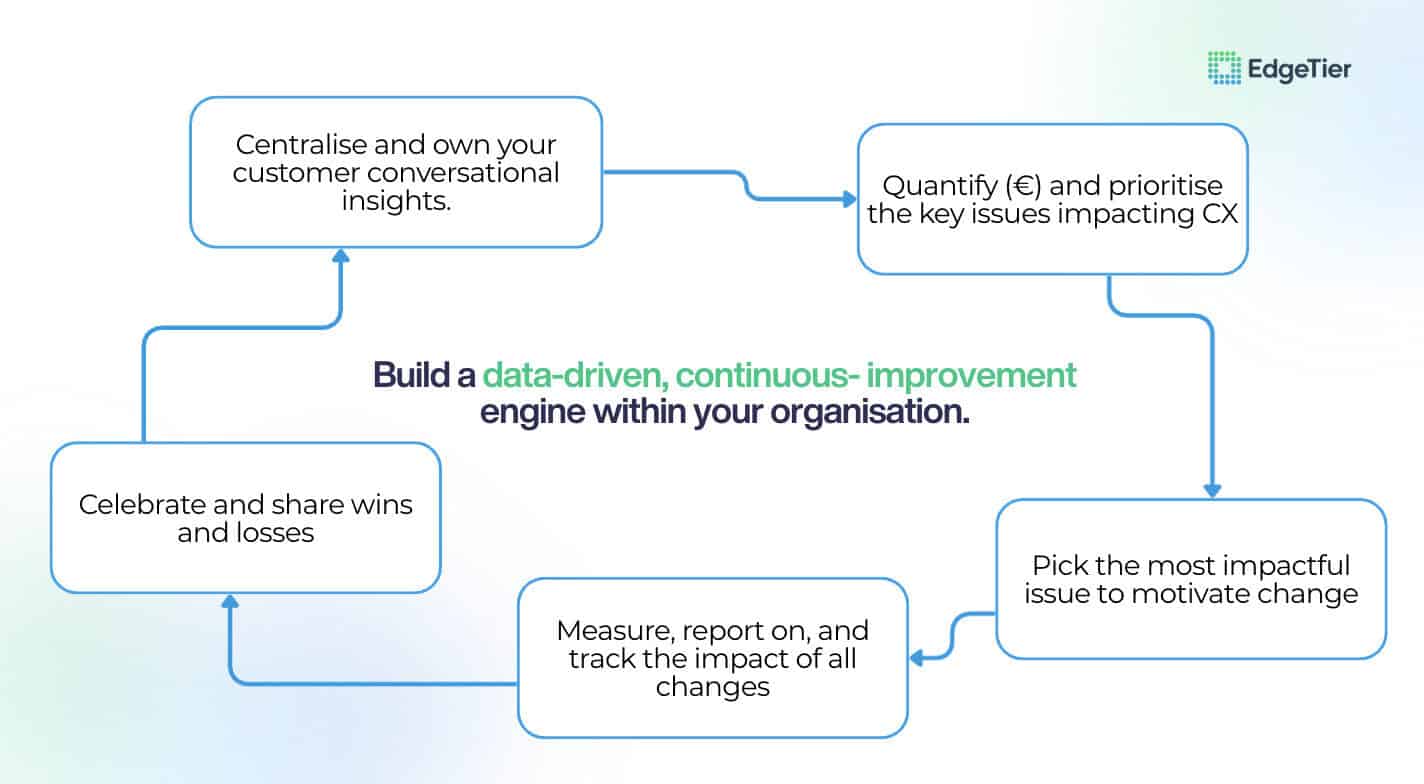
Do that, and you create a continuous-improvement engine: centralise insight, quantify it, pick the most impactful thing, measure outcomes, share wins and losses, repeat.
That loop is how CX stops being “support’s problem” and becomes everyone’s advantage.
At EdgeTier, this is exactly what we built for. I won’t go in for the big sell here, but our entire being is centered around proactively giving support teams customer insights that the business actually cares about.
We created this not because “AI is cool” but because the contact centre is sitting on the most honest dataset in your business and it’s criminal to leave that locked away.
The next time Elaine rings, what actually happens?
Do you spin up a mini-crisis because she’s loud? Or do you already know, in minutes, whether this is a blip, a trend, a product bug, a policy failure, or a churn risk?
That’s the difference between a contact centre that reacts and one that steers.
CX deserves a seat at the boardroom table. But you don’t get it by asking nicely. You get it by walking in with the numbers, the signals, and the measurable outcomes.
Want to see what conversational analytics could do for your contact centre? Get in touch with the EdgeTier team – we’d love to show you.
Contact center management has always been a job of contradictions. You’re expected to keep service levels stable while volumes shift
Most customer operations don't have a data problem. They have a clarity problem. You track the essential metrics: volumes, AHT,
This article originally appeared on Edge Signals – Bart Lehane’s LinkedIn newsletter on customer experience, analytics, and AI. Follow for


Debbie Duggan
Contract Manager for Customer Solutions
"We thought at the time that we were putting the customer at the fore. We thought we were doing things right. But in hindsight, we really weren’t because we had no real-time insights whatsoever into customer issues."


Nick Brazitis
Global Customer Care Manager
"The anomaly feature is a game changer for us. It’s highly accurate and has helped us identify customer issues, agent errors, and even fraud that would have taken us longer to catch."


Deborah Guivisdalsky
COO
"We now have highly detailed understanding of agent performance, not just on key agent metrics, but also on how customers react to our agents and the emotions of our customers feel when talking to our team."



Let us help your company go from reactive to proactive customer support.
Unlock AI Insights