Conversational Analytics, Done Right (In Our Biased Opinion)
EdgeTier turns your customer conversations into a single connected system: it catches anomalies before they escalate, scores every agent interaction
Contact centre costs are under more pressure than ever. The average cost-per-call metric hit a five-year high in 2024, according to Call Centre Helper, and that's before you factor in the growing volume of digital interactions, rising agent expectations, and the increasing complexity of customer issues landing in the queue. Most cost-reduction conversations in contact…


Contact centre costs are under more pressure than ever. The average cost-per-call metric hit a five-year high in 2024, according to Call Centre Helper, and that’s before you factor in the growing volume of digital interactions, rising agent expectations, and the increasing complexity of customer issues landing in the queue.
Most cost-reduction conversations in contact centres start in the wrong place. They focus on headcount, outsourcing, or pushing customers toward self-service, all without addressing the underlying reasons contact is happening at all. That’s treating the symptom rather than the cause.
Speech analytics takes a different approach. By surfacing what’s actually driving cost inside customer conversations, it gives contact centre leaders the evidence they need to make targeted improvements that reduce demand, improve efficiency, and protect against risk, with the benefit of not compromising the customer experience in the process!
To understand how speech analytics reduces cost, it helps to be specific about where cost accumulates in the first place.
Volume is the most obvious driver. Every contact handled costs money. According to ContactBabel’s 2025 US Contact Center Decision-Makers’ Guide, the average cost of an inbound call is $7.16, and that’s significantly higher than digital alternatives, with calls costing more than email and web chat. Anything that reduces unnecessary contact volume has a direct and measurable cost impact.
Repeat contacts compound that cost significantly. According to SQM Group, 29% of customers have to contact a company more than once to resolve the same issue, a figure that hasn’t meaningfully improved in over a decade. Every repeat contact is a cost that shouldn’t have existed at all: the original issue wasn’t resolved, the customer is more frustrated, and the operation is absorbing double the work for a single problem.
Handle time is another major lever. Calls that take longer than necessary, because agents are unclear on process, customers are confused by policy, or interactions escalate due to unresolved frustration, all drive cost without delivering proportionally better outcomes.
Compliance failures carry a different kind of cost: fines, remediation, complaints handling, and reputational damage. These don’t show up in cost-per-call metrics, but they represent some of the most significant financial exposure a contact centre can carry.
Speech analytics creates visibility into all of these cost drivers, directly from the conversations where they originate.
Not all contact volume is inevitable. A meaningful portion of what lands in a contact centre’s queue is avoidable, generated by unclear processes, confusing customer communications, broken digital journeys, or product and policy issues that keep recurring without being fixed.
The challenge is identifying which contacts are avoidable and why. When you’re handling thousands of interactions a day, patterns that look obvious in hindsight can take weeks or months to surface through manual analysis, if they surface at all.
Speech analytics changes this by automatically analysing every conversation to identify contact drivers at scale. It can surface questions like:
When these drivers become visible and quantifiable teams can prioritise fixes that actually reduce demand. TUI, for example, used EdgeTier’s Explore to identify a hidden payment confirmation issue driving 20% of all queries. A single fix cut payment contacts by 40% and reduced overall volume by 12%.
Repeat contacts are one of the most reliable indicators of unresolved cost. Each one represents a failure point in the original interaction, and unless the underlying cause is identified and addressed, it will keep generating cost.
Speech analytics enables genuine root cause analysis by linking repeat contact patterns to what actually happened in the conversations that preceded them. Instead of knowing that repeat contacts are happening, teams can understand why; whether it’s an agent knowledge gap, a process step that’s consistently skipped, a policy that customers find confusing, or a product issue that’s generating follow-up calls across the board.
That diagnostic capability is what transforms repeat contact data from a lagging metric into an actionable insight, one that can drive process improvements, agent coaching, and operational changes that actually stop the cycle.
First contact resolution (FCR) is one of the strongest levers for cost reduction available to a contact centre. High FCR rates mean fewer repeat calls, happier customers, and reduced operational costs – the three outcomes that matter most to both leaders and teams. Every percentage point improvement in FCR has a direct impact on volume, cost, and customer satisfaction simultaneously.
Speech analytics supports FCR improvement by identifying where and why resolution is failing. Common failure patterns (e.g. agents lacking the knowledge to resolve certain issue types, customers being transferred unnecessarily, process steps being missed) become visible across thousands of interactions rather than inferred from a small sample of reviewed calls.
That analysis enables targeted interventions: better agent training where knowledge gaps are consistent, process improvements where steps are being skipped, or self-service improvements where customers are repeatedly contacting for something they should be able to resolve themselves.
Compliance failures are a cost category that rarely gets discussed alongside operational efficiency, but they should be. Missed disclosures, skipped verification steps, and improper complaint handling all carry financial consequences that can dwarf the operational savings achieved elsewhere.
Manual compliance monitoring, where reviewing a sample of calls and hoping the sample is representative, leaves most of that exposure undetected. Speech analytics monitors every interaction automatically, flagging compliance gaps before they become formal complaints, regulatory investigations, or audit failures. The cost avoided here isn’t always easy to quantify in advance. But the contact centres that have faced regulatory action because a compliance issue ran undetected for months understand its scale well enough.
Average handle time (AHT) is one of the most watched metrics in contact centre operations, and one of the most frequently misunderstood. Reducing AHT by rushing agents through interactions can damage quality and resolution rates. Reducing it by equipping agents better is a very different proposition.
Speech analytics identifies what’s actually driving longer handle times: interactions where agents spend time searching for information they should have at hand, calls where confusion about a process step creates extended back-and-forth, or contacts where a product issue is generating disproportionately long, complex conversations.
These are systemic issues that coaching alone won’t fix. But once they’re visible, they can be addressed through knowledge base improvements, process changes, or better agent tooling which goes a long way to reducing handle time without compromising the quality of the interaction.
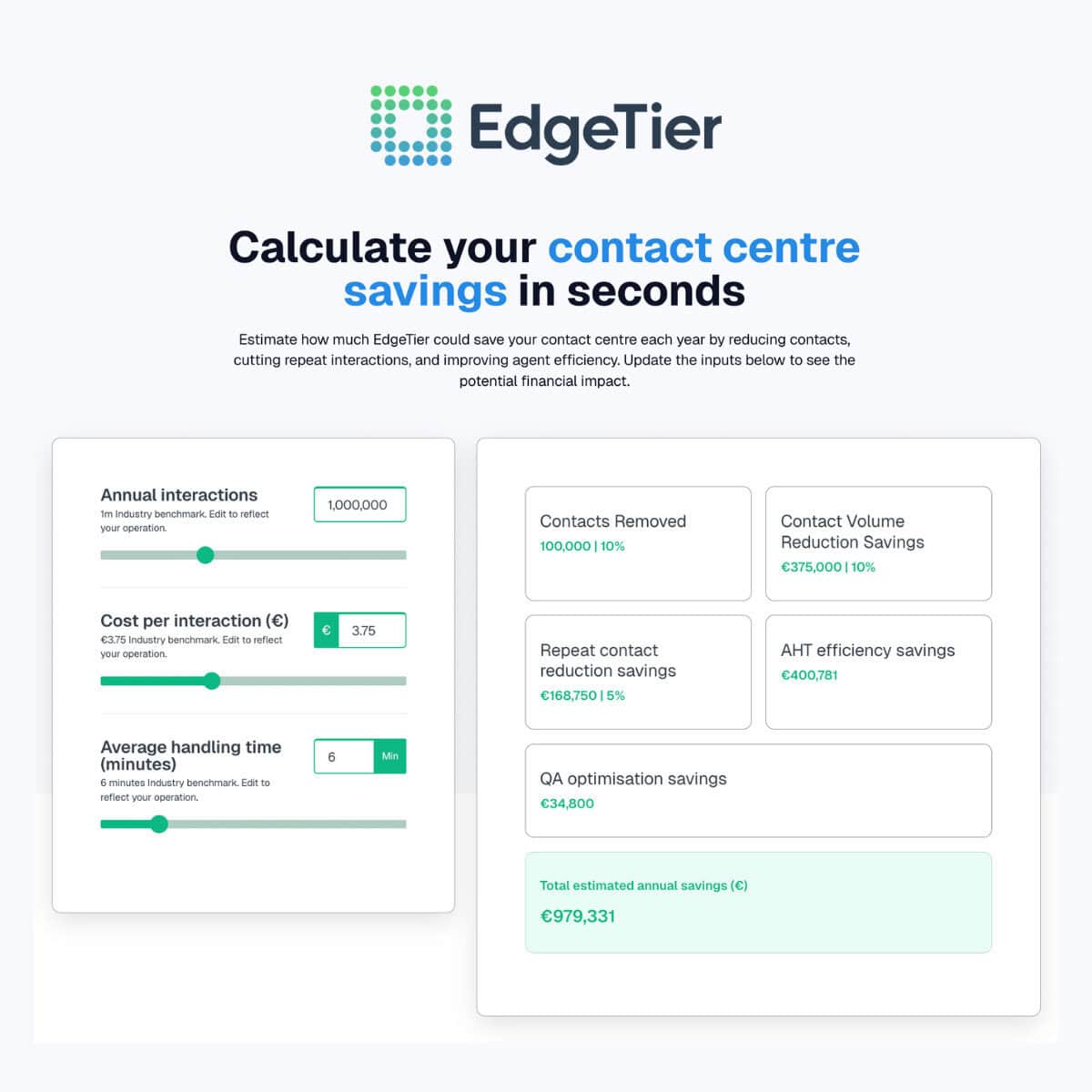
The cost levers covered in this article (contact volume, repeat interactions, handle time, QA efficiency) are exactly what EdgeTier’s ROI calculator is built around.
In a few inputs, it estimates your potential annual savings across four areas: overall contact volume reduction, fewer repeat contacts through improved FCR, reduced average handling time, and QA team optimisation as interaction volume falls. The assumptions are transparent and the results are directional, designed to give you a realistic starting point for the business case conversation, not an inflated number that falls apart under scrutiny.
→ Calculate your potential contact centre savings with EdgeTier’s ROI calculator
The most significant cost shift speech analytics enables isn’t any single efficiency gain. It’s the ability to connect contact centre insight to the wider business, getting product, operations, policy, and leadership teams to see the cost implications of their decisions in near real time, rather than finding out months later through rising complaint volumes or declining CSAT.
When the contact centre becomes a genuine source of operational intelligence (not just a function absorbing demand!) cost reduction stops being a reactive exercise and becomes a continuous capability.
EdgeTier’s Explore is built for exactly this: unifying conversation data across channels, quantifying the size and impact of every issue, and making it easy to share that insight with the teams who can act on it, from support to product, compliance, and leadership.
→ Back to the full guide: What Is Speech Analytics in the Contact Centre?
EdgeTier turns your customer conversations into a single connected system: it catches anomalies before they escalate, scores every agent interaction
AutoQA lets you review every customer conversation instead of a small sample. Coverage is only part of the story, though.
Most Ask Spotlight conversations run to about two messages. The longest one we found ran to forty-eight. Both can be


Deborah Guivisdalsky
COO
"We now have highly detailed understanding of agent performance, not just on key agent metrics, but also on how customers react to our agents and the emotions of our customers feel when talking to our team."


James Waghorn
Director of Customer Contact
"EdgeTier is no ordinary software product... It has completely changed how we work at CarTrawler."


Afroditi Pina
Director of Customer Service
"It has reduced the time for the quality assurance process as it provides clear data and a very robust direction on where to look and what matters the most."



Let us help your company go from reactive to proactive customer support.
Unlock AI Insights