

Table of contents

Definition
Speech analytics is the process of automatically analysing recorded customer conversations to extract actionable insights, capturing what was said, understanding intent and sentiment, and identifying patterns that improve contact centre quality, compliance, and customer experience.
For contact centres, this means every conversation becomes structured data rather than disappearing when the call ends.
Speech analytics allows teams to quantify trends in customer complaints, benchmark agent performance against best practices, and surface emerging business issues, such as product defects or process failures, that would otherwise have remained invisible.
How speech analytics works in contact centres
At a practical level, speech analytics turns unstructured customer conversations into structured insight that teams can act on.
While speech analytics originated with recorded phone calls, modern platforms extend this approach beyond voice alone. Today, the same analytical techniques are applied across text-based interactions such as chat transcripts, email threads, SMS messages, customer surveys, and even social conversations, creating a complete view of customer intent and experience across channels.
The underlying technology can vary by platform, but most contact centre speech analytics have a general flow to proceedings.
1) Capturing and preparing customer conversations
Customer conversations are captured through telephony, CCaaS, and digital support platforms. For voice interactions, calls are recorded and prepared for analysis, reducing background noise, separating agent and customer speech where possible, and handling accents, overlap, and call-quality issues.
For digital channels, text-based conversations are ingested directly, preserving context such as message order, response timing, and conversation history.
2) Converting speech into text
Voice interactions are transcribed using automatic speech recognition (ASR), creating a searchable text record of each customer call. Transcription accuracy is critical: topics, sentiment, compliance checks, and root-cause analysis all depend on reliably capturing what was actually said, not just isolated keywords where context can be lost.
Text-based interactions, such as chat, email, and surveys, skip this step but are processed using the same downstream analysis techniques.
3) Identifying meaning, intent, and signals
Once conversations are available in text form, speech analytics applies natural language processing (NLP) to understand what’s happening within and across interactions. This typically includes detecting:
- Topics and themes (e.g. delivery delays, pricing confusion, cancellation requests)
- Customer intent and outcomes (why the customer contacted support and what happened next)
- Sentiment and emotional signals (frustration building, reassurance working, dissatisfaction persisting)
- Critical moments (escalations, competitor mentions, churn-risk language)
Traditional tools often rely heavily on keyword spotting and static rules. More advanced platforms combine rules, for must-catch items like compliance, with machine learning models that can identify, in real-time, emerging patterns teams didn’t explicitly configure.
This is where speech analytics shifts from reporting what already happened to revealing what’s changing.
4) Evaluating quality and compliance at scale
Speech analytics allows contact centres to assess and QA 100% of conversations instead of manually reviewing small samples. Every interaction, voice or text, can be evaluated against defined standards, such as:
- Required disclosures and regulated language
- Identity verification steps
- Agent behaviours (empathy, interruptions, talk-to-listen balance)
- Risk events (complaints, threats to cancel, sensitive data sharing)
This removes sampling bias and gives teams a more accurate, consistent view of agent performance and compliance risk.
5) Turning insight into action
The final (and most important) step is operationalising the insight gleaned. Speech analytics outputs typically surface through dashboards, alerts, scorecards, and searchable conversation libraries, for example:
- A spike in billing complaints this week
- A new product issue emerging across multiple channels
- Missed disclosures detected yesterday
- High churn-risk language triggering retention workflows
The difference between interesting data and actual business impact is whether these signals connect to real workflows, like coaching, compliance reviews, product feedback loops, and operational fixes.
Modern speech analytics delivers the most value when it helps teams act early, and not just explain issues after the fact.
Where speech analytics is used in contact centres
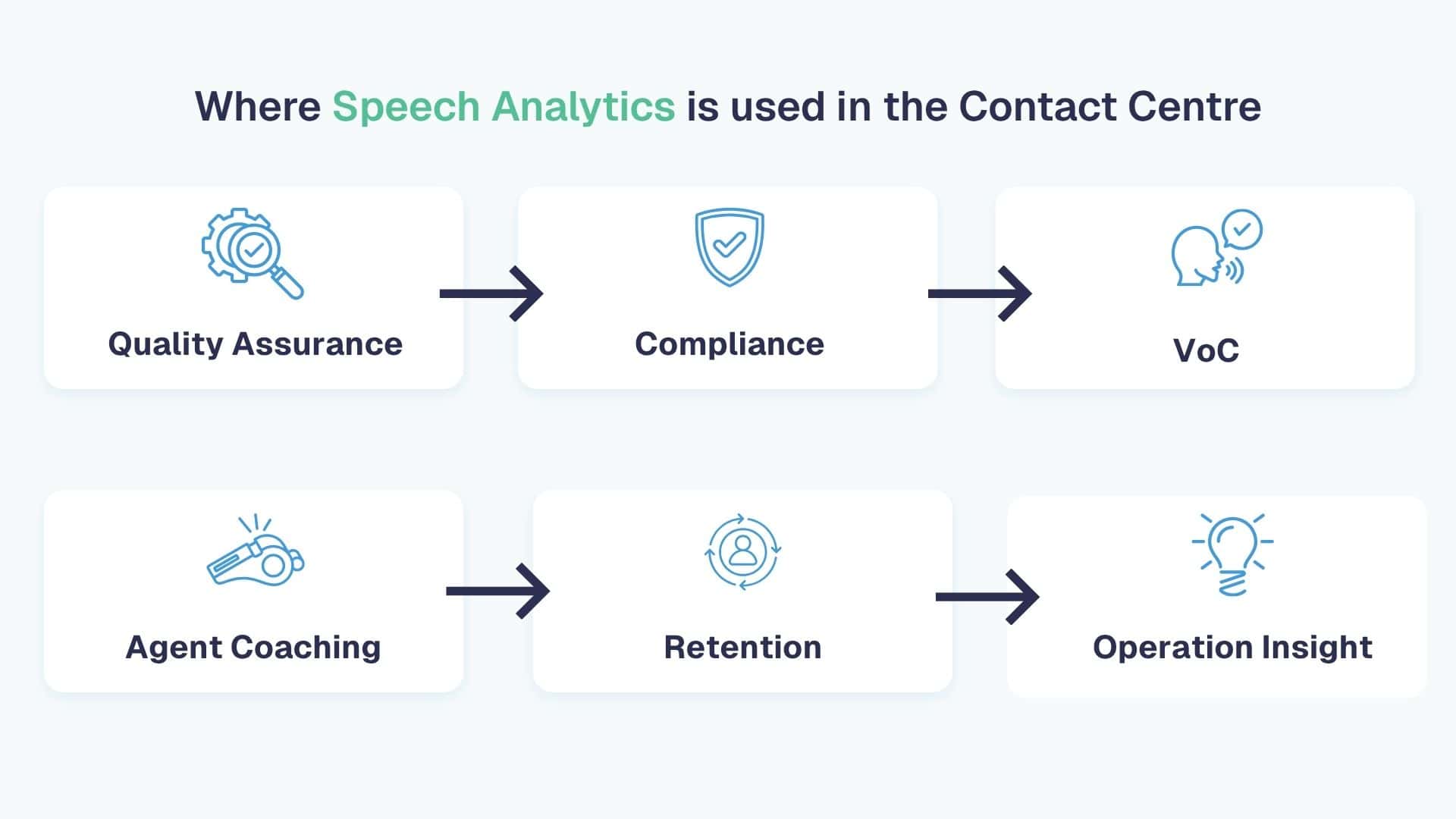
Speech analytics sits across multiple contact centre functions, but its value comes from one core shift: moving teams from sampled opinions to evidence-based decisions drawn from every customer conversation. Below are the main areas where it’s used, and where organisations typically see impact first.
Quality assurance (QA)
Traditionally, QA teams review a small sample of calls and extrapolate from there. Speech analytics changes that model entirely. By analysing 100% of conversations across voice and digital channels, teams can:
- Measure agent performance consistently, not selectively
- Identify coaching opportunities based on real behaviour patterns
- Spot systemic issues that individual scorecards and samples miss
Instead of asking “Was this one call good or bad?”, QA leaders can answer higher-impact questions like which behaviours actually drive better outcomes at scale.
Compliance and risk management
In regulated environments, missing a required phrase or process step can be costly. Speech analytic software supports continuous monitoring by automatically checking conversations for:
- Mandatory disclosures and regulated language
- Identity verification steps
- Data protection and consent handling
- Early indicators of complaints or regulatory risk
This allows compliance teams to move from reactive audits to proactive risk detection, often identifying issues early, before they escalate into formal complaints or fines.
Voice of the Customer (VoC)
Customer surveys capture what customers say after an interaction. Speech analytics captures what they say during it, often more candidly and with far more context. Used as a VoC input, speech analytics can reveal:
- Why customers are really contacting support
- Which issues drive repeat contacts across channels
- Emerging product or policy problems before they appear in NPS or CSAT
- The language customers use to describe friction, confusion, or value
This turns the contact centre into a real-time source of customer insight for product, CX, and operations, not just a service function.
Agent coaching and performance improvement
Because speech analytics surfaces patterns across large volumes of interactions, it enables more focused and fair coaching. Common use cases include:
- Identifying high-performing behaviours to replicate
- Detecting early signs of stress, frustration, or disengagement
- Tailoring coaching to individual agents based on real interaction data
- Reducing subjective feedback and bias
The result is coaching that’s grounded in evidence, easier to act on, and more likely to improve performance over time.
Churn prevention and retention
Customers often signal dissatisfaction long before they cancel, through tone, phrasing, or repeated issues. Speech analytics helps surface those signals at scale.
Contact centres use it to:
- Detect churn-risk language in live or recent interactions
- Route at-risk customers to retention workflows
- Understand which issues most often precede cancellations
This shifts retention from a last-ditch save to an early-intervention strategy.
Operational insight and cost reduction
Finally, speech analytics provides visibility into inefficiencies that drive cost, such as:
- Avoidable contacts caused by unclear processes or broken journeys
- Call drivers that shouldn’t require assisted support
- Policy or product confusion creating repeat interactions
By tying conversation data to volumes, trends, and outcomes, leaders can prioritise fixes that reduce contact demand, improve resolution, and prevent small issues from becoming systemic problems.
Why speech analytics matters in the contact centre
Speech analytics matters because contact centres sit at the intersection of cost, risk, and customer experience, and customer conversations are where those pressures surface first.
When those conversations go unanalysed, organisations are forced to rely on partial data, assumptions, or lagging indicators to make decisions. Speech analytics changes that by turning everyday interactions into a continuous source of operational intelligence.
From lagging metrics to early signals
Most contact centre metrics (CSAT, NPS, churn) tell you what already happened. By the time they move, the underlying issue is often weeks old.
Speech analytics surfaces problems as they emerge, directly from customer conversations. Rising frustration, repeated complaints, or new points of confusion can be detected early, long before volumes spike, scores drop, or issues escalate. This allows teams to act sooner, when fixes are smaller, cheaper, and less disruptive.
From sampled opinion to full evidence
Traditional QA and compliance processes rely on small samples and subjective judgement. Important patterns are easy to miss, and decisions are often debated rather than proven. By analysing 100% of interactions, speech analytics replaces extrapolation with evidence. Teams can see which behaviours, processes, and issues consistently affect outcomes, across agents, queues, regions, and channels.
That shift enables more objective decisions about coaching, policy changes, and investment priorities.
From reactive firefighting to prevention
Risk and cost rarely appear as single failures. They build through repeated friction: unclear policies, broken journeys, missed steps, and unresolved customer effort.
Speech analytics makes those drivers visible and quantifiable. Instead of responding after complaints rise or audits fail, teams can identify and address issues while they’re still contained.
This reduces avoidable contact, lowers compliance exposure, and prevents small problems from becoming systemic ones.
From a cost centre to a listening post
Finally, speech analytics matters because it connects the contact centre to the wider organisation.
When conversation insight flows beyond the contact centre:
- Product teams see real-world defects and usability gaps
- Policy owners understand unintended consequences
- Training teams identify actual skill gaps
- Leaders get evidence to support change
The contact centre becomes a real-time feedback loop for the business, not just a function that absorbs demand.

Call Centre Speech Analytics: Use Cases & Benefits
Call centre speech analytics is most valuable when it’s applied to the problems contact centres feel every day: inconsistent quality, rising contact volume, compliance risk, and customer frustration that shows up too late in surveys.
Teams typically see impact first in a small number of high-value use cases:
- Quality assurance at scale: replacing sampled call reviews with objective analysis across 100% of interactions
- Compliance monitoring: detecting missing disclosures, risky language, and process gaps early, not weeks later
- Repeat contact reduction: uncovering the true drivers behind avoidable calls and unresolved issues
- Churn prevention: surfacing dissatisfaction signals in language and sentiment before customers cancel
- Voice of the Customer insight: capturing unfiltered feedback directly from real conversations, not just surveys
The benefits compound quickly: lower cost to serve, reduced risk exposure, more effective coaching, and earlier visibility into issues that impact CX and retention.
→ Read the full breakdown of call centre speech analytics use cases and benefits
Speech Analytics Software: What to Look For
When you really dig into it, choosing speech analytics software isn’t just about transcribing calls or generating dashboards. The real difference between tools shows up in how quickly teams can spot emerging issues, trust the insights, and turn them into action across QA, compliance, CX, and operations.
Here is your go-to checklist for when you’re evaluating speech analytics software. Look for capabilities such as:
- Coverage across 100% of conversations (not sampling), including voice and digital channels
- Accurate analysis at scale, with reliable transcription and multilingual support
- Theme detection and trend tracking that surfaces what’s changing now, not weeks later
- Clear quantification of impact, so teams can prioritise what to fix based on business outcomes
- Workflows and sharing, so insight reaches the right teams without the ever-annoying dashboard digging
The best platforms (like EdgeTier!) don’t just explain what happened, they help teams act way before issues escalate.
→ Read the full guide: Speech Analytics Software – What to Look For
Voice Analytics: Explained
Call centre voice analytics helps contact centres understand what’s happening inside customer calls, without listening to them one by one. By analysing voice conversations at scale, teams can see common issues, shifts in sentiment, and patterns in agent and customer behaviour that would otherwise go unnoticed.
For teams early in their research, voice analytics is often the first step toward better quality, compliance, and customer experience. It shows where customers struggle, where agents need support, and where processes break down, using real conversations rather than assumptions or small samples.
This article explains call centre voice analytics in plain English: what it is, how it works, how it’s different from speech analytics, and when it’s the right place to start.
→ Read the plain-English guide to call centre voice analytics
Speech Analytics vs Conversation Analytics
If you’ve been researching contact centre analytics tools, you’ve probably noticed that some vendors call their product “speech analytics” and others call it “conversation analytics.” The terms are used interchangeably but they’re not the same thing, and the distinction matters.
Speech analytics analyses spoken conversations, primarily recorded calls. Conversation analytics applies the same intelligence across every channel a customer uses: voice, chat, email, messaging, and surveys. One is channel-specific. The other is channel-agnostic.
For contact centres handling meaningful digital volume (which is most of them) the difference has real implications for:
- What you can see: call-level insight vs a unified view across all contact channels
- Where gaps appear: compliance and QA blind spots in digital interactions
- What questions you can answer: per-channel reporting vs full customer journey visibility
The terminology in this space is genuinely messy, and what a tool is called doesn’t always reflect what it actually covers. Understanding the distinction helps you ask the right questions when evaluating platforms and make sure you’re not solving for voice alone when your customers are reaching you everywhere.
→ Read the full breakdown: Speech Analytics vs Conversation Analytics — What’s the Difference?
How Speech Analytics Improves Quality Assurance
Traditional contact centre QA has a structural problem: there’s far more happening than any team can manually review. Most organisations are scoring somewhere between 1% and 5% of interactions, which means the other 95% is invisible. Issues build, patterns go undetected, and feedback arrives too late to change much.
Speech analytics fixes the model by giving QA teams complete coverage rather than a sample. Every conversation is automatically assessed against your quality criteria, consistently, at scale, across every agent and channel. That changes what QA can actually deliver:
- 100% interaction coverage: no blind spots, no lucky or unlucky agents, no issues hiding in the unreviewed majority
- Consistent, objective scoring: the same criteria applied to every interaction, removing the subjectivity that makes feedback hard to trust
- Earlier issue detection: problems surface as they emerge, not weeks later when scores have already dropped
- Fairer coaching: feedback grounded in patterns across all interactions, not impressions from a handful of sampled calls
- Compliance monitoring without gaps: every interaction checked for required language and process steps, not just the 3% someone got to
The result is a QA function that spends less time on manual scoring and more time on the coaching, calibration, and operational fixes that actually move performance.
→ Read the full guide: How Speech Analytics Improves Quality Assurance
How Speech Analytics Reduces Contact Centre Costs
Running a contact centre is expensive, and costs are moving in the wrong direction. The average cost of an inbound call hit a five-year high in 2024, and most cost-reduction efforts focus on headcount or self-service without addressing the underlying reasons contact is happening at all.
Speech analytics takes a more surgical approach: surfacing what’s actually driving cost inside customer conversations, so teams can make targeted improvements that reduce demand rather than just manage it. The impact shows up across four areas:
- Avoidable contact reduction: identifying the process gaps, policy failures, and broken digital journeys that keep generating unnecessary calls
- Repeat contact reduction: understanding why customers are calling back — and fixing the root cause, not just logging the metric
- Handle time improvement: pinpointing what’s making interactions longer than they need to be, without compromising resolution quality
- Compliance cost avoidance: catching missed disclosures and process gaps before they become regulatory or complaints exposure
The savings compound quickly. Fewer contacts means lower volume. Better FCR means less repeat demand. Shorter handle times mean more efficient operations. And compliance monitoring at scale means fewer costly failures slipping through.
If you want to put numbers to it, EdgeTier’s ROI calculator estimates your potential annual savings across contact volume, repeat interactions, handling time, and QA efficiency, based on your own contact centre inputs.
→ Read the full breakdown: How Speech Analytics Reduces Contact Centre Costs
Speech Analytics Reporting: Metrics That Matter
There’s no shortage of data in a modern contact centre. Handle time, service levels, FCR, CSAT, repeat contact rates; the dashboards are full. Reports go out every week. Numbers get reviewed. And yet a lot of contact centre leaders will tell you, honestly, that they still don’t really know why performance looks the way it does.
That’s the gap speech analytics reporting is designed to fill. Not by replacing the metrics teams already track, but by connecting them to what’s actually happening inside customer conversations, the layer of intelligence that traditional reporting has never been able to reach.
Nearly half of contact centres aren’t tracking customer emotion at all and they’re missing one of the clearest early indicators of dissatisfaction, escalation risk, and churn intent. But sentiment is just the start. Speech analytics reporting surfaces contact driver analysis drawn from real conversation language rather than agent wrap-up codes, emerging topic trends before they appear in CSAT or NPS, agent behaviour and compliance data across every interaction rather than a sample, and risk signals detected in near real time rather than next week’s report.
The result is reporting that both describes performance and explains it, allowing insight to reach the product, operations, compliance, and leadership teams who need it most.
→ Read the full guide: Speech Analytics Reporting — Metrics That Matter
Conclusion
Speech analytics gives contact centres something most reporting tools have never been able to offer: a complete, evidence-based view of what’s actually happening inside customer conversations, across every agent, channel, and interaction.
The contact centres getting the most from it are using it to catch problems earlier, coach more fairly, reduce avoidable contact, and give the wider business the customer insight it’s always needed but could never reliably access. Every conversation your team handles contains signal. The question is whether you’re capturing it.
See how EdgeTier turns your contact centre conversations into early warning signals, before issues reach your dashboards. [See it Live.]