
Overheard at EdgeTier
Most of what we hear on customer calls is useful. Some of it is just lovely. We've rounded up the
It’s 9:12am on a Monday. Your status page is green, but the queue is telling a VERY different story. Customers aren’t saying the usual “app is down”, they’re quoting something different, something new back at your agents, word for word: “Stuck on Verifying….” “It keeps looping me back to the login screen.” “I’m getting ‘Error…

It’s 9:12am on a Monday. Your status page is green, but the queue is telling a VERY different story.
Customers aren’t saying the usual “app is down”, they’re quoting something different, something new back at your agents, word for word: “Stuck on Verifying….” “It keeps looping me back to the login screen.” “I’m getting ‘Error 7F3A’ after the update.” One person mentions it started “right after my phone updated overnight.” Another says their partner can get in fine. Suddenly, you’re not dealing with a tidy, pre-labelled problem, you’re chasing a pattern.
In moments like these, the contact centre becomes the organisation’s most reliable sensor. Not social media. Not dashboards. The clearest signal is the one customers create in real time: the phrases they repeat when they’re stuck, anxious, and trying to get back to normal.
But if you weren’t already tracking that exact wording – that login loop, that “Verifying…” screen, that specific error line – your richest source of truth turns into a needle‑in‑a‑haystack problem. You can listen to calls, sample tickets, and build a story from fragments once you organically realise that something is happening. Or you can turn last week’s conversations into structured insight fast, by applying phrase tags retroactively and letting the data show you when it started, how big it got, and who it hit.
Most contact teams have a tagging taxonomy: i.e., reasons for contact, product areas, policy questions, sentiment signals. It’s essentially how you move from “We had a busy day” to “Billing contacts spiked after the invoice change.”
But major events don’t follow your taxonomy, instead, they arrive unannounced. Think things like a third‑party outage breaking login, a promotion going viral and fulfilment slipping, a pricing update triggering confusion about fees. In the first hours you’re trying to reduce handling time, protect quality, and communicate clearly, while also answering:
If you can’t quickly find and quantify the conversations tied to the event, decisions get made on partial information. And the stakes are high: PwC found that 32% of customers would stop doing business with a brand they loved after just one bad experience. Microsoft’s Global State of Customer Service report found 90% of consumers say customer service is important to their choice of (and loyalty to) a brand.
Phrase tags work because they mirror how customers actually speak. Instead of relying on a perfect wrap‑up code (in the middle of a stressful interaction), you can detect intent from the customer’s own language: “can’t log in,” “card declined,” “delivery delayed,” “cancel my subscription.”
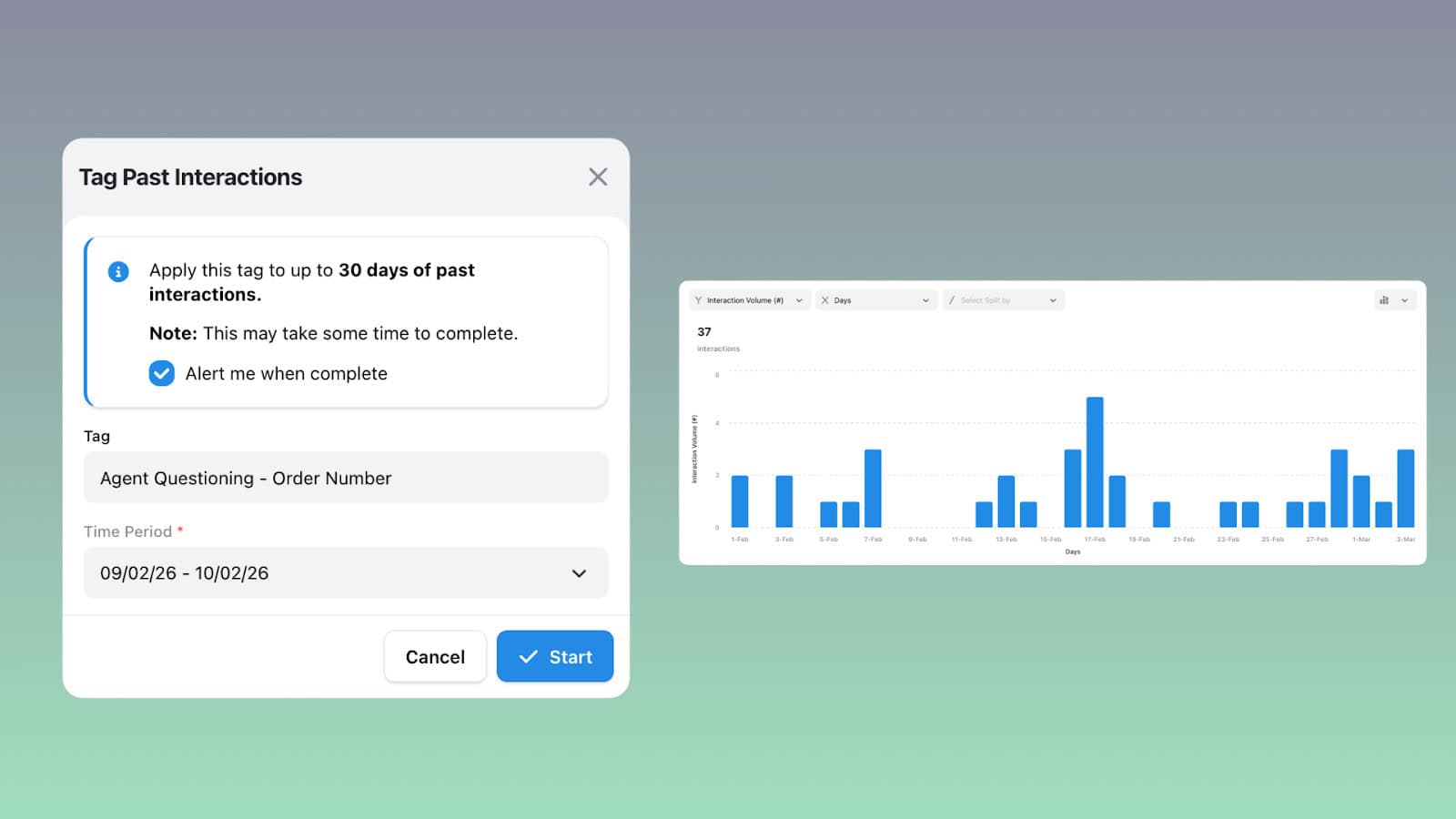
The real unlock is being able to take a phrase tag you create or refine today and apply it to conversations that already happened. That turns tagging into an investigation tool.
In practice, the workflow is simple: define the trigger phrases (including variants and common wording), choose a recent time window (usually the last 7, 14, or up to 30 days), and run the process in the background. When it’s complete, you can trend and slice instantly: how many interactions included the phrase, when it began, whether it’s rising or fading, and where it’s concentrated.
Instead of “We think the issue started on Friday,” you can say, “We saw early mentions Thursday afternoon, the peak Saturday morning, and the remaining volume is concentrated in mobile customers.”
When something breaks, your first goal (naturally!) is resolution. Your second, however, should be learning: how many customers felt the impact, and what exactly did they experience? Retroactive phrase tagging lets you build a clean incident cohort even if the tag didn’t exist at the moment the event began. That means you can quantify volume, identify the most common sub‑issues, and track recovery with real customer language, not assumptions.
It’s also important to remember that phrase tagging is never perfect on the first attempt. Customers misspell, abbreviate, and use local slang. If a tag is too tight, you miss signals. Too loose, and you drown in false positives. By adjusting trigger wording and re-running it across historical conversations, you can validate improvements on a meaningful sample size, before you rely on the tag for reporting, escalations, or alerts.
A lot of problems have a soft launch, like scattered mentions before the true avalanche. Once you know the telltale phrases (“stuck on verifying”,“Error 7F3A”, etc.), backfilling lets you look backwards and pinpoint when the first whispers started. That changes your post‑mortem; instead of having a vague gut feeling about when an incident may have started, you can show certainty and detail – and make it easier to build proactive monitoring for the future.
When a major event rocks your contact centre, speed matters. But so does clarity. With the ability to apply phrase tags to past interactions in EdgeTier, you get both: the confidence to communicate what’s happening now, and the evidence to understand the full story afterwards, using the conversations you already have.
Learn more about EdgeTier’s Tag Past Interactions feature.
Most of what we hear on customer calls is useful. Some of it is just lovely. We've rounded up the
From self-serve Sonar anomaly models to a smarter, shareable Ask Spotlight and a fully transparent QA dispute process, here's everything
EdgeTier turns your customer conversations into a single connected system: it catches anomalies before they escalate, scores every agent interaction


Nick Brazitis
Global Customer Care Manager
"The anomaly feature is a game changer for us. It’s highly accurate and has helped us identify customer issues, agent errors, and even fraud that would have taken us longer to catch."


Deborah Guivisdalsky
COO
"We now have highly detailed understanding of agent performance, not just on key agent metrics, but also on how customers react to our agents and the emotions of our customers feel when talking to our team."


Vladimir Greavu
BBG Director of Customer Service
"I specifically liked the flexibility. I liked the can-do attitude. I always felt supported. There hasn’t been any single point in our journey where EdgeTier has said no."



Let us help your company go from reactive to proactive customer support.
Unlock AI Insights