
Table of contents

Contact center quality assurance turns customer conversations into a measurable, coachable standard. This guide covers what QA actually involves, how teams run it day to day, where it typically breaks down, and how AI is changing what “full coverage” means.
Definition
Contact center quality assurance (QA) is the ongoing process of evaluating customer interactions (calls, chats, and emails) against a defined standard, then using that evaluation to coach agents, close performance gaps, and keep service consistent. It’s usually run by a dedicated QA team or team leaders, using scorecards to score conversations against criteria like accuracy, empathy, tone, and process or compliance adherence.
Traditionally, quality assurance has meant a supervisor listening back to a handful of recorded calls each month, scoring them against a form, and delivering feedback in a 1:1. The scary reality is that this process still exists in most contact centers today. What’s changed, however, is the volume QA needs to cover. As conversation volumes grow and channels multiply, a small manual sample can no longer represent what’s actually happening across a team. That gap is why quality assurance is increasingly discussed alongside automation, and why terms like quality monitoring, agent monitoring, and quality management now get used almost interchangeably with QA, even though they mean slightly different things (more on that below).
Done well, contact center QA is the mechanism that turns “we think our service is good” into “we know exactly where it isn’t, and we’re fixing it.“
Why Contact Center Quality Assurance Matters
Quality assurance sits at the intersection of three things contact center leaders are judged on:
- Customer experience,
- Compliance, and
- Agent performance.
Get it right, and all three improve together. Leave it running on a thin manual sample, and problems compound quietly for months before they show up in CSAT, churn, or a regulatory audit.
The scale of the coverage problem is bigger than most teams assume. According to Verint’s research into contact center quality monitoring, traditional manual QA typically evaluates somewhere between 1% and 5% of interactions, meaning the overwhelming majority of conversations are never scored, coached against, or checked for compliance at all. For a team handling a few thousand conversations a week, that’s a QA programme built entirely on a handful of calls a month per agent.
That gap matters because customers rarely give a second chance. Verint’s 2026 State of CX research found that 79% of customers will switch to a competitor after just one bad experience, which means the interactions QA never sees are exactly the ones with the highest chance of quietly costing you a customer. A quality programme that only reviews 2–3% of conversations is, statistically, blind to almost everything that could be going wrong.
This is also why AI is moving into QA workflows so quickly. In a 2026 survey of customer service leaders, Gartner found that 91% report pressure from their own leadership to implement AI in 2026, and quality assurance, being one of the most manual, sample-based processes left in most contact centers, is a natural place to start.
How Contact Center Quality Assurance Works
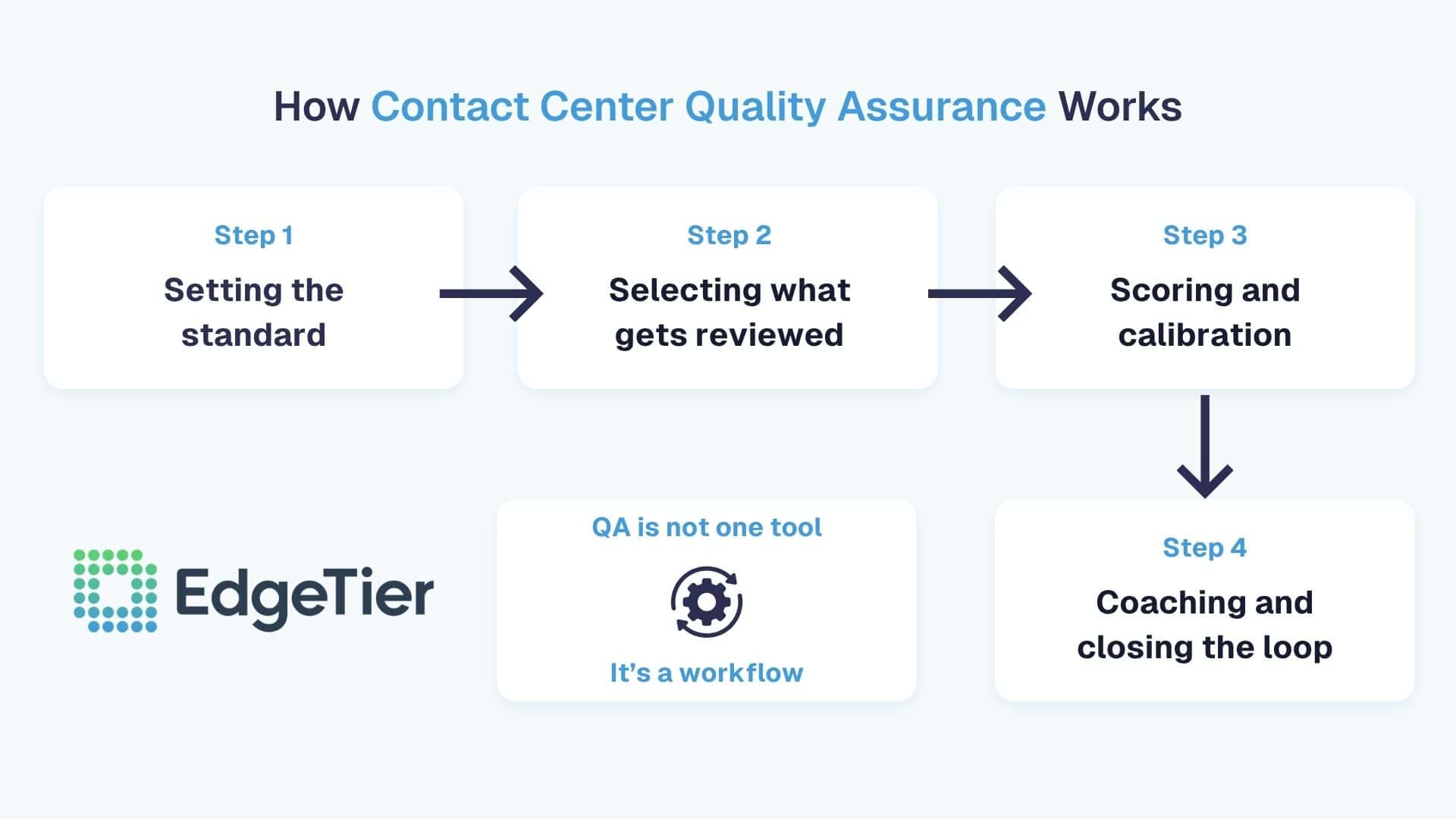
QA isn’t a single tool, but a workflow that turns a standard into a score, and a score into a changed behaviour. In practice, it comes down to four moving parts.
1. Setting the standard
Every QA programme starts with a scorecard: a defined set of criteria, for example: process adherence, tone, empathy, accuracy, and compliance language, against which conversations get scored. Some criteria are binary (was the required disclosure given, yes or no); others are more subjective (did the agent show empathy). Good scorecards are specific enough to score consistently, but not so rigid that they penalise good judgement.
We cover what these actually look like in practice in Quality Monitoring Scorecards for Contact Centers.
2. Selecting what gets reviewed
Next is deciding which conversations actually get looked at. Most teams use some mix of random sampling (a baseline cross-section of interactions) and targeted sampling (new agents, flagged conversations, complaints, low-CSAT interactions). The day-to-day mechanics of this (and where coverage gaps typically show up) are covered in more depth in our dedicated article: Call Center Quality Monitoring: How It Works in Practice.
3. Scoring and calibration
A reviewer scores the conversation against the scorecard. Because scoring involves judgement, different reviewers can drift toward different standards over time; one team leader scoring generously, another strictly, for the same behaviour. Calibration sessions, where reviewers score the same sample conversations together and reconcile differences, are how QA programmes keep scoring consistent across a team.
4. Coaching and closing the loop
The score itself isn’t really the point, it’s what happens next. Feedback goes back to the agent, ideally with the reasoning behind it, not just a number. The best QA programmes make this a two-way process: agents can see their own scores and trends over time, and increasingly, can respond to or dispute a review they disagree with, rather than QA operating as a one-way judgement.
This is also where automation is changing the workflow most. Instead of a QA analyst manually completing a scorecard for every reviewed conversation, AI can complete a first-pass score automatically, across every conversation, not just a sample, leaving QA teams to focus on coaching and pattern-spotting rather than admin. That shift is covered in more depth in our piece Automated Quality Management in Contact Centers.
What Contact Center QA Looks Like in Practice
The theory is straightforward. The difference shows up in how fast a problem gets caught.
- A new agent joins the team and starts handling live conversations.
- Under a manual sampling process, a supervisor might realistically review two or three of that agent’s calls in their first month.
- Under an AI-assisted process, every one of that agent’s conversations is scored automatically against the same scorecard, from day one.
- A pattern shows up immediately – say, the agent is consistently skipping a compliance disclosure, or struggling with a specific product query.
- Coaching happens in week one, not week four, when the habit is still easy to correct.
- The agent’s next batch of conversations shows the change numerically, against the same standard, not just anecdotally.
The same logic scales up across a team. If every agent scores low on the same scorecard question, that’s rarely an individual coaching issue, it’s usually a process, training, or policy gap. Full-coverage QA is what makes that distinction visible in the first place; a 2% sample usually can’t. This is the point where quality assurance starts to shade into quality management, how QA processes hold together as a contact center grows, covered in greater detail here: Contact Center Quality Management at Scale.
Contact Center QA Approaches and Methods
There’s no single “right” way to run QA. Most mature programmes combine several of the following, with the mix shifting toward automation as volume grows.
- Manual sampling and scorecards: The traditional approach where a reviewer selects a small number of recorded interactions and scores them by hand. Flexible and easy to start, but the coverage ceiling is low, realistically 1–5% of total volume for most teams.
- Call and screen recording review: Reviewers listen back to or watch recorded interactions, sometimes alongside CRM or screen activity, to assess not just what was said but how the interaction was handled operationally.
- Calibration sessions: Not a review method on its own, but a necessary companion to manual scoring; regular sessions where reviewers align on how they’re interpreting the scorecard, to stop scores drifting apart across a team.
- Customer surveys as an indirect signal: CSAT, NPS, and CES scores aren’t QA in themselves, but they’re a useful outcome signal that can point QA teams toward conversations worth a closer look. They tell you that something went wrong more often than why; for more on how these signals fit into a broader customer feedback picture, see What Is Voice of the Customer (VoC)?
- Agent monitoring software: Purpose-built platforms that track agent activity and performance metrics alongside QA scores, giving supervisors a single view of how an agent is performing rather than piecing it together from separate systems. Covered in Call Center Agent Monitoring Software Explained.
- Automated, AI-assisted QA: The most significant shift in the space: AI analyses a wider depth of conversations automatically scoring against the scorecard, flagging priority conversations for human review, and surfacing trends no manual process could realistically catch. Read Call Center Quality Assurance Software: What Teams Use to learn more about this.
Most contact centers already generate more than enough conversation data to run a rigorous QA programme. The limiting factor is almost never data but the reviewer hours needed to get through it.
Contact Center QA vs. Quality Monitoring vs. Quality Management
These terms get used loosely, often as synonyms, but the distinctions are worth being precise about, especially when you’re evaluating tools or processes.
- QA vs. quality monitoring. Monitoring is the act of observing and scoring individual interactions. Quality assurance is the broader discipline: setting the standard, running that monitoring, calibrating scorers, and turning scores into coaching. Monitoring is one part of QA, not a replacement for it.
- QA vs. quality control (QC). Quality control is reactive, catching an error after it’s happened, usually through spot-checks or escalation review. Quality assurance is proactive and continuous, defining what “good” looks like in advance and building the interactions, coaching, and processes that get agents there consistently.
- QA vs. quality management. Quality management is the operational layer above QA: how quality processes, tooling, scorecards, and standards stay consistent as a contact center grows across teams, sites, and languages. QA is what happens inside a single team; quality management is how that stays coherent across ten teams. See Contact Center Quality Management at Scale.
- QA vs. coaching. Coaching is the output of QA, not QA itself. A scorecard without a coaching conversation attached to it is just a number in a spreadsheet.
Common Challenges in Contact Center Quality Assurance
Most QA programmes start with good intentions and run into the same handful of problems.
- The coverage gap: A programme built on 2–5% of interactions is, by definition, blind to 95%+ of what’s actually happening. Compliance risk, poor experiences, and coaching opportunities accumulate in the interactions no one ever reviews.
- Calibration drift: Without regular calibration, reviewers slowly diverge in how strictly they score the same behaviour which makes agent-to-agent or team-to-team comparisons unreliable, and can feel unfair to agents being scored inconsistently.
- Feedback lag: By the time a scored conversation reaches an agent as coaching, the habit it was flagging may already be weeks old and well established. Fast feedback is far more correctable than delayed feedback.
- QA as an administrative bottleneck: Manually completing scorecards, running calibration, and writing up reports consumes the majority of a QA team’s time, leaving little left for the coaching that actually changes behaviour. Rising attrition makes this worse: industry benchmarks from QATC put annual contact center attrition at 30–45%, with each departure costing an estimated $10,000–$20,000 to replace and inconsistent coaching is a recurring, avoidable contributor to agents leaving early.
- Disconnected channels and tools: Voice QA, chat QA, and email QA are often run through separate tools or processes entirely, meaning no one has a single view of an agent’s full conversation quality across every channel they actually work in.
Related Contact Center QA Guides
Call Center Quality Assurance Software: What Teams Use
How teams actually evaluate QA software, the problems they’re trying to solve, and where spreadsheets or manual review processes fall down as volume grows.
→ Read the full guide: Call Center Quality Assurance Software: What Teams Use
Call Center Quality Monitoring: How It Works in Practice
How monitoring actually gets done day to day, sampling logic, coverage gaps, and the operational challenges teams run into running it manually.
→ Read the full guide: Call Center Quality Monitoring: How It Works in Practice
Quality Monitoring Scorecards for Contact Centers
What scorecards look like in practice, what teams actually choose to measure, and where scorecards fall short when used on their own.
→ Read the full guide: Quality Monitoring Scorecards for Contact Centers
Automated Quality Management in Contact Centers
What QA automation actually means in practice, what gets automated first, and why teams move away from fully manual QA as volumes grow.
→ Read the full guide: Automated Quality Management in Contact Centers
Contact Center QA and EdgeTier
EdgeTier’s Coach is built to close the coverage gap described throughout this guide.
Instead of scoring a small sample, Coach analyses 100% of chat, call, and email conversations automatically, using AI to complete scorecards, flag priority conversations for review, and surface performance trends across agents and teams in real time.
Teams using Coach have seen a 90%+ increase in QA coverage, a 16-point increase in CSAT scores, and QA reviews completed 2.5x faster than manual processes. Electric Ireland moved from anecdotal, delayed sampling to a complete, real-time view of agent interactions, resulting in a 21% increase in CSAT, a 37% reduction in emails, and a 19% improvement in first contact resolution.
Coach also keeps QA transparent and two-way: agents can view their own scores and trends, and can now formally respond to or dispute a review they disagree with, turning QA into a genuine feedback loop rather than a one-way scorecard. Because Coach runs on the same conversation data as Explore and Ask Spotlight, QA trends can also be cross-referenced against the wider drivers of customer contact, instead of being reviewed in isolation.
FAQs
What is contact center quality assurance?
Contact center quality assurance (QA) is the process of evaluating customer conversations — calls, chats, and emails — against a defined standard, then using that evaluation to coach agents and improve service consistency. It combines scorecards, review, and coaching into a continuous programme rather than a one-off check.
What’s the difference between quality assurance and quality monitoring?
Quality monitoring is the act of observing and scoring individual conversations. Quality assurance is the broader discipline that includes monitoring, but also covers setting standards, calibrating reviewers, and turning scores into coaching and process change.
What is a QA scorecard?
A QA scorecard is a defined set of criteria — such as process adherence, compliance language, tone, and empathy — used to score a customer interaction consistently. Scorecards give QA teams a repeatable standard to score against, rather than relying on individual reviewer judgement alone.
How many interactions should a contact center review for QA?
Manual QA processes typically review only 1–5% of total interactions, which most teams recognise as too small a sample to reliably represent overall quality. AI-assisted QA can score up to 100% of conversations automatically, which is increasingly the benchmark teams are moving toward rather than a larger manual sample.
What’s the difference between quality assurance and quality control?
Quality control is reactive — catching an issue after it has happened. Quality assurance is proactive and continuous — defining standards in advance and building the review and coaching processes that keep performance consistent, rather than just catching failures after the fact.
Can contact center QA be automated?
Yes. AI-assisted QA can analyse every conversation across voice, chat, and email, automatically completing scorecards and flagging priority conversations for human review. This doesn’t remove the need for a QA team — it changes their role from manually scoring a small sample to coaching and pattern-spotting across full coverage.
What does a QA analyst do day to day?
A QA analyst reviews and scores customer conversations against a scorecard, participates in calibration sessions to keep scoring consistent, delivers coaching feedback to agents, and identifies trends or process issues across a team. With AI-assisted QA, more of this time shifts toward coaching and analysis rather than manual scoring.
How does QA affect CSAT and agent retention?
Poor or inconsistent QA lets small problems go unnoticed until they show up in customer churn or compliance incidents — and inconsistent, delayed coaching is a recurring, avoidable driver of early agent attrition, which industry benchmarks put at 30–45% annually across the sector. Faster, more consistent feedback loops tend to improve both.