

Table of contents

Definition
Voice of the Customer (VoC) is the process of capturing and analysing what customers say, feel, and need, across every channel and touchpoint, to give organisations the insight they need to make better decisions, improve products, and reduce friction.
For contact centres, voice of the customer is less of a survey programme and more like a continuous feed of structured intelligence drawn from the conversations customers are already having: support calls, chat sessions, email threads, and social messages. Every time a customer contacts your team, they are telling you something. VoC is the discipline of making sure that information reaches the people who can act on it.
When done well, voice of the customer closes the gap between what organisations think their customers experience and what customers actually experience. It surfaces problems before they compound, identifies patterns that individual tickets can never reveal, and turns the contact centre from a cost function into a direct line to customer truth.
Why Voice of the Customer Matters in the Contact Centre
Most organisations have more customer feedback than they know what to do with. The problem is not (and never is!) volume, it is visibility.
CSAT scores tell you a customer was unhappy. They rarely tell you why. NPS tells you a customer won’t recommend you. It won’t tell you what changed. Tickets tell you what a customer asked for. They won’t tell you what the same question, repeated across 4,000 conversations this week, actually means for your product or your processes. According to Gartner, 60% of organizations will adopt analytics technologies to supplement traditional surveys by analysing voice and text interactions with customers in the next year.
Voice of the customer programmes exist to bridge that gap: turning fragmented, unstructured signals into patterns that matter.
Contact centres are where the gap is most costly. Agents handle the consequences of broken journeys, unclear policies, and product failures every day, at scale. Without a structured VoC approach, those insights stay inside individual tickets. They never reach the product team, the operations team, or the leadership team who could actually fix the root cause.
So as you can see, that is not a people problem but a visibility problem, and it is one that a properly structured VoC programme solves.
How Voice of the Customer Works
VoC is not a single tool or method. It is a set of inputs, analysis processes, and output channels that when viewed together give an organisation a reliable view of customer experience from the customer’s perspective.
1) Capturing feedback across channels
Effective VoC programmes draw from multiple sources, not just surveys. In a contact centre context, the richest signals come from the interactions customers are already having:
- Support calls and chat conversations
- Email and messaging threads
- Post-interaction surveys (CSAT, NPS, CES)
- Social and review channels
- Community forums and self-service feedback
The more channels included, the more complete the picture. Customers who never fill in a survey still tell you a great deal. VoC makes sure that signal is captured, not lost and with McKinsey predicting that contact volumes will increase by 20% over the next two years, this is more important than ever.
2) Structuring and analysing what customers say
Raw feedback, whether it comes from a call transcript, a survey response, or a chat thread, is unstructured. Contact centres deal with thousands of interactions daily. No manual review process can keep pace with that volume without introducing gaps, bias, or delay.
Modern VoC programmes use analytics to structure this data at scale: identifying contact reasons, detecting sentiment, tracking how themes shift over time, and surfacing the conversations that matter most. This is where voice of the customer moves from a reporting exercise to an operational intelligence function.
3) Distributing insight to the people who can act on it
The most common failure in VoC programmes is getting insight to the right people quickly enough for it to matter. Customer feedback about a payment failure that takes three weeks to reach the product team is not voice of the customer. It is history.
Effective VoC programmes build clear pathways: from conversation to insight, from insight to action, and from action back to measurement. Contact centres play a central role here because they sit closest to the customer, and the best VoC programmes make that proximity into a competitive advantage for the whole organisation.
What Voice of the Customer Looks Like in Practice
The theory is clear. The harder question is what VoC actually looks like when it is working inside a contact centre.
- A product issue surfaces before it reaches the queue.
- Your analytics flag a rising number of customers mentioning payment errors across chat and phone.
- The issue reaches your product team before it drives a volume spike, and before it reaches social media.
- A policy change reduces repeat contacts.
- VoC data shows that a large share of your repeat callers are confused about the same billing term.
- The copy changes.
- The contact volume drops.
Novibet saw this in practice with EdgeTier: after shifting from quarterly to monthly voice of the customer reporting, the team could connect specific conversation themes to specific operational outcomes.
Coaching also becomes evidence-based, not impressionistic. Instead of reviewing a handful of calls per agent per month, QA teams can use VoC data to understand which agent behaviours consistently correlate with better outcomes and coach to that.
Finally, leadership gets answers without digging for them and the contact centre stops being the place where insight goes to die! Instead, insight flows upward, automatically, in a format that makes sense to a COO or a product director, not just a contact centre analyst.
Learn more: How EdgeTier’s Agentic AI ‘Ask Spotlight’ is changing the game
Voice of the Customer Capture Methods
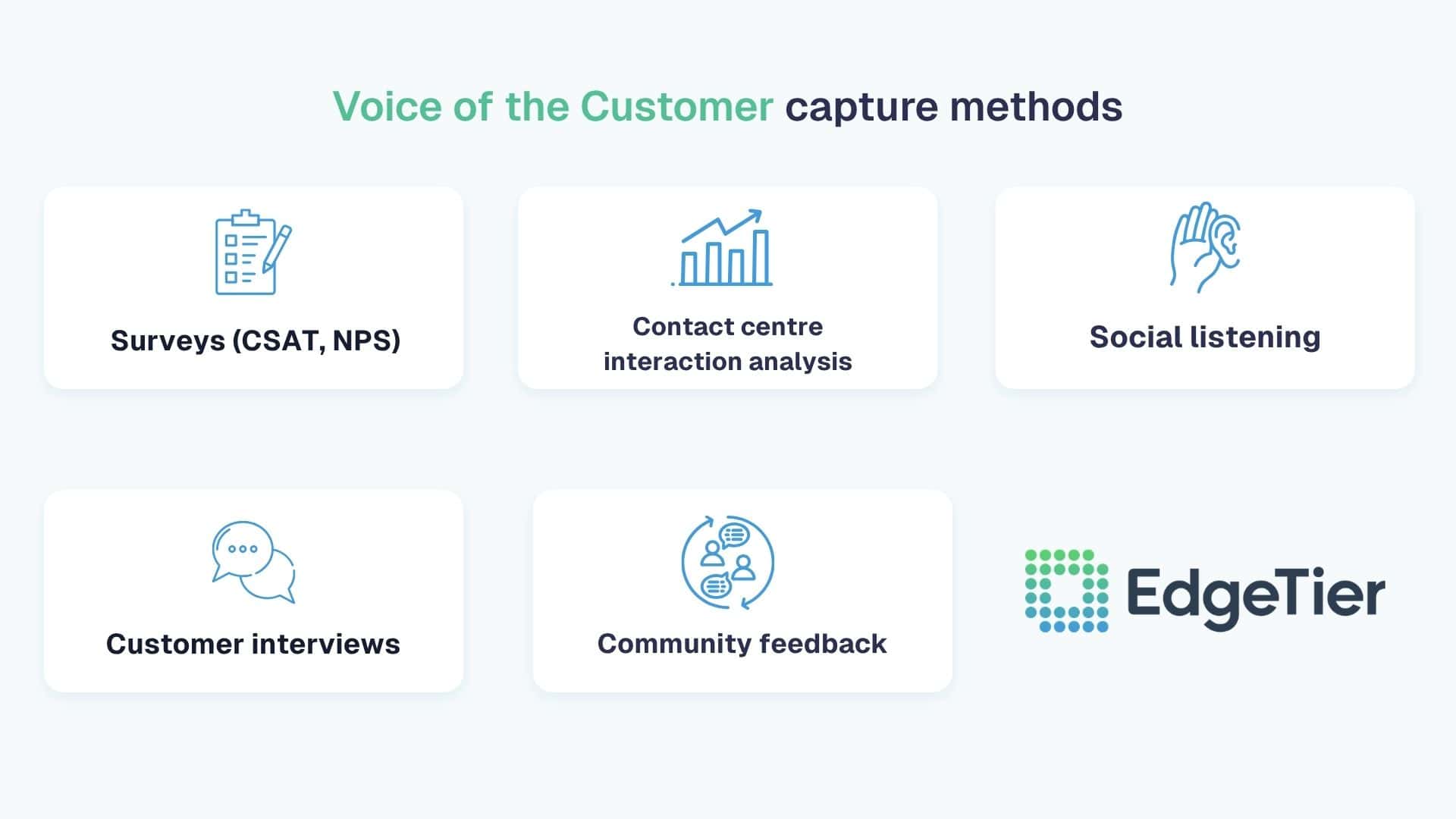
There is no single method for capturing voice of the customer. The most effective programmes combine direct and indirect feedback, quantitative and qualitative signals, and structured collection alongside always-on conversational data.
- Surveys (CSAT, NPS, CES): Direct, structured, and widely used but limited by response rates and by the fact that they capture what customers say after an interaction, not what they say during it. Useful for benchmarking; less useful for diagnosis.
- Contact centre interaction analysis: The highest-volume, highest-fidelity VoC input available to most organisations. Every call, chat, and email is a direct expression of what customers need, where they struggle, and how they feel. Analytics applied at scale across all interactions turns this into a continuous source of insight.
- Social listening: Captures unsolicited feedback from customers who choose to post publicly. Useful for detecting sentiment at scale and for catching issues customers are too frustrated to raise through official channels.
- Customer interviews and focus groups: Rich, qualitative, and contextual, but slow to run, expensive to scale, and subject to social desirability bias. Best used to go deep on themes that quantitative data has already surfaced.
- Online reviews and community feedback: Often overlooked, but can surface very specific product and service issues directly from customer language. Particularly useful for benchmarking against competitors.
Most contact centres are already sitting on the richest VoC data source available: their own conversations. The gap is usually not in capture but an inability to structure, analyse, and act on what is already there.
Voice of the Customer vs. Other Feedback Programmes
VoC is often confused with adjacent concepts. The distinctions matter when you are building a programme or evaluating where to invest.
- VoC vs. CSAT: CSAT measures satisfaction with a specific interaction. Voice of customer is broader; it draws on CSAT as one input among many, combining it with conversational data, behavioural signals, and trend analysis to give a fuller picture of customer experience.
- VoC vs. NPS: NPS measures customer loyalty and likelihood to recommend. It is useful for tracking direction over time. VoC tells you why the number is moving, which is the more operationally useful question.
- VoC vs. customer journey mapping: Journey mapping is a planning and design exercise that models the customer experience as it should work. VoC is real-time evidence of how it actually works. They are complementary, but VoC is more operationally immediate.
- VoC vs. customer analytics: Customer analytics covers a wide range of data like behavioural, transactional, and demographic. VoC is specifically focused on what customers say and feel, making it the most direct form of feedback. Combined with behavioural analytics, it gives a much more complete picture.
Common Challenges in Voice of the Customer Programmes
Most VoC programmes start with good intentions, but many of them stall at the same points.
Too much data, not enough structure as contact centres generate enormous volumes of feedback. Without a way to structure and prioritise it, VoC programmes become another dashboard nobody acts on.
Insight doesn’t travel when customer feedback stays in the contact centre. It never reaches the product team, the policy owners, or the leadership team who could address root causes so the loop doesn’t close.
Sampling instead of coverage. Traditional QA and feedback processes work from small samples. VoC programmes built on samples miss the patterns that only become visible at scale.
Lag between signal and action. By the time customer feedback reaches a decision-maker, it is often weeks old. The issue has already escalated and the fix arrives after the damage.
Disconnected tools are the final challenge. Survey data lives on one platform. Call recordings in another. Chat transcripts in a third. Without integration, VoC produces a fragmented picture, and fragmented pictures lead to fragmented decisions.
The contact centres that get VoC right solve for all five. They build programmes that capture broadly, analyse continuously, and distribute insight fast enough for teams to act before problems compound.

How to Build a Voice of the Customer Programme
Most VoC programmes are built backwards. Teams start with a survey tool, add an analytics layer later, and wonder why the insight never quite reaches the people who need it.
Building a VoC programme that works means starting with the question of what you need to know and who needs to act on it, then designing the capture, analysis, and distribution processes around that. This guide covers the steps that contact centre and CX leaders need to take to build a programme that produces insight at the speed their business needs it.
→ Read the full guide: How to Build a Voice of the Customer Programme
Voice of the Customer Analytics Explained
Collecting customer feedback is the easy part. Turning it into patterns your organisation can act on is harder.
VoC analytics is the set of methods and technologies that transforms raw customer feedback – across calls, chats, surveys, and emails – into structured intelligence. This article explains how it works, what to look for in an analytics approach, and why the difference between sampling and full coverage matters more than most organisations realise.
→ Read the full guide: Voice of the Customer Analytics Explained
Voice of the Customer Software: What to Look For
The VoC software market is crowded, and most vendors make the same promises. The real differences show up in how quickly the platform surfaces actionable insight, how reliably it handles real contact centre data at scale, and whether it makes insight easy to share across the business.
This guide covers the capabilities that actually matter when you are evaluating VoC software and the questions worth asking before you commit.
→ Read the full guide: Voice of the Customer Software – What to Look For
Voice of the Customer Tools: What Teams Actually Use
There is an important distinction between VoC tools and VoC platforms and understanding it saves time when you are building or expanding a programme. Standalone tools handle specific parts of the problem: survey collection, transcription, sentiment tagging. Platforms connect those capabilities into a workflow that moves insight from conversation to decision.
This article explains the landscape, clarifies where each type of tool adds value, and helps teams decide what combination actually fits their situation.
→ Read the full guide: Voice of the Customer Tools – What Teams Actually Use
Voice of the Customer Analysis: How to Do It at Scale
Analysing a hundred survey responses is straightforward. Analysing fifty thousand conversations a month, across calls, chats, and emails, in multiple languages, is a different problem entirely!
This article covers the practical approaches to VoC analysis at scale: how to move from raw feedback to structured themes, how to prioritise what matters, and how to build the habit of acting on insight rather than just collecting it.
→ Read the full guide: Voice of the Customer Analysis – How to Do It at Scale
Voice of the Customer Templates and Frameworks
Templates and frameworks are most useful when they help teams ask sharper questions, structure their programmes more clearly, and share insight in a format that gets used. This article covers the VoC frameworks that contact centre teams actually find practical, along with templates for programme planning, insight reporting, and stakeholder communication.
→ Read the full guide: Voice of the Customer Templates and Frameworks
Voice of the Customer and EdgeTier
EdgeTier analyses every customer interaction – calls, chats, emails, and messages – across every channel, in every language, in real time. That means voice of the customer is not a reporting exercise that happens at the end of the month, but a continuous feed of structured insight drawn from 100% of the conversations your customers are already having.
Teams using EdgeTier have shifted from quarterly VoC reviews to monthly (and in some cases weekly) insight cycles. Novibet went from generating customer insight in hours to generating it in minutes. Betclic saw a 15% drop in contact volume after acting on product messaging changes identified through EdgeTier’s conversation analysis. Abercrombie & Fitch moved from, in their own words, “flying blind to what’s happening with customers” to proactive, evidence-based decisions.
The contact centre already holds most of the insight your organisation needs. EdgeTier makes sure it gets to the people who can act on it.