
Overheard at EdgeTier
Most of what we hear on customer calls is useful. Some of it is just lovely. We've rounded up the
This article originally appeared on Edge Signals – Bart Lehane’s LinkedIn newsletter on customer experience, analytics, and AI. Follow for future insights like this!Customer support is being reshaped in 2026 as AI adoption accelerates, self-serve becomes the default, and customer patience for friction hits new lows. This article explores why high-stakes “edge moments” still demand…


| This article originally appeared on Edge Signals – Bart Lehane’s LinkedIn newsletter on customer experience, analytics, and AI. Follow for future insights like this! Customer support is being reshaped in 2026 as AI adoption accelerates, self-serve becomes the default, and customer patience for friction hits new lows. This article explores why high-stakes “edge moments” still demand human judgment, and how CX teams can use AI to protect the conversations that define loyalty. You’ll learn: ✔ Why routine support is ideal for automation, but edge cases are not ✔ How U-shaped CSAT topics reveal where customers are most emotional ✔ What “fringe moments” look like in real customer conversations ✔ Why automation can increase churn when the stakes are high ✔ How AI should enable human agents, not replace them |
A few months ago, I stole a car.
Not on purpose, obviously. There was no grand plan nor crime spree! It happened in the most boring, frustrating way possible: by being a customer who needed help at the worst possible moment, and finding that the system simply had no way to support me.
I was in an airport car park at 3 a.m., holding a booking confirmation and slowly realising that nobody from the rental company was going to show up. We had done what you are supposed to do. We emailed ahead, told them we would be late, and got a reassuring response back: “No problem, all good.”
Except when we arrived, it was not all good.
The underground car park was half-lit, silent, and full of cars. There was no desk, no staff member, no instructions, and no sign of life. We called. We waited. We paced. We called again. Eventually, out of pure desperation, we tried the handle on one of the cars.
It opened.
Then we tried another. Also open. It turned out that every car was unlocked, with the keys sitting inside. At that point we were somewhere between disbelief and exhaustion, and we made the only decision that felt even remotely rational.
“Our car must be one of these.”
So we picked the one that looked most plausibly like it could be ours and drove it out.
We did not get very far. At the barrier, an employee from a different brand in the same rental group appeared, took one look at us, and said something along the lines of: “I can help you, but please bring the fancy car back.”
And that was it. The whole thing got resolved in minutes, not because of automation or self-serve, but because a single human being happened to be there at exactly the right moment.
Without that person, we would probably still be in that car park, stuck behind multiple automated gates, trapped in an endless loop of unanswered calls, unreturned emails, and chatbot conversations that never quite match the reality of what is happening.
It was chaotic, slightly ridiculous, and a perfect example of the kind of customer experience moment where AI and automation should not be left in charge.
Most customer support conversations are routine. They are the predictable, repeatable issues that make up the bulk of contact volume, and they are the reason AI in customer service has become such a powerful lever for teams trying to scale. When a customer needs a delivery update, a password reset, or a quick policy answer, automation can be genuinely helpful. It can be faster than waiting in a queue, and it can deliver consistent answers at scale.
But customer experience is not defined by the average interaction.
It is defined by the moments that feel personal, urgent, or emotionally charged. These are the moments where customers are either delighted beyond expectation or frustrated beyond belief, and they tend to happen at the edges of your support operation, not in the middle.
The mistake many companies make is assuming that because most conversations are routine, most conversations can be treated the same way. They cannot. The high-stakes moments do not behave like routine ones, and when you push customers through the wrong system in those moments, you create the kind of experience they never forget.
Sometimes for the wrong reasons.
At EdgeTier, we analyse millions of customer conversations across industries every year, and one of the most interesting patterns we see appears when you break customer satisfaction (CSAT) down by topic.
Some topics produce a normal, predictable distribution. You might see a spread of scores from 1 to 10, with most people sitting somewhere in the middle. A login issue is a good example. Nobody is thrilled to deal with it, but it is usually solvable, and the emotional stakes are low.
Other topics look completely different. Instead of a bell curve, you get a U-shape.
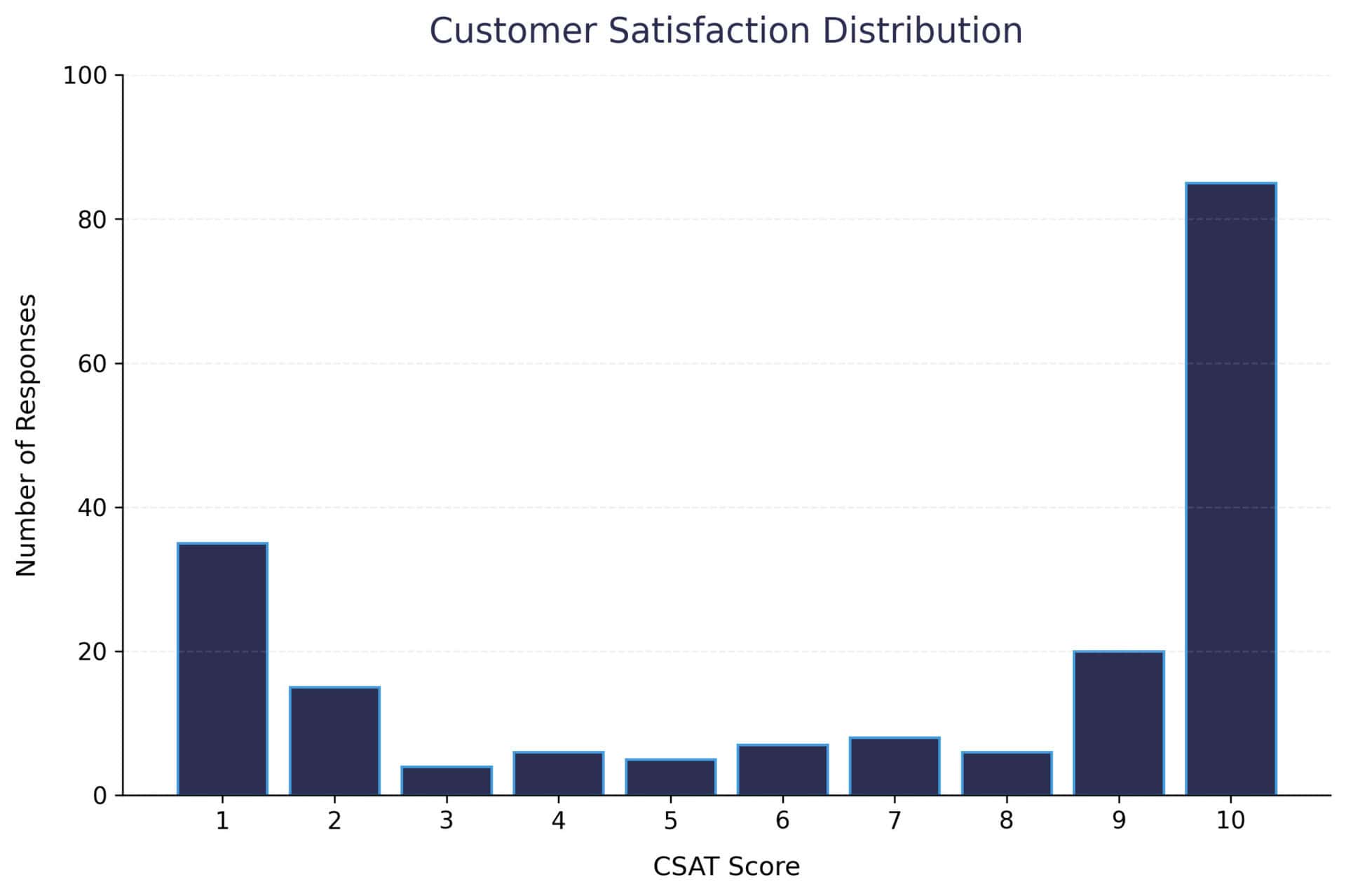
In U-shaped topics, customers are either extremely happy or extremely unhappy, and almost nobody is neutral. One of the clearest examples we saw came from an iGaming client looking at settlement disputes. These conversations tended to end with either a 10 out of 10 response or a 0 out of 10 response, with very little in between.
That kind of distribution tells you something important: the experience is inherently high-stakes. When it goes well, the customer feels relief, gratitude, and loyalty. When it goes badly, the customer feels anger, stress, and a desire to churn.
There is no “fine” outcome in these moments. There is no polite middle ground.
AI and automation are at their best when the problem is clear, the solution is known, and the customer’s expectations can be met through speed and consistency. In other words, they work brilliantly for high-volume, low-complexity support.
But high-stakes customer support moments are rarely neat. They involve uncertainty, emotion, and context that is not always captured cleanly in a system. The customer is often dealing with something that feels personal and urgent, and they need reassurance that someone understands the situation.
That is why these moments should never be automated by default.
It is not because AI is useless. It is because the cost of getting it wrong is so much higher. A mishandled settlement dispute, a failed claims process, a major travel disruption, or a serious complaint does not just result in a slightly lower CSAT score. It can cost you trust, future revenue, retention, and brand reputation.
And it creates stories customers will repeat for years.
The best way to think about AI in customer support is not as a replacement for human agents, but as a way to protect them. AI should take the repetitive load off your team so your best people have time, energy, and focus for the conversations that actually determine customer loyalty.
If your team is buried in ticket status updates, password resets, and routine policy questions, they will not be available when the high-stakes moments arrive. And those are the moments where empathy, judgment, and flexibility matter most.
The challenge is that many organisations do not have clear visibility into what their customers are saying across channels, or which topics are becoming emotionally charged in real time. Without that visibility, it is easy to over-automate the wrong conversations and under-resource the ones that need humans most.
That is how you end up with customers stuck behind automated flows, no agents scheduled when something goes wrong out of hours, and urgent situations that remain unresolved simply because they do not fit neatly into the support playbook.
Or, in my case, two founders standing in an airport car park at 3 a.m., accidentally stealing a car because there was no other path to resolution.
If you want AI to improve customer experience, not damage it, the goal is not to automate everything. The goal is to automate the right things.
That means using automation where it creates speed and consistency, while designing your support operation around the reality that some conversations carry far more emotional and commercial weight than others.
When you identify your U-shaped topics, you can treat them differently. You can route them faster, staff them appropriately, and ensure customers reach a human when it matters. You can also use AI to detect when a conversation is shifting into high-stakes territory, before it becomes a churn event.
Because customers might forgive a slow response on a routine question.
They rarely forgive being abandoned when it matters most.
🔗 Read the full article on Bart Lehane’s LinkedIn post for examples, stories, and community discussion.
Bart Lehane is the Co-founder & CCO at EdgeTier and a PhD engineer who’s spent 20+ years building and delivering advanced technology. His background spans applied research, software development, and product management. His interests lie at the intersection of CX, AI, and tech.
Most of what we hear on customer calls is useful. Some of it is just lovely. We've rounded up the
From self-serve Sonar anomaly models to a smarter, shareable Ask Spotlight and a fully transparent QA dispute process, here's everything
EdgeTier turns your customer conversations into a single connected system: it catches anomalies before they escalate, scores every agent interaction


Afroditi Pina
Director of Customer Service
"It has reduced the time for the quality assurance process as it provides clear data and a very robust direction on where to look and what matters the most."


Quentin Bottner
Head of Continuous Improvement
"We’re a big business, so getting the right people to agree and fix something hasn’t always been easy. Now we’ve got one version of the truth—it’s much easier to align and act"


Robert Davies
Consultant
"You’ve got an issue, but you don’t know how many people are affected. You don’t know the scale. You don’t even know if it’s real."



Let us help your company go from reactive to proactive customer support.
Unlock AI Insights