Conversational Analytics, Done Right (In Our Biased Opinion)
EdgeTier turns your customer conversations into a single connected system: it catches anomalies before they escalate, scores every agent interaction
Summer peak is THE moment of truth for travel brands. Demand surges, operations get tested, and customers' tolerance for friction drops to near zero because the stakes are so much higher in this industry. Nobody's "just browsing" when they're trying to rebook a missed connection, fix a payment error before a fare jumps, or figure…


Summer peak is THE moment of truth for travel brands.
Demand surges, operations get tested, and customers’ tolerance for friction drops to near zero because the stakes are so much higher in this industry. Nobody’s “just browsing” when they’re trying to rebook a missed connection, fix a payment error before a fare jumps, or figure out what they’re entitled to during travel disruption.
And the sheer scale and stress of the travel industry is only intensifying. The UN Tourism Barometer uncovered that 2025 saw 1.52 billion international tourists recorded around the world (up 60 million on the previous year) while major airlines report interaction contact volumes routinely spiking by up to 400% during the busy season. So planes and hotels are full, meaning recovery options are tighter and service failures cascade faster, while support teams flounder under the weight of contact.
For CX and contact centre leaders however, the regrettable truth is this: summer peak doesn’t actually create any new problems, instead it magnifies your existing ones to stratospheric levels. And the only question really worth answering is whether you can spot them early enough to act, or whether you find out when the queue is already on fire.
This guide covers what travel contact centres are contending with in peak season, and how EdgeTier’s Sonar gives you the visibility to get through summer without major incidents by detecting anomalies in real time, diagnosing root causes fast, and quantifying impact so teams can move before problems escalate. That’s a dream scenario right?!
Most travel organisations don’t lack dashboards, but we know that they lack any kind of early warning system.
When something goes wrong during summer peak like a payment flow breaking, a disruption comms failure, or a booking amendment bug, traditional detection only relies on:
By the time the business realises there’s a problem, you’re already in the dreaded firefighting mode. And firefighting during the busy summer travel rush is expensive: contacts spike, repeat contacts spike on top of that, agents spend capacity on investigation instead of resolution, and five teams end up working from five different versions of what’s actually happening. A common calamity you’re undoubtedly all-too familiar with!
The travel brands that come out of summer in the best shape generally aren’t the ones with the most agents, but the ones who treated customer conversations as real-time telemetry and acted on signals BEFORE they became incidents.
That’s exactly what Sonar is built to do.
Before getting into how to handle it, it’s worth being clear on what you’re actually up against, because let’s be real: summer peak in travel isn’t just a standard “busy period.”
With increasing travel numbers across the board, the operational buffer disappears. A routine rebooking becomes “the next available flight is tomorrow, different city.” A standard room upgrade becomes impossible. A car category substitution turns into a complaint. Scarcity turns these run-of-the-mill issues into high-stress contacts and drives up handle time, escalations, and policy exceptions.
Weather, crew constraints, ATC restrictions – the causes vary, but disruption is a given in summer travel. What separates the brands customers forgive from the ones they abandon entirely is communication, speed, and quality.
A UK Civil Aviation Authority study published last year found that only 1 in 10 passengers felt fully informed of their rights during disruption, and nearly two-thirds expressed dissatisfaction with how disruption was communicated. Nearly 7% of passengers who experienced a cancellation ended up cancelling their trip entirely.
Read that last figure again: when disruption comms fail, it doesn’t just create contacts, it destroys trips and directly costs your organisation revenue.
Even with significant investment in apps and self-service, peak season exposes the limits of what customers can actually complete by themselves online. McKinsey has noted that many passengers end up calling contact centres or visiting airport representatives because the transaction they need simply can’t be completed digitally, and that airline platforms may only support a fraction of the transactions customers need during disruption.
In situations like this, your contact centre becomes the safety net for digital limitations, precisely when volumes are already elevated. Knowing and understanding this level of communication could be a huge factor in freeing your agents up.
Peak season travellers are spending more, coordinating more, and carrying more emotional weight. Zendesk’s 2025 CX Trends research found that 63% of consumers are willing to switch to a competitor after just one poor experience. In travel, that “one poor experience” is rarely a single moment but a chain reaction. A failure happens, customers flood in, hold times climb, agents lack context, and the business finds out too late.
Travel is a paradox right now: international tourism receipts reached approximately $1.9 trillion in 2025, up 5% year-on-year, yet the ACSI recorded a 4% drop in airline satisfaction, and a 3% drop in online travel agency satisfaction in the same period. Travellers are spending more and enjoying it less. That gap is where brand loyalty is won or lost.
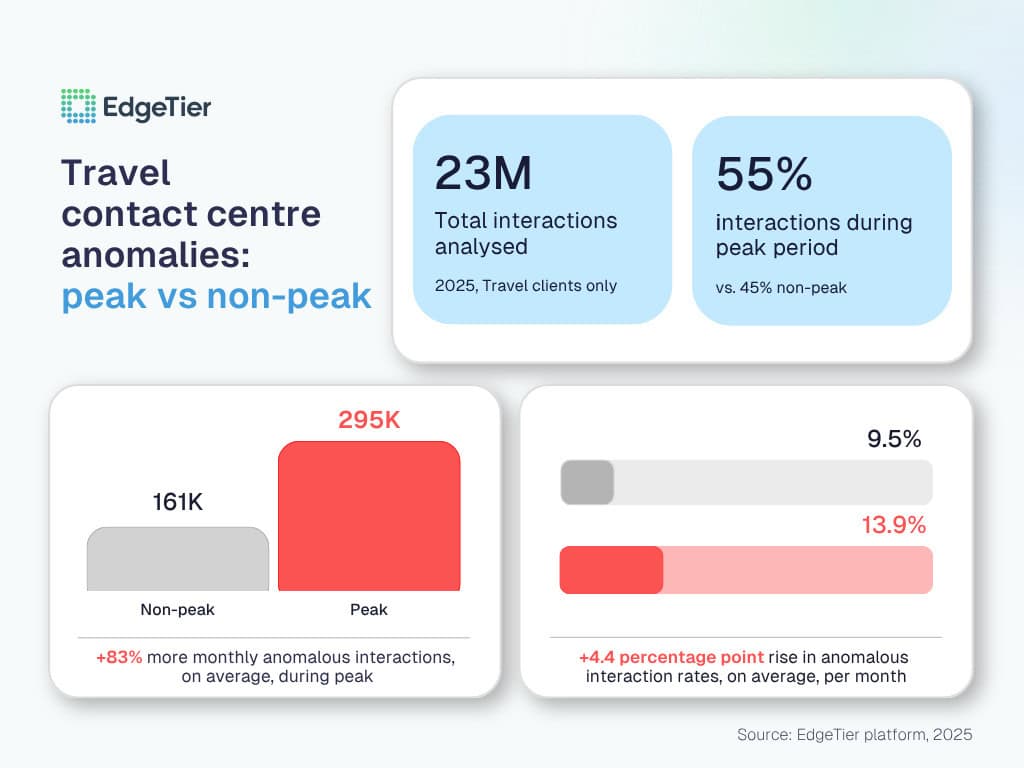
EdgeTier’s platform processes customer conversations across some of Europe’s largest travel operators, and what we’re seeing in the data reinforces everything above, with some striking specifics!
Across our travel clients in 2025, we analysed over 23 million customer interactions. 55% of them fell within peak travel periods. That alone isn’t surprising. What is telling is what happens to anomaly rates when volume climbs.
During peak months, interactions flagged as anomalous increased by 83% compared to non-peak periods. More volume is always going to mean more issues, of course, but the anomaly rate itself rising from 9.5% to 13.9% of all interactions tells you something important: peak season doesn’t just bring more contacts, it brings disproportionately more problems.
And those problems have a very predictable shape. The top anomalies we saw during peak were:
That last one is worth pausing on. A customer calling about a missed connection or a payment error, already stressed, already time-pressed, and landing in an automated loop that goes nowhere. That’s not a minor friction point but the kind of experience that ends relationships.
January was an outlier worth flagging too: despite sitting outside the traditional summer peak, it recorded the highest anomaly volume of any month at over 400,000 flagged interactions. Post-holiday travel complexity, new year booking surges, and reduced staffing capacity likely all play a role, and it’s a reminder that “peak” isn’t exclusively a summer phenomenon.
The throughline across all of it: these aren’t random failures. They cluster around the same contact reasons, in the same channels, at the same points in the customer journey. Which means they’re detectable, if you’re looking in the right place, at the right time. Enter Sonar!
Sonar monitors every customer conversation across chat, email, and voice in real time. It learns what “normal” looks like for your operation – by market, language, channel, and contact reason – and flags anomalies as they form, before they surface in your performance metrics.
Here’s what that means in practice during summer peak.
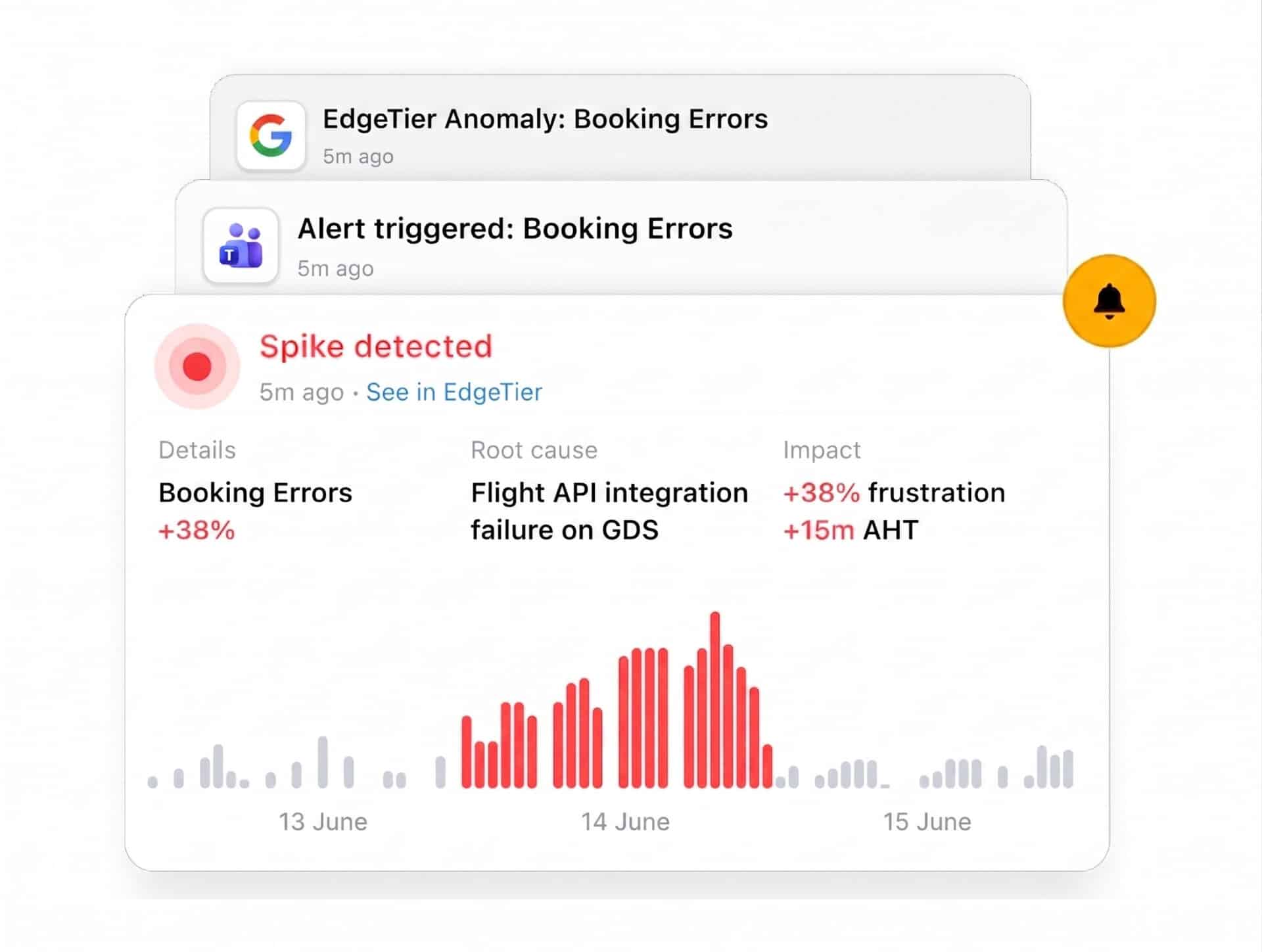
Imagine it: a subtle change in a payment flow starts causing intermittent booking failures.
Without Sonar:
Customers try twice, then contact support. Chat queues rise. Agents start hearing “payment not going through” but there’s no systemic flag. Calls spike because this is urgent and high value. CX sees AHT climb and CSAT drop but doesn’t know why. Product may hear about it hours later, once anecdotal “evidence” has organically accumulated. Meanwhile the brand absorbs abandoned bookings, chargebacks, complaints, and social posts all weekend.
With Sonar:
Sonar detects an anomaly within minutes: “payment failed” contact reason spiking above baseline. It shows which markets are affected, how many customers are likely impacted, and early root-cause signals from what customers are actually describing. CX, Product, and Ops get alerted immediately in the tools they already use. The team ships a fix faster and deploys interim comms and agent macros to reduce repeat contacts while the fix goes out.
That’s the difference between containing an incident and living inside it. And the financial stakes aren’t abstract either. Enterprises face a median annual cost of $76 million from IT outages and service disruptions, and in high-volume sectors like transportation, unplanned downtime feeds right into this.
Teams using Sonar have reported:
These are precisely the metrics that buckle under peak pressure, and precisely the metrics that protect both customer experience and revenue when summer hits hardest. Results vary by organisation and operating environment, but the direction of travel is consistent: when your team spends less time finding the problem, they spend more time fixing it.
When a Sonar alert fires, move through a fast, structured response:
Update macros and knowledge base content quickly to deflect repeat contacts. Use Sonar’s data to keep leadership updates tight, consistent, and grounded in facts rather than anecdote.
Review your biggest anomaly events and ask:
Turn those answers into product backlog items, process improvements, policy clarifications, and better comms workflows before next summer arrives.
Travel brands can’t control weather, ATC, or global events. But they can control how quickly they detect emerging problems, how confidently they diagnose them, and how effectively they coordinate a response. Peak season rewards the contact centre teams who catch issues early from real customer signals, align cross-functional teams on one version of truth, prioritise by impact rather than noise, and resolve quickly with full context.
That’s what Sonar is built for. Not just surviving summer, but protecting experience and revenue when it matters most.
Want to see how Sonar works in a travel environment? [Book a live demo.]
EdgeTier turns your customer conversations into a single connected system: it catches anomalies before they escalate, scores every agent interaction
AutoQA lets you review every customer conversation instead of a small sample. Coverage is only part of the story, though.
Most Ask Spotlight conversations run to about two messages. The longest one we found ran to forty-eight. Both can be


Giovane Nicolau Junior
Head of Operations Performance
"EdgeTier is really shining when it comes to responsible gambling. We can proactively track critical issues and take actions, reducing human error."


Quentin Bottner
Head of Continuous Improvement
"We’re a big business, so getting the right people to agree and fix something hasn’t always been easy. Now we’ve got one version of the truth—it’s much easier to align and act"


Deborah Guivisdalsky
COO
"We now have highly detailed understanding of agent performance, not just on key agent metrics, but also on how customers react to our agents and the emotions of our customers feel when talking to our team."



Let us help your company go from reactive to proactive customer support.
Unlock AI Insights