
What is Contact Centre AI Analytics? A Complete Guide
Contact centre AI analytics is the use of artificial intelligence to automatically analyse 100% of customer interactions, across chat, email,
The fastest way to reduce contact volume is to fix the problems that are generating contacts in the first place. AI makes this possible by analysing every customer conversation as it happens, identifying the root causes of avoidable contacts, and surfacing the insights your product, operations, and CX teams need to act. Most contact centres…


The fastest way to reduce contact volume is to fix the problems that are generating contacts in the first place. AI makes this possible by analysing every customer conversation as it happens, identifying the root causes of avoidable contacts, and surfacing the insights your product, operations, and CX teams need to act. Most contact centres that apply this approach see a 10–20% reduction in contact volume within the first few months.
This guide explains how it works, what it looks like in practice, and what steps to take if you want to get started.
Reducing contact volume means decreasing the number of inbound contacts your contact centre receives, without reducing the quality of support you provide. The goal is not to make it harder for customers to get help. It is to eliminate the reasons they needed to contact you in the first place.
Contacts typically fall into two categories:
The practical challenge is that most contact centres do not know which contacts are which. Without visibility into what is driving volume at a granular level, it is very difficult to know where to focus your reduction efforts. That is the gap AI is designed to close.
The scale of the opportunity is significant. According to McKinsey, only 20% of digital customer contacts are currently handled without some form of assisted support, meaning the vast majority involve agent time that could, in many cases, have been avoided upstream. Meanwhile, research from Call Centre Helper found that 33% of contact centre professionals cite reducing contact volume as one of their primary motivations for adopting AI, making it the single most common driver of AI investment in the sector.
Learn more: The Customer Visibility Playbook
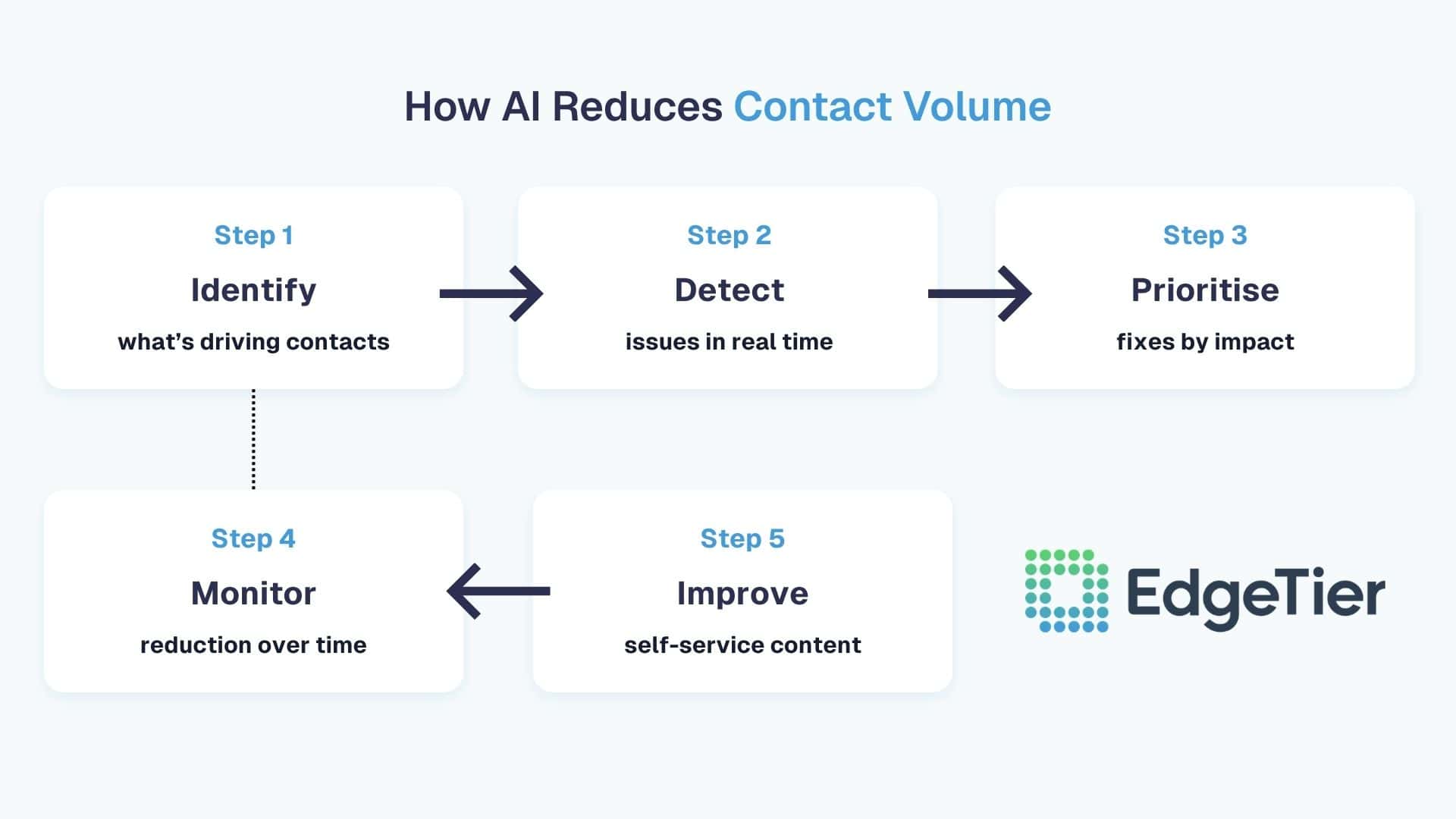
Reducing contact volume with AI is not about deploying a chatbot and hoping for the best. The most effective approach follows a clear sequence: understand, fix, deflect, and monitor. Here is how each step works.
You cannot reduce volume you cannot explain. The first step is getting a structured, accurate picture of why customers are contacting you, across every channel and at scale.
Traditional approaches rely on manual tagging or agent wrap-up codes. Both are imperfect. Agents under time pressure apply the nearest available category, not necessarily the right one. The result is contact reason data that is too vague to act on.
AI analytics tools read every conversation, identify the underlying reason for contact, and cluster contacts into meaningful categories automatically. This gives you a real-time, accurate breakdown of contact volume by root cause: not just “billing query,” but “customer received incorrect charge after promo code applied at checkout.” That level of specificity is what makes action possible.
EdgeTier Explore surfaces this kind of insight across 100% of interactions, across all channels, in real time.
A significant proportion of avoidable contacts are triggered by specific, fixable events: a website change that confuses users, a payment processor outage, a batch of delayed deliveries, a new returns policy that is not clearly communicated. Left undetected, these events generate hundreds or thousands of contacts before anyone realises what is happening.
AI anomaly detection monitors contact patterns in real time and alerts teams the moment something deviates from the norm. This means you can identify and fix the underlying issue in hours rather than days, cutting the tail of contacts that would otherwise follow.
EdgeTier Sonar is purpose-built for this: it learns what normal looks like in your contact centre and flags deviations as they emerge, not after the fact.
Once you can see what is driving volume, the next step is deciding what to fix first. Not all contact reasons are equal. Some are high volume but quick to resolve. Others are lower volume but generate frustrated, high-effort contacts that drag on AHT.
Effective contact volume reduction requires ranking issues by the total cost they represent: volume multiplied by handling time, plus the downstream impact on CSAT and repeat contacts. AI analytics makes this calculation straightforward by combining contact reason data with handling time, sentiment, and resolution data in one view.
This turns contact reduction from a guessing game into a prioritised roadmap, with a clear business case for each fix.
One of the most direct ways to reduce contact volume is improving self-service: better FAQs, more useful help centre content, smarter chatbot journeys. The problem is that most self-service content is written using internal language, not the words customers actually use.
AI conversation analysis tells you exactly what language customers use when they have a particular problem, what they search for, how they phrase their question. This gives your content and product teams the raw material to build self-service that actually works, reducing the contacts that would otherwise reach an agent.
Reducing contact volume is not a one-time project. New issues emerge, products change, customer behaviour shifts. Continuous monitoring ensures that fixes are holding, that new drivers of avoidable contact are caught early, and that the overall trend is moving in the right direction.
The most effective contact centres treat volume reduction as an ongoing discipline, not a quarterly initiative.
TUI, one of Europe’s largest travel companies, used EdgeTier to identify that a significant cluster of contacts related to a specific payment journey were avoidable. Customers were contacting the team because the payment confirmation flow was ambiguous, leaving them unsure whether their booking had gone through.
Once the issue was identified and quantified, it was straightforward to fix. TUI cut payment-related contacts by 40%, freeing up substantial agent capacity without any reduction in service quality.
Electric Ireland used EdgeTier’s real-time anomaly detection to identify a spike in contacts related to a billing statement change before it became a major escalation. By catching the issue early, they were able to proactively communicate with affected customers and deploy updated FAQ content within hours.
The result was a contained contact spike rather than a prolonged surge, alongside a 21% improvement in CSAT scores across the team over the same period.
One EdgeTier customer identified a platform bug affecting 95 customers in real time, before the issue had generated significant inbound contact. The web team was notified and the fix was deployed within the hour. Related contact volume dropped to zero. Without real-time detection, the same issue would have generated hundreds of contacts across the following 24 hours.
Most contact centres operate reactively. A wave of contacts arrives, agents handle them, and the team tries to figure out what happened after the fact. The reporting comes days later. The root cause analysis might happen in the next quarterly review, if at all.
AI changes the operating model. When you can see what is driving volume in real time, not just in aggregate but at the level of individual conversation topics, product journeys, and customer segments, the entire dynamic shifts. Problems get fixed before they peak. Self-service content gets updated based on actual customer language, not assumptions. Agent capacity gets redirected from avoidable contacts to the complex, high-value interactions that genuinely need a human.
The outcome is a leaner, higher-quality contact centre, one where agents spend their time on work that actually requires their skills, customers get faster resolutions, and the business case for every improvement is grounded in data rather than instinct.
That shift does not happen overnight. But it starts the moment you can see clearly why your customers are contacting you. Everything else follows from there.
Frequently Asked Questions:
Most teams begin to see measurable reductions within 8 to 12 weeks. The speed depends on how quickly identified issues can be fixed by the relevant teams (product, operations, content). The AI surfaces the insight immediately; the reduction follows once the underlying cause is addressed.
No. The goal is to eliminate avoidable contacts, where the customer would not have needed to reach out if something had been handled better upstream. Genuine, complex queries that benefit from human support are unaffected.
Deflection means routing contacts away from agents, typically to chatbots or self-service tools. Contact reduction means the customer never needed to make contact in the first place, because the problem was fixed at the source. Deflection has its place, but true contact reduction delivers a better experience and a lower cost.
Across most industries, the highest-volume avoidable contacts relate to order or delivery status, payment and billing confusion, account access issues, and unclear policy communication. These are also the areas where better self-service or proactive communication has the biggest impact.
Yes. The value of AI analytics scales with contact volume, but even mid-sized contact centres handling a few thousand interactions per week generate enough data to surface meaningful patterns. The diagnostic value is present regardless of size.
A chatbot attempts to handle contacts at the point they arrive. AI analytics identifies the conditions that caused the contact and enables you to fix them. The two can complement each other, but they address different parts of the problem.
If you are looking to reduce contact volume in your contact centre, the starting point is always the same: understanding what is driving contacts in the first place.
If you want to see how much contact volume you could realistically reduce, our ROI Calculator gives you a quick, data-backed estimate based on your current volumes and handling times.
Contact centre AI analytics is the use of artificial intelligence to automatically analyse 100% of customer interactions, across chat, email,
It’s 9:12am on a Monday. Your status page is green, but the queue is telling a VERY different story. Customers
This article originally appeared on Edge Signals – Bart Lehane’s LinkedIn newsletter on customer experience, analytics, and AI. Follow for


Quentin Bottner
Head of Continuous Improvement
"We’re a big business, so getting the right people to agree and fix something hasn’t always been easy. Now we’ve got one version of the truth—it’s much easier to align and act"


Deborah Guivisdalsky
COO
"We now have highly detailed understanding of agent performance, not just on key agent metrics, but also on how customers react to our agents and the emotions of our customers feel when talking to our team."


Debbie Duggan
Contract Manager for Customer Solutions
"We thought at the time that we were putting the customer at the fore. We thought we were doing things right. But in hindsight, we really weren’t because we had no real-time insights whatsoever into customer issues."



Let us help your company go from reactive to proactive customer support.
Unlock AI Insights