
5 Ways Conversational AI is Improving the Life of Contact Center Managers
Contact center management has always been a job of contradictions. You’re expected to keep service levels stable while volumes shift
Retail contact centres face intense pressure during the festive period and January returns surge. This article explains how real-time anomaly detection helps retailers spot emerging issues hidden in high-volume conversations – like delivery cut-off mistakes, refund delays, and carrier bottlenecks – so teams can act early, protect CX, and turn seasonal chaos into strategic insight.You’ll…


| Retail contact centres face intense pressure during the festive period and January returns surge. This article explains how real-time anomaly detection helps retailers spot emerging issues hidden in high-volume conversations – like delivery cut-off mistakes, refund delays, and carrier bottlenecks – so teams can act early, protect CX, and turn seasonal chaos into strategic insight. You’ll learn: ✔ Why visibility drops just as volumes, returns, and expectations spike. ✔ How hidden festive issues (delivery, payments, returns) quietly drive contacts. ✔ The cost of late detection in revenue, brand trust, and operational stress. ✔ What anomaly detection does in practice across chat, email, and voice. ✔ How seasonal insights feed 2025 planning for CX, operations, and logistics. |
Every year, as the festive season approaches, retail contact centres prepare for the same paradox: customers expect magic while teams brace for chaos. Surging volumes, compressed SLAs, supply-chain uncertainty, and the pressure to deliver flawless experiences at unprecedented scale – it’s a cocktail that tests even the most seasoned operations.
This year, the stakes are higher. Customer service volumes have already climbed 22% as holiday shopping accelerates (TypeWise), and three-quarters of consumers report elevated service expectations compared to last year (Zendesk). Factor in labour market pressures and heavy reliance on seasonal staff, and you’ve created conditions where minor hiccups trigger major consequences.
Yet the biggest challenge retail contact centres face isn’t the volume itself.
It’s the invisibility of what’s actually happening.
From Black Friday through January, retailers encounter their most volatile customer landscape:
With this many moving parts, seeing what’s happening in real time across the customer journey becomes nearly impossible.
Most organisations depend on agent escalations, manual triage, dashboards, and instinct to catch emerging issues. But during peak season, these mechanisms fail precisely when they’re needed most. Agents lack bandwidth to raise flags. Supervisors lose analytical capacity. Issues that would normally surface quickly disappear into high-volume noise.
The consequence? Operational problems lurk undetected for hours (sometimes days) until customers have already experienced the fallout and, increasingly, shared it publicly.
The problem isn’t insufficient data. It’s the absence of immediate signal.
Learn more: Black Friday Survival Guide for Contact Centre Leaders
Holiday-season issues don’t simmer – they erupt! They appear suddenly, scale rapidly, and can ripple across markets within minutes.
Common seasonal flashpoints include:
These issues don’t announce themselves. They hide within thousands of conversations until the pattern becomes unavoidable. By then, the damage has compounded. Contact volumes spike, customers feel abandoned and social sentiment deteriorates, leading to reactive scrambling and both revenue opportunities and brand trust start to erode.
During the festive season, discovering problems late doesn’t just cost more—it costs exponentially more.
Story time: it’s mid-December, and customers are ordering gifts with clear delivery expectations. Without your CX or operations teams knowing, an outdated delivery cut-off date remains live on a key product category. It’s only off by one day – but during Christmas week, one day is everything.
Customers start reaching out:
“Will this arrive before Christmas?”
“Your website says Tuesday, but customer service told me Wednesday.”
“I ordered specifically for Christmas – will it make it?”
Initially, these queries trickle in, scattered across channels. Agents address them individually, unaware others are experiencing the same confusion. Within hours, frustration intensifies. By the time leadership spots the pattern, it’s already driving significant contact volume, and holiday sentiment has begun its decline.
This type of issue evades detection during peak season because volume is already elevated, signals scatter across teams, seasonal agents may not escalate, and manual reviews lag behind events.
But catching it earlier would have enabled:
This is precisely where tools like Sonar deliver outsized impact – surfacing patterns long before they cascade into crises.
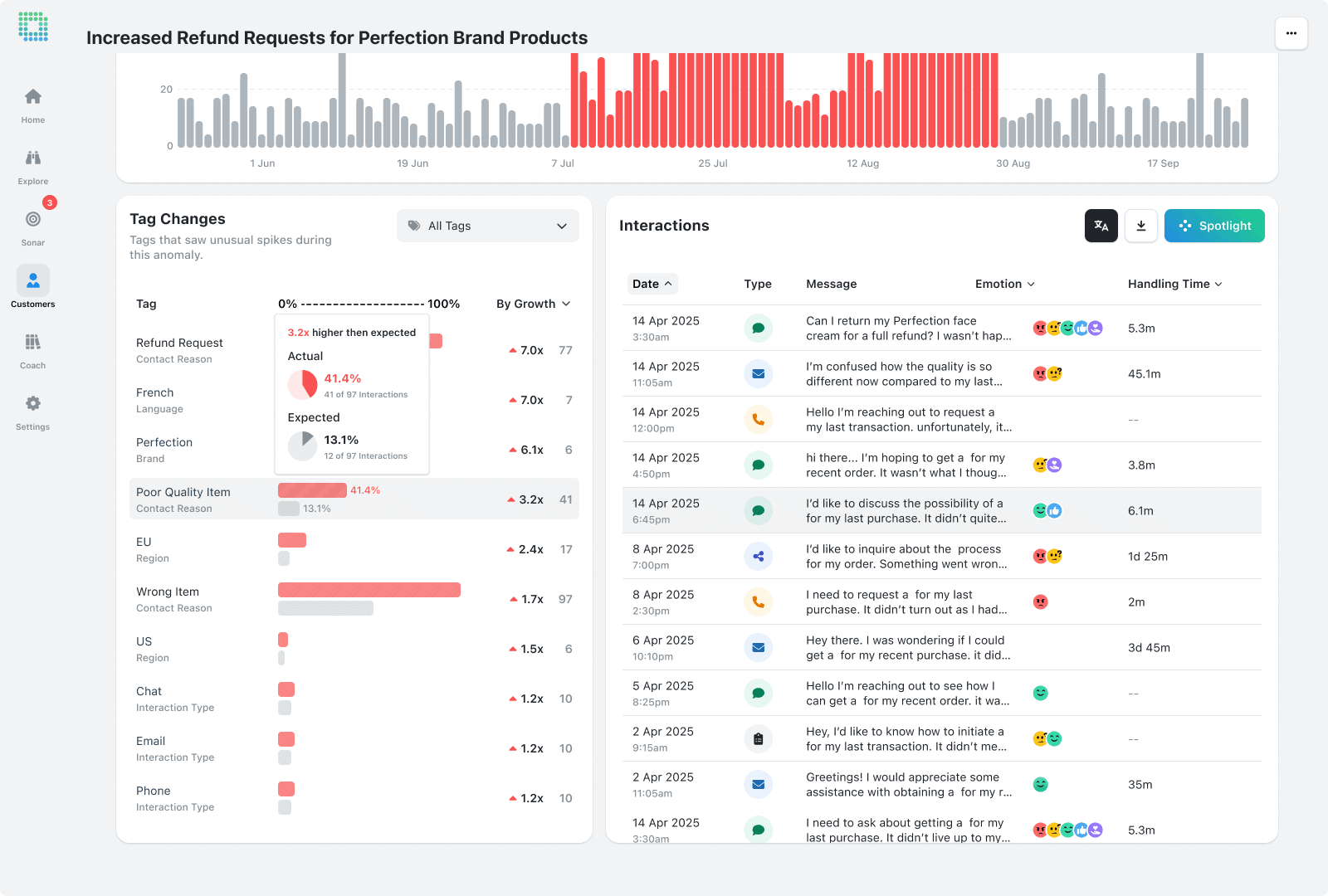
The principle is straightforward: your customers know when something’s wrong, often before your systems do. They bring that intelligence into your contact centre in their own words.
Real-time anomaly detection gives retailers the power to recognise these signals instantly rather than waiting for patterns to crystallise into crises.
Instead of monitoring static dashboards or depending on manual escalation, teams gain:
EdgeTier’s Sonar operates as a practical intelligence layer that enhances collaboration across CX, Operations, Product, Logistics, and eCommerce during peak periods. It monitors every conversation across chat, email, and voice, learns your business’s normal patterns, and flags deviations the moment they occur. Rather than requiring agents to raise alerts, Sonar surfaces signals automatically.
Retailers typically experience:
The most critical benefit? Problems get resolved before customers feel abandoned – not after.
While December always commands attention, January often proves more operationally complex.
Returns queries flood every channel. Warehouses hit peak processing capacity. Refund delays spark anxious contacts. Delivery networks navigate seasonal backlogs. Seasonal staff begin departing. Internal teams stretch thin.
This is when anomaly detection transitions from useful to indispensable.
Customers are emotionally invested in returns and refunds. Even minor missteps, like a delayed refund, unclear returns status, or unexpected processing time can generate disproportionate contact volumes.
Real-time insight helps retailers avoid common pitfalls:
January may lack December’s glamour, but it’s equally risky and far more operationally intricate.
Retail teams excel at problem-solving under pressure. The challenge is that peak season demands proactive problem-solving, not reactive firefighting.
Real-time anomaly detection enables this shift by delivering:
Sonar represents one path to achieving this, but the broader principle applies industry-wide: visibility has become the new differentiator in customer experience.
When emotions run high, timelines compress, and volume explodes, real-time understanding of customer conversations transforms from nice-to-have to business-critical.
Learn more: How Can Contact Centres Stop Reactive Firefighting and Start Proactive Service?
By February, most retailers enter planning mode. Insights gathered from November through January become the foundation for process improvement, systems investment, vendor reviews, roadmap planning, and workforce design.
Retailers relying solely on retrospective reporting miss the depth of available insight.
Those with real-time signals throughout the season enter the new year with:
This transforms a challenging season into strategic advantage.
The festive season will always bring unpredictable, emotional, high-stakes challenges. But retailers don’t need to navigate them blind.
Real-time insight empowers teams to catch issues early, protect customer trust, reduce unnecessary contacts, communicate proactively, make better cross-functional decisions, and deliver experiences that feel seamless even under intense pressure.
Sonar supports this mission, but the bigger truth is clear: the retailers who thrive during the festive season are those who see what’s happening early enough to act on it.
Discover how EdgeTier’s Sonar can give your team the real-time visibility needed to navigate peak season with confidence.
Contact center management has always been a job of contradictions. You’re expected to keep service levels stable while volumes shift
Most customer operations don't have a data problem. They have a clarity problem. You track the essential metrics: volumes, AHT,
This article originally appeared on Edge Signals – Bart Lehane’s LinkedIn newsletter on customer experience, analytics, and AI. Follow for


James Waghorn
Director of Customer Contact
"EdgeTier is no ordinary software product... It has completely changed how we work at CarTrawler."


Deborah Guivisdalsky
COO
"We now have highly detailed understanding of agent performance, not just on key agent metrics, but also on how customers react to our agents and the emotions of our customers feel when talking to our team."


Giovane Nicolau Junior
Head of Operations Performance
"EdgeTier is really shining when it comes to responsible gambling. We can proactively track critical issues and take actions, reducing human error."



Let us help your company go from reactive to proactive customer support.
Unlock AI Insights