
5 Ways Conversational AI is Improving the Life of Contact Center Managers
Contact center management has always been a job of contradictions. You’re expected to keep service levels stable while volumes shift
Strong emotions in customer conversations are easy to miss – not because teams don’t care, but because frustration, confusion, and praise often appear as brief spikes buried in long transcripts. Those moments are the real signals: they show where processes break, where loyalty is built, and where churn risk begins. This article explains why detecting…


| Strong emotions in customer conversations are easy to miss – not because teams don’t care, but because frustration, confusion, and praise often appear as brief spikes buried in long transcripts. Those moments are the real signals: they show where processes break, where loyalty is built, and where churn risk begins. This article explains why detecting strong emotions (not just overall sentiment) is essential for modern CX, and how EdgeTier’s Strong Customer Emotions widget brings these hotspots to the surface instantly. Here’s what you’ll learn: ✔ Why Strong Emotions Outweigh Broad Sentiment: How emotional spikes reveal root causes that overall “negative/positive” tags can’t. ✔ Where Strong Emotions Hide in Transcripts: Why the most important moments are brief, distributed, and easy to overlook. ✔ The Business Cost of Missing Emotional Hotspots: How buried frustration and confusion delay fixes and increase churn risk. ✔ What Precision Emotion Detection Makes Possible: How sentence-level AI shifts emotion insights from summary to action. ✔ How to Spot Frustration, Confusion, and Praise Fast: A look at EdgeTier’s Strong Customer Emotions widget and how it surfaces the most critical lines on your Home screen. |
There’s a line buried somewhere in your customer transcripts from last Tuesday. Maybe it reads: “I’ve been trying to fix this for three days.” Or: “No one is actually listening to what I’m saying.” Or perhaps: “Thank you – this is the first time someone really helped.”
That single line probably tells you more about your customer experience than the 47-message thread it’s hiding in. But chances are, no one on your team has seen it yet. And by the time they do (if they do) the moment will have already passed.
This is the paradox of modern customer service: we’re drowning in conversational data while simultaneously missing the signals that matter most.
Not all emotional moments are created equal. A customer might express mild annoyance, brief confusion, or polite satisfaction throughout a conversation. These are real emotions, and they matter. But they rarely tell you what’s actually broken – or what’s working exceptionally well.
The moments that carry diagnostic power are the ones with intensity. The spikes. When a customer says “I’ve called three times about this” – that’s not mild frustration, that’s a breaking point being reached. When someone writes “Oh! That actually makes sense now” – that’s not casual acknowledgment, that’s the moment confusion lifted.
These emotionally charged moments are rare relative to the full volume of conversation. But they’re disproportionately valuable. They reveal:
A 28-minute call might contain one minute of genuine emotional intensity. Traditional approaches tell you the call was “negative.” What you actually need to know is: which minute, what triggered it, and what happened next?
Most organisations can’t read every transcript. Even well-resourced QA teams must sample, prioritize, or rely on automated tagging. This makes sense – until you realize what it means in practice.
The early warning signs of churn become visible only in retrospect. A customer doesn’t typically leave after one bad interaction. They leave after a pattern of unresolved frustration that nobody spotted early enough. Those moments existed in your data. They just didn’t surface.
Product and process issues stay hidden longer than they should. If fifteen customers express confusion at the same point in your payment flow, you might never connect the dots, unless someone surfaces those specific moments and recognizes the pattern.
Your best service interactions go unrecognized. The line where a customer expresses genuine gratitude is a coaching opportunity. It tells you what excellence looks like in your operation. But if it’s buried in transcript 2,847 of last week, who’s going to find it?
Manual review becomes expensive and reactive. Teams spend time hunting for emotional context after something goes wrong, like a complaint escalates, a survey score drops, or a customer churns, but by then, you’re playing catch-up.
As an industry, we’ve gotten good at summarising emotion. We haven’t been as good at pinpointing it.
Modern language models have changed what’s possible here. They can read conversational nuance the way a skilled QA analyst would – understanding not just that someone is frustrated, but which sentence reveals that frustration, and why it matters in context.
This creates a different kind of emotional intelligence: not broad sentiment across a conversation, but sentence-level precision that highlights the moments carrying the most weight.
Imagine opening your customer service dashboard and seeing, immediately:
Gamechanging, no?!
When you can detect and surface strong emotions with precision, the nature of customer insight changes.
This shift toward precision is what drove us to build the Strong Customer Emotions widget into EdgeTier – a feature designed to surface the exact moments that carry the most emotional weight, directly on your Home screen where you can act on them immediately.
Instead of tagging conversations with broad sentiment, it highlights the specific lines where frustration peaks, confusion emerges, or praise appears. EdgeTier’s AI analyzes each sentence, scoring it not just for the emotion present, but for its severity and frequency across your interactions. Strong emotions are then ranked against the rest of your data, so the moments that matter most rise to the top.
Click on any highlighted sentence and you’re taken directly to that moment in the conversation. Filter by brand, topic, language, or market to see what’s emotionally charged across your operation right now.
It’s not a replacement for the emotion analysis teams already rely on. It’s a lens that brings the highest-signal moments into focus, so you can understand what’s happening without reading every word of every conversation.
Learn more: Strong Customer Emotions Product Update
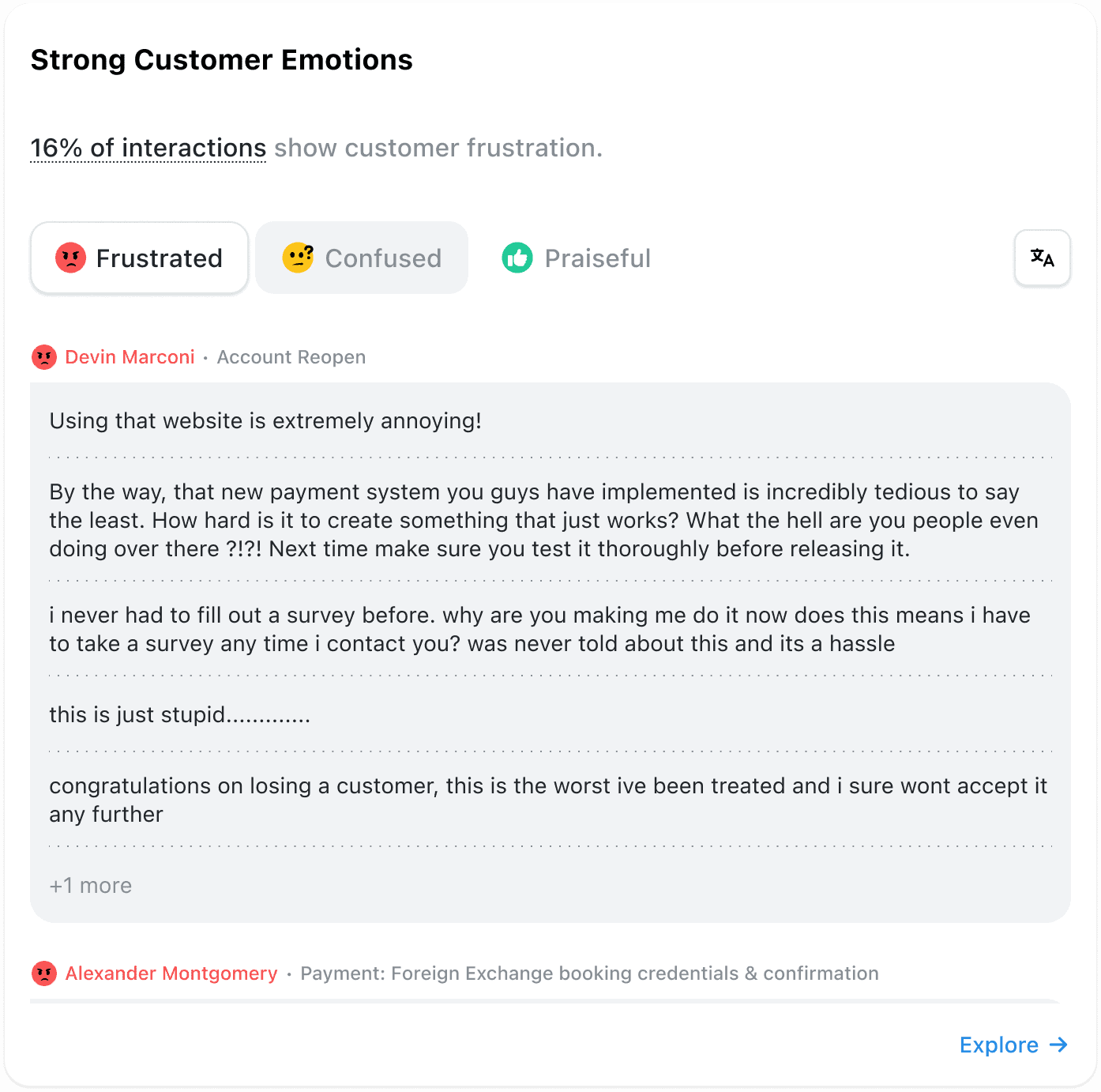
Every conversation generates data. But only certain moments within those conversations carry real signals. The strongest expressions of frustration, confusion, relief, gratitude – these are the compass points. They show you where you are, and where you need to go.
The teams that can detect these moments and act on them systematically will understand their customers in a fundamentally different way. Not just how people feel in aggregate, but why they feel that way in specific, fixable moments. They’ll solve problems earlier. They’ll coach with greater precision. They’ll make decisions grounded in clarity rather than assumptions.
Because in customer service, the moments that matter most are rarely the ones we’ve been measuring. They’re the ones we’ve been missing – until now!
See how EdgeTier can help you elevate your approach to customer support. Try a free demo today!
Contact center management has always been a job of contradictions. You’re expected to keep service levels stable while volumes shift
Most customer operations don't have a data problem. They have a clarity problem. You track the essential metrics: volumes, AHT,
This article originally appeared on Edge Signals – Bart Lehane’s LinkedIn newsletter on customer experience, analytics, and AI. Follow for


Quentin Bottner
Head of Continuous Improvement
"We’re a big business, so getting the right people to agree and fix something hasn’t always been easy. Now we’ve got one version of the truth—it’s much easier to align and act"


Deborah Guivisdalsky
COO
"We now have highly detailed understanding of agent performance, not just on key agent metrics, but also on how customers react to our agents and the emotions of our customers feel when talking to our team."


Debbie Duggan
Contract Manager for Customer Solutions
"We thought at the time that we were putting the customer at the fore. We thought we were doing things right. But in hindsight, we really weren’t because we had no real-time insights whatsoever into customer issues."



Let us help your company go from reactive to proactive customer support.
Unlock AI Insights