What is the True Cost of Poor Customer Visibility?
Poor customer visibility rarely looks like a data problem. It shows up as rising contact volumes, endless manual analysis, failing
If you lead a contact centre, you already know the drill. Volumes spike. Service levels slip. Teams scramble. Leaders react instead of plan. In other words: firefighting. And here’s the kicker – it can feel like it’s just part of the job. But does it really have to? Spoiler: No, it doesn’t! Across industries, we’re…

If you lead a contact centre, you already know the drill. Volumes spike. Service levels slip. Teams scramble. Leaders react instead of plan.
In other words: firefighting.
And here’s the kicker – it can feel like it’s just part of the job. But does it really have to? Spoiler: No, it doesn’t!
Across industries, we’re seeing a BIG shift from reactive firefighting to proactive service – powered by real-time insight, smarter automation, and a sharper focus on the root causes of customer contact.
One story that illustrates this shift is Electric Ireland’s. As Ireland’s largest energy provider, serving 1.3 million customers, they found themselves overwhelmed during the global energy and cost-of-living crisis. But what they did next offers lessons for every customer service leader.
Every contact centre deals with some combination of three issues:
Put those three challenges together and you get the dreaded firefighting loop.
Problems stay invisible until they blow up. Backlogs swell. Customers get frustrated. Agents burn out. And leaders are left asking, “How did we get here again?”
Sound familiar?
Let’s look at a real example to get close to the issue.
During the energy crisis, Electric Ireland’s contact volumes jumped 35% in a year.
Email response times stretched from 24 hours to as long as 15 days. And CSAT scores, as Contract Manager for Customer Solutions, Debbie Duggan, put it, “plummeted through the floor.”
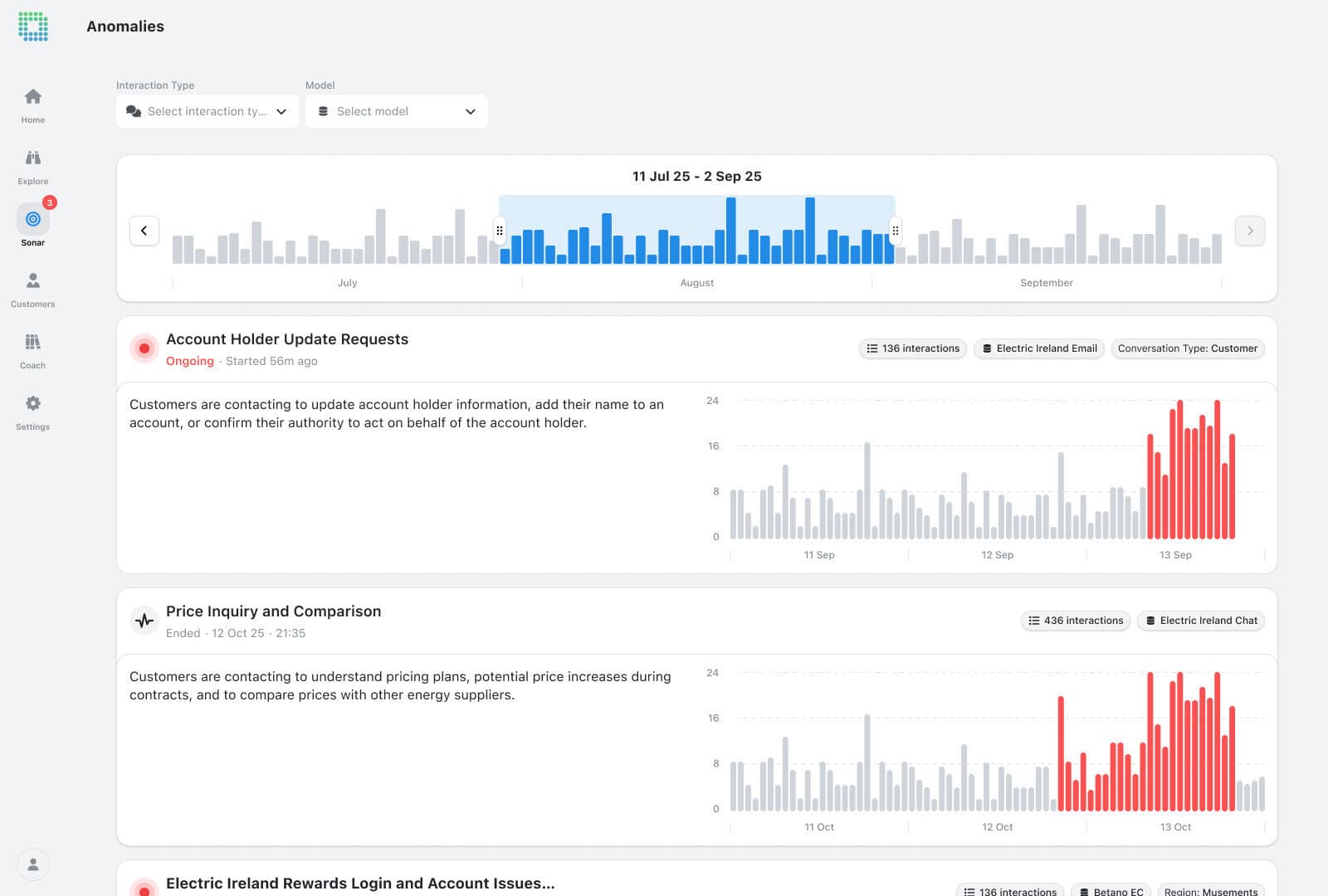
The breakthrough came when the team moved away from anecdotal agent feedback and lagging reports. Instead, they introduced real-time anomaly detection (Hi, EdgeTier!), catching issues like payment failures or portal outages as they happened.
Agents were armed with scripts instantly, so the very first customer got a clear, confident answer.
That’s the exact mindset shift we’re talking about here: from reacting to resolving. If you don’t know what’s happening until next month’s report, you’ll always be too late.
Learn more: See how Sonar is reducing contact volume with real-time alerts.
Another lesson: not all contact volume is created equal.
Electric Ireland discovered that a surprising portion of their email backlog was actually spam – irrelevant messages agents had to sift through before they could get to real customers.
It’s a reminder that improving customer experience isn’t always about big transformation projects. Sometimes it’s about clearing the underbrush.
Deloitte research backs this up: reducing unnecessary contacts doesn’t just lower costs, it builds efficiency, value, and trust across the business. Duplicates, repeat queries, irrelevant requests – eliminate these for the fastest wins.
By tackling this “hidden workload,” Electric Ireland cut email volumes by 37%, boosted first contact resolution by 19%, and saw CSAT climb by 21%.
Less wasted effort = more capacity for meaningful conversations. Simple!
You don’t need to be an energy utility to take something from this story. Here are three lessons that apply universally for every contact centre leader:
Firefighting might feel inevitable, but it isn’t. As Electric Ireland’s experience shows, shifting to proactive service is possible – and it pays off in efficiency, customer satisfaction, and long-term resilience. AI is changing the game and can make this kind of reactive customer experience a relic from the past.
So, ask yourself: are you willing to wait weeks to find out what your customers are struggling with, or do you want to know today? I don’t think it’s a tough question!
Want to learn more? Watch EdgeTier’s full webinar with Electric Ireland’s Debbie Duggan HERE
Poor customer visibility rarely looks like a data problem. It shows up as rising contact volumes, endless manual analysis, failing
This article originally appeared on Edge Signals – Bart Lehane’s LinkedIn newsletter on customer experience, analytics, and AI. Follow for
Retail contact centres face intense pressure during the festive period and January returns surge. This article explains how real-time anomaly


Vladimir Greavu
BBG Director of Customer Service
"I specifically liked the flexibility. I liked the can-do attitude. I always felt supported. There hasn’t been any single point in our journey where EdgeTier has said no."


Afroditi Pina
Director of Customer Service
"It has reduced the time for the quality assurance process as it provides clear data and a very robust direction on where to look and what matters the most."


Deborah Guivisdalsky
COO
"We now have highly detailed understanding of agent performance, not just on key agent metrics, but also on how customers react to our agents and the emotions of our customers feel when talking to our team."



Let us help your company go from reactive to proactive customer support.
Unlock AI Insights