
Retroactive Phrase Tagging: Turning Yesterday’s Conversations into Today’s Answers
It’s 9:12am on a Monday. Your status page is green, but the queue is telling a VERY different story. Customers
Contact centre AI analytics is the use of artificial intelligence to automatically analyse 100% of customer interactions, across chat, email, voice, and messaging, in real time. It surfaces patterns, detects emerging issues, measures sentiment, and identifies coaching opportunities that would be impossible to find through manual review. Traditional contact centre reporting tells you what happened.…


Contact centre AI analytics is the use of artificial intelligence to automatically analyse 100% of customer interactions, across chat, email, voice, and messaging, in real time. It surfaces patterns, detects emerging issues, measures sentiment, and identifies coaching opportunities that would be impossible to find through manual review.
Traditional contact centre reporting tells you what happened. AI analytics tells you why it happened, when it started, and what you can do about it before the next wave of contacts arrives.
This guide explains how contact centre AI analytics works, what it can do for your operation, and what to look for when evaluating a platform.
Most contact centres run on dashboards built around a handful of metrics: average handling time, CSAT, first contact resolution, and queue length. These are useful but they have a fundamental flaw.
They tell you about the past, not the present. By the time a spike in contacts shows up in your weekly report, hundreds of customers have already experienced the problem. The issue that triggered it (a broken checkout flow, a delayed delivery batch, a confusing policy change, for example) has been compounding for hours or days.
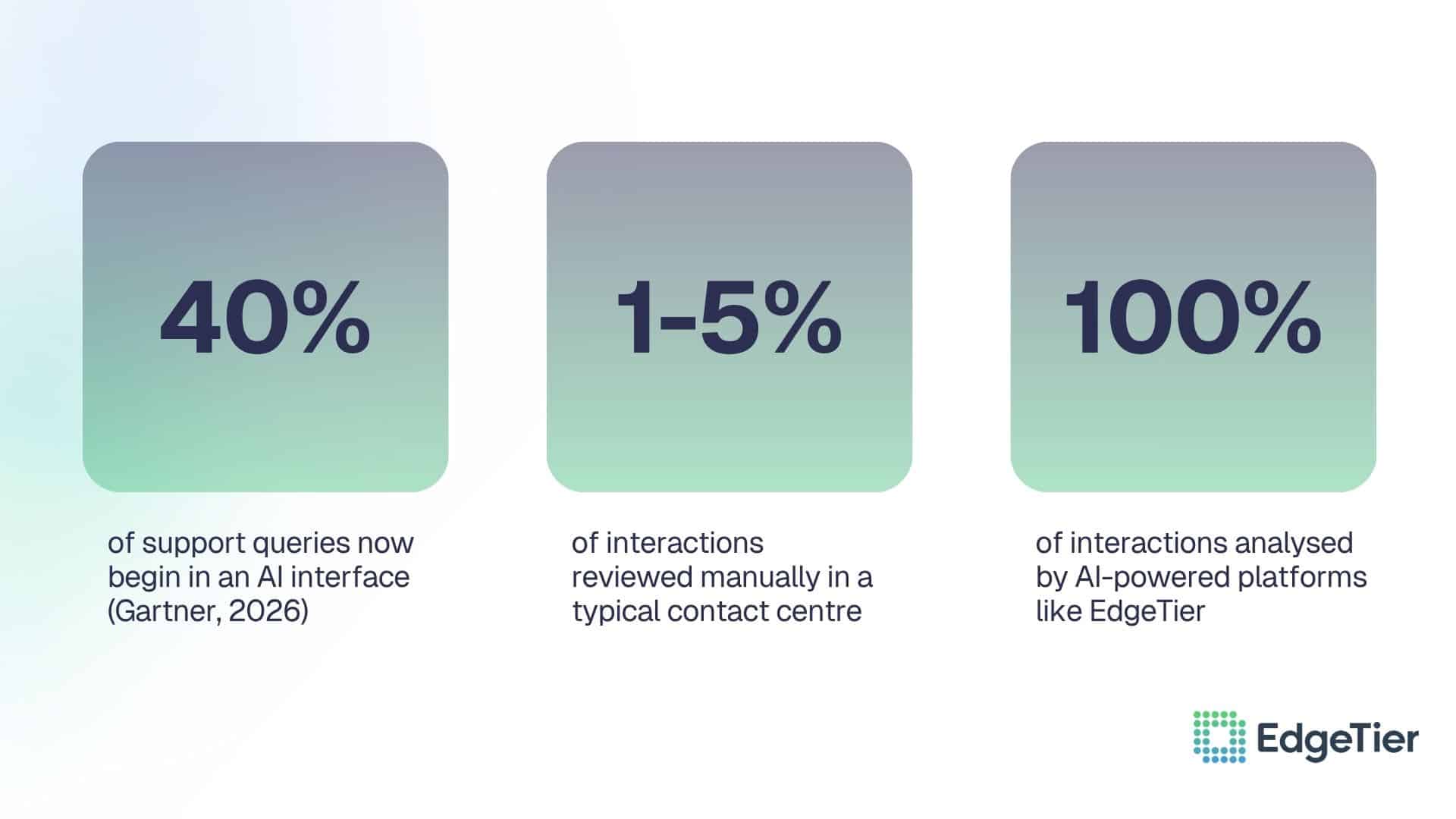
There’s also a coverage problem. A contact centre handling 10,000 interactions a day might have QA analysts review 200 of them. That’s 2%. The other 98%, where the compliance breach happened, where the agent coaching opportunity was missed, where the product bug first surfaced, goes unseen.
“We used to hear about problems second-hand, usually from a frustrated manager who’d seen a spike in contacts. Now we see issues the moment they start, often before the team even notices.”
– Head of CX Operations, European travel brand
AI analytics exists to close both of these gaps: full coverage, in real time.
At its core, contact centre AI analytics does three things:
The key distinction from generic business intelligence tools is that contact centre AI is trained on the specific language of customer service conversations, the way people complain about delivery delays, the phrases agents use when de-escalating, the vocabulary customers use across different industries and languages.
This matters enormously. A general-purpose language model might understand that “my order hasn’t arrived” expresses frustration. A model trained on millions of contact centre conversations understands that this phrase, combined with a spike in similar messages, a specific product category, and a particular regional cluster, probably indicates a courier failure affecting a specific postcode batch. That’s the difference between a notification and an actionable insight.
Modern contact centre AI analytics platforms typically deliver three distinct capabilities. Understanding each one helps you assess which gaps matter most for your operation.
This is the most time-sensitive capability. AI monitors every conversation as it happens, learning what ‘normal’ looks like in your contact centre, like typical contact volumes, standard topic distributions, expected sentiment levels, and alerting teams the moment something deviates.
In practice, this means a contact centre can know within minutes that a checkout promo code is failing, that a new website update has confused customers, or that a delivery partner is causing a surge in complaints in a specific region. The fix can begin before the issue ever appears in a dashboard or escalates to a manager.
One EdgeTier customer detected a platform bug that was affecting 95 customers in real time. The web team was notified, the issue was fixed, and related contact volume dropped to zero within the hour.
Learn more about real-time issue detection.
Beyond alerts, AI analytics transforms your contact centre into a structured source of customer intelligence. Every conversation is automatically tagged by contact reason, topic, and sentiment, creating a searchable, quantified picture of what your customers are experiencing.
This is sometimes called voice of customer (VoC) analytics. The difference from traditional surveys is that it’s passive (i.e. no customer has to fill in a form) and it covers 100% of interactions rather than a self-selected sample. It also happens in real time, not at the end of a reporting period.
The value extends well beyond the CX team. Product teams use these insights to identify recurring bugs and feature gaps. Marketing teams discover how customers actually describe their problems. Operations teams can quantify exactly which issues are driving contact volume and make the business case for fixing them.
Learn more about customer interaction analytics.
The final capability addresses the 98% coverage problem. Rather than reviewing a random 2% of interactions, AI analyses every single one, scoring conversations against custom QA frameworks, flagging off-brand language, identifying agents who are generating repeat contacts, and highlighting coaching opportunities.
This doesn’t replace QA analysts; it changes what they spend their time on. Instead of manually listening to calls to find issues, analysts can focus on the interactions the AI has already flagged as needing attention, or on coaching conversations where the patterns are clear. Most teams using AI-powered QA report getting 2–3x more value from the same headcount.
Learn more about AI-powered QA.
| CAPABILITY | TYPICAL RESULT |
| Real-time issue detection | 12% reduction in contact volume |
| Customer interaction analytics | Voice of customer insights surfaced daily, not quarterly |
| AI-powered QA | 2.5× faster QA reviews; 100% interaction coverage |
| Agent coaching | 21% improvement in CSAT; 25% reduction in handling time |
Contact centre AI analytics delivers the most value in high-volume environments, typically contact centres handling thousands of interactions per day, where manual review is simply not feasible at scale. That said, the use cases span a broad range of industries:
The common thread is volume and complexity. If your team is handling more contacts than it can meaningfully review, and if understanding the root causes of those contacts would change how your business operates, contact centre AI analytics will deliver measurable ROI.
Not all AI analytics platforms are built the same. Here are the questions that matter most when evaluating your options:
Batch processing tools deliver insights hours after the fact. For issue detection and customer experience management, real-time analysis is non-negotiable. By the time a nightly batch runs, the damage is already done.
General-purpose analytics tools and generic LLMs lack the contextual understanding of contact centre language. A model trained on millions of actual customer service conversations will understand nuance, industry terminology, and sentiment in ways a generic model simply won’t.
For any business operating across European or global markets, multilingual support is essential. Look for platforms that handle multiple languages natively through a unified architecture, rather than requiring separate per-language models that create inconsistency.
Your AI analytics platform should connect to your existing helpdesk, CRM, and telephony systems – Zendesk, Salesforce, Intercom, Five9, Freshdesk, and others – without requiring a rip-and-replace migration. Most implementations should take weeks, not months.
The best contact centre AI platforms don’t just serve the CX team. They turn the contact centre into a data source for product, operations, compliance, and marketing. Evaluate whether the platform has the reporting and integrations to distribute insights across your organisation.
Contact centre AI analytics is no longer a nice-to-have. As customer expectations rise and contact volumes grow, the gap between what manual review can cover and what’s actually happening in your contact centre keeps widening.
The organisations getting ahead are those that have stopped thinking of the contact centre as a cost centre to manage, and started treating it as the richest real-time data source in their business. Every conversation is a signal. AI analytics is what turns those signals into decisions.
Frequently Asked Questions:
Traditional reporting aggregates historical metrics like AHT, CSAT, and FCR at set intervals. Contact centre AI analytics analyses every interaction in real time, automatically identifying root causes, emerging issues, sentiment trends, and coaching opportunities that manual review would miss. The core difference is coverage (100% vs. 1–5%) and timeliness (real-time vs. retrospective).
Implementation timelines vary by platform and complexity, but best-in-class solutions connect to your existing helpdesk and begin surfacing insights within a few weeks. Look for vendors with a dedicated onboarding team and a lightweight integration approach that doesn’t require data migration.
No, it changes what they spend their time on. Rather than manually reviewing a small random sample of interactions, QA analysts can focus on the conversations the AI has flagged as most significant, or on coaching sessions informed by clear performance patterns. Most teams report getting significantly more value from the same headcount.
Yes, provided the platform uses a unified multilingual architecture. The best platforms detect and analyse conversations in any language without requiring separate models per language, delivering consistent insights across all markets simultaneously.
Voice of customer (VoC) analytics in a contact centre involves automatically analysing 100% of customer conversations to understand what customers are feeling, what problems they’re experiencing, and what drives their satisfaction or frustration. Unlike surveys, it’s passive, real-time, and covers every interaction, not just those from customers who opted in.
Most platforms price on interaction volume, the number of conversations analysed per month, sometimes with modular pricing by capability (analytics, issue detection, QA). This approach means you pay for what you use and can expand as your operation grows.
See EdgeTier in action: watch how leading brands use EdgeTier to detect issues in real time, reduce contact volume, and improve agent performance.
It’s 9:12am on a Monday. Your status page is green, but the queue is telling a VERY different story. Customers
This article originally appeared on Edge Signals – Bart Lehane’s LinkedIn newsletter on customer experience, analytics, and AI. Follow for
Contact center management has always been a job of contradictions. You’re expected to keep service levels stable while volumes shift


Nick Brazitis
Global Customer Care Manager
"The anomaly feature is a game changer for us. It’s highly accurate and has helped us identify customer issues, agent errors, and even fraud that would have taken us longer to catch."


Deborah Guivisdalsky
COO
"We now have highly detailed understanding of agent performance, not just on key agent metrics, but also on how customers react to our agents and the emotions of our customers feel when talking to our team."


Vladimir Greavu
BBG Director of Customer Service
"I specifically liked the flexibility. I liked the can-do attitude. I always felt supported. There hasn’t been any single point in our journey where EdgeTier has said no."



Let us help your company go from reactive to proactive customer support.
Unlock AI Insights